Saves instantly, no account needed. Already a member? Sign in.
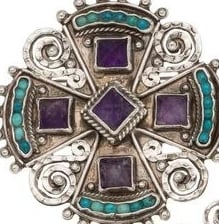
The lobed cross organizes this brooch. Four arms of nearly equal length spread from a central boss, each arm expanding into rounded lobes that soften the cross into something closer to a flower or a heart at every terminal. Turquoise fills the field in irregular pieces set close together, its blue-green interrupted by a central amethyst that pulls the eye to the middle of the composition. The silverwork surrounding the stones is dense with small scrolls, beads, and curling tendrils, a vocabulary that Matilde Poulat drew from colonial Mexican devotional silver and popular ornament rather than from the reductive geometry favored in Taxco during the same years.
The construction depends on the contrast between the stones and the silver that holds them. Poulat set turquoise in a mosaic manner, fitting shaped pieces into a bed so that the color reads as a continuous surface broken by thin metal lines, while the amethyst sits raised and faceted as a single accent. Around this the silver is worked into applied filigree-like scrollwork and granulation, building a raised border that frames the color and casts small shadows across it. The lobed profile is not incidental. It repeats the curves of the interior scrollwork at the scale of the whole object, so that the outline and the ornament belong to one another. This is decorative logic carried through consistently, closer to the aesthetics of retablo frames and church ornament than to the modernist silver being produced elsewhere in Mexico.
Poulat trained as a painter and designer at the Academy of San Carlos and opened her Mexico City workshop in 1934, registering the trademark Matl, adapted from an Aztec word for water, under number 142093. Her work sits within the postrevolutionary embrace of Mexican folk and colonial sources, a current parallel to the Taxco renaissance but distinct from it in temperament. Where much Taxco silver of the period pursued clean sculptural mass, Poulat pursued density, color, and the emblematic power of the cross, the bird, and the flower. Her nephew Ricardo Salas worked alongside her throughout her career and continued producing Matl designs after her death in 1960, later marking pieces Salas or MS-12. The design vocabulary of this brooch belongs to a body of work that Poulat established and Salas sustained, which means a lobed cross of this type can carry the Matl mark across several decades of production. The documented marks range from the early block-letter MATL over 0.900 through the script forms with Hecho en Mexico DF, to the etched trademark-number marks of the 1950s and the post-1980 Salas period, and the specific mark on a given example identifies where within that long production it belongs.
Museum of Mexican Silver. “Lobed Cross Brooch with Turquoise and Amethyst.” Catalog no. MoMS-002250. https://museumofmexicansilver.com/pieces/matl-lobed-cross-brooch-with-turquoise-and-amethyst
See something wrong with this record? Suggest a correction and the piece details fill in automatically.
Within a collection of Mexican silver, the brooch documents an alternative to the Taxco School's dominant modernism. It shows how a Mexico City workshop translated colonial and popular devotional imagery into wearable silver, using turquoise and amethyst not as luxury display but as the color structure of a composition built around the cross. For readers who know Poulat primarily by reputation, the object makes the Matl manner concrete: the lobed frame, the mosaic turquoise, the accented amethyst, and the scrolled silver working together as a single ornamental idea.
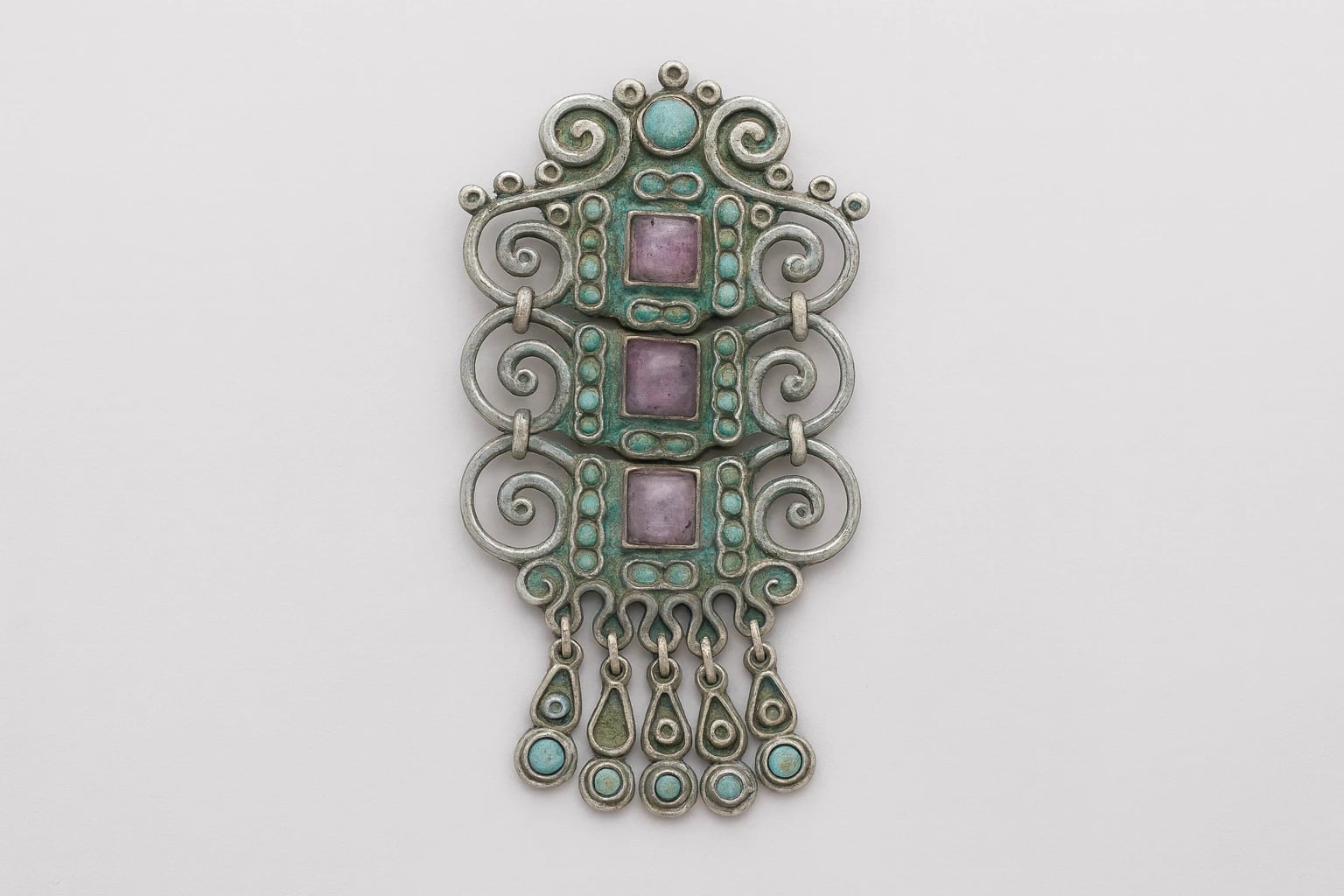
MATL (Matilde Poulat)
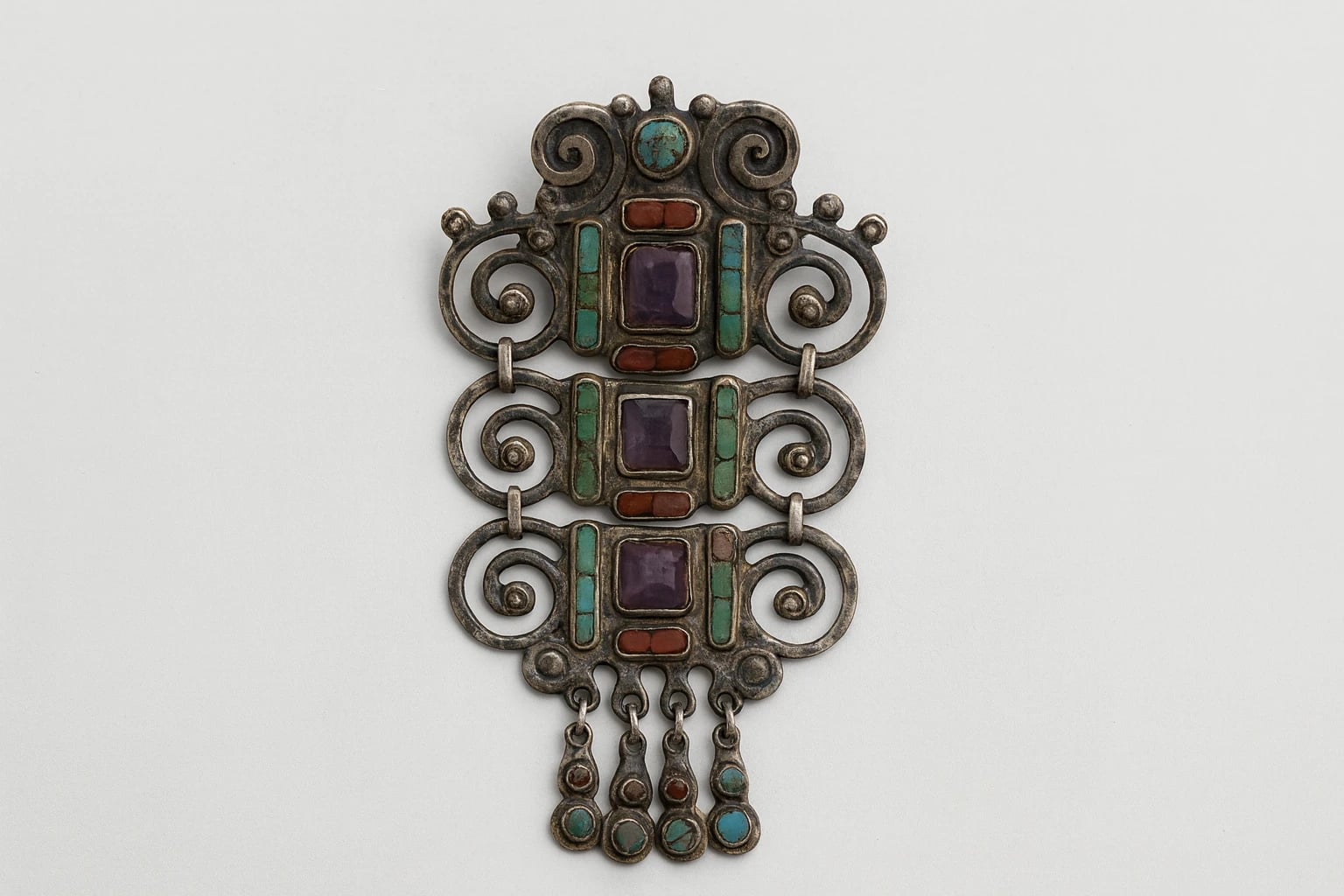
Triple-Amethyst Scrollwork Drop Brooch with Turquoise
1934 or later
Silver