Saves instantly, no account needed. Already a member? Sign in.
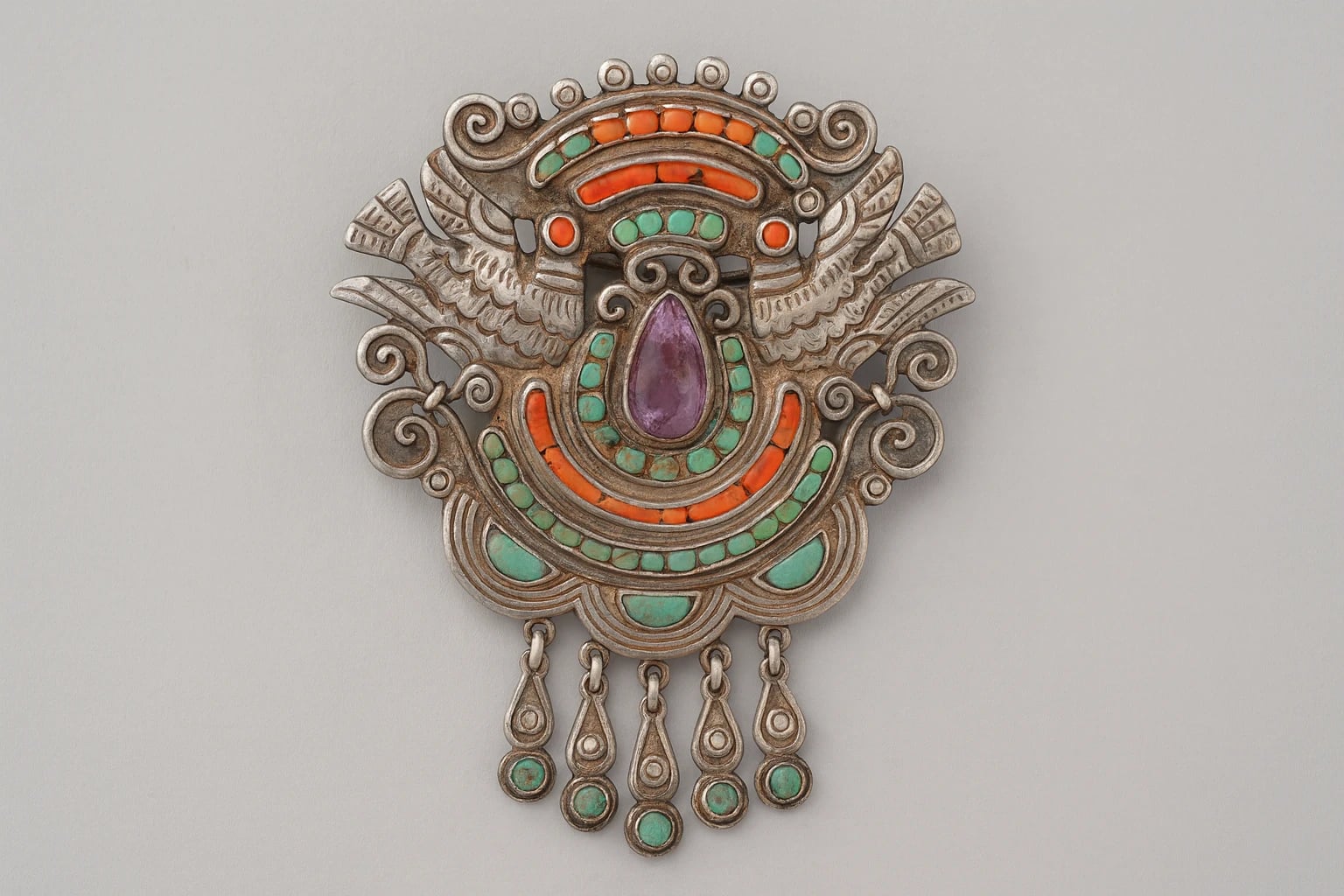
A cluster of doves, coral cabochons, and turquoise resolves into a single pendant mass in this MATL brooch, where dense ornament is held together by strict bilateral symmetry. Two birds face inward at the top, their bodies framing a central axis that descends through scrolled silver into a suspended drop. The composition reads as a small devotional field rather than a spray of naturalistic detail. Every element is subordinated to the vertical center line, and the paired doves establish a mirrored rhythm that the lower ornament repeats and elaborates.
The silverwork organizes color through contrast and containment. Turquoise supplies a cool blue-green that MATL characteristically set against the warm red of coral, and here those two stones are distributed so that neither dominates. The metal itself does the structural work: tight scrolls, beaded edges, and open silver framing enclose each cabochon and separate one color from the next. This is the ornamental vocabulary for which the workshop is known, a hand-built accumulation of small silver units that supports the stones while forming a continuous decorative surface. The drop at the base gives the brooch weight and movement, extending the vertical composition below the fastening point so that the ornament hangs as much as it sits.
Matilde Poulat trained as a painter and designer at the San Carlos Academy before opening her Mexico City shop in 1934, and the MATL style she developed stands somewhat apart from the Taxco workshops. The name derives from a variation of an Aztec word for water and became her registered trademark, number 142093. Rather than the reductive geometry pursued by many silver designers of the period, Poulat built a revival idiom drawn from colonial and Mexican folk sources, with doves, flowers, and small birds recurring across her jewelry. The paired dove is among the motifs most associated with the workshop. After her death in 1960, her nephew Ricardo Salas continued the MATL designs, at times supervising several dozen silversmiths, so the design vocabulary persisted well beyond Poulat's own lifetime under the same mark.
Because the MATL mark spans Poulat's production and the long continuation under Salas, the specific hallmark on a given brooch matters for dating. The early script MATL stamps with 0.925 and Hecho en Mexico DF belong to the 1934 to 1948 range, the M. Regis 142093 marks to roughly 1950 to 1960, and the Salas-era objects after 1980 carry the MATL mark alongside MS-12. Without the mark on this example recorded here, the object is best understood as representative of the MATL idiom rather than fixed to a single decade. As a document of that idiom, it shows how Poulat translated a painter's sense of composition into silver and stone, holding an intricate folk vocabulary within a disciplined symmetrical structure.
Museum of Mexican Silver. “Paired-Dove Drop Brooch with Turquoise and Coral.” Catalog no. MoMS-002218. https://museumofmexicansilver.com/pieces/matl-paired-dove-drop-brooch-with-turquoise-and-coral
See something wrong with this record? Suggest a correction and the piece details fill in automatically.
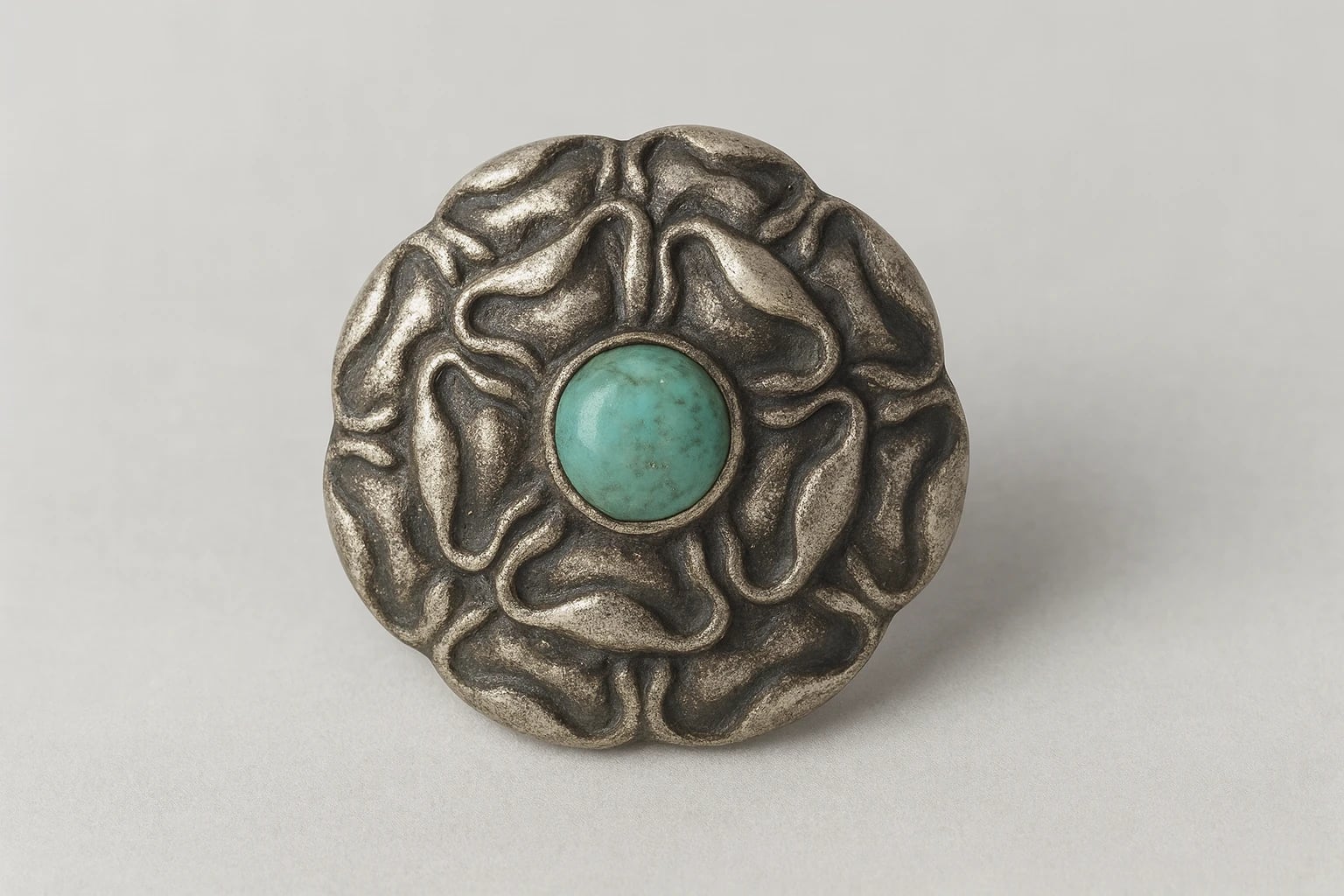
MATL (Matilde Poulat)
Round Scrollwork Brooch with Turquoise
1934 or later
Silver