Saves instantly, no account needed. Already a member? Sign in.
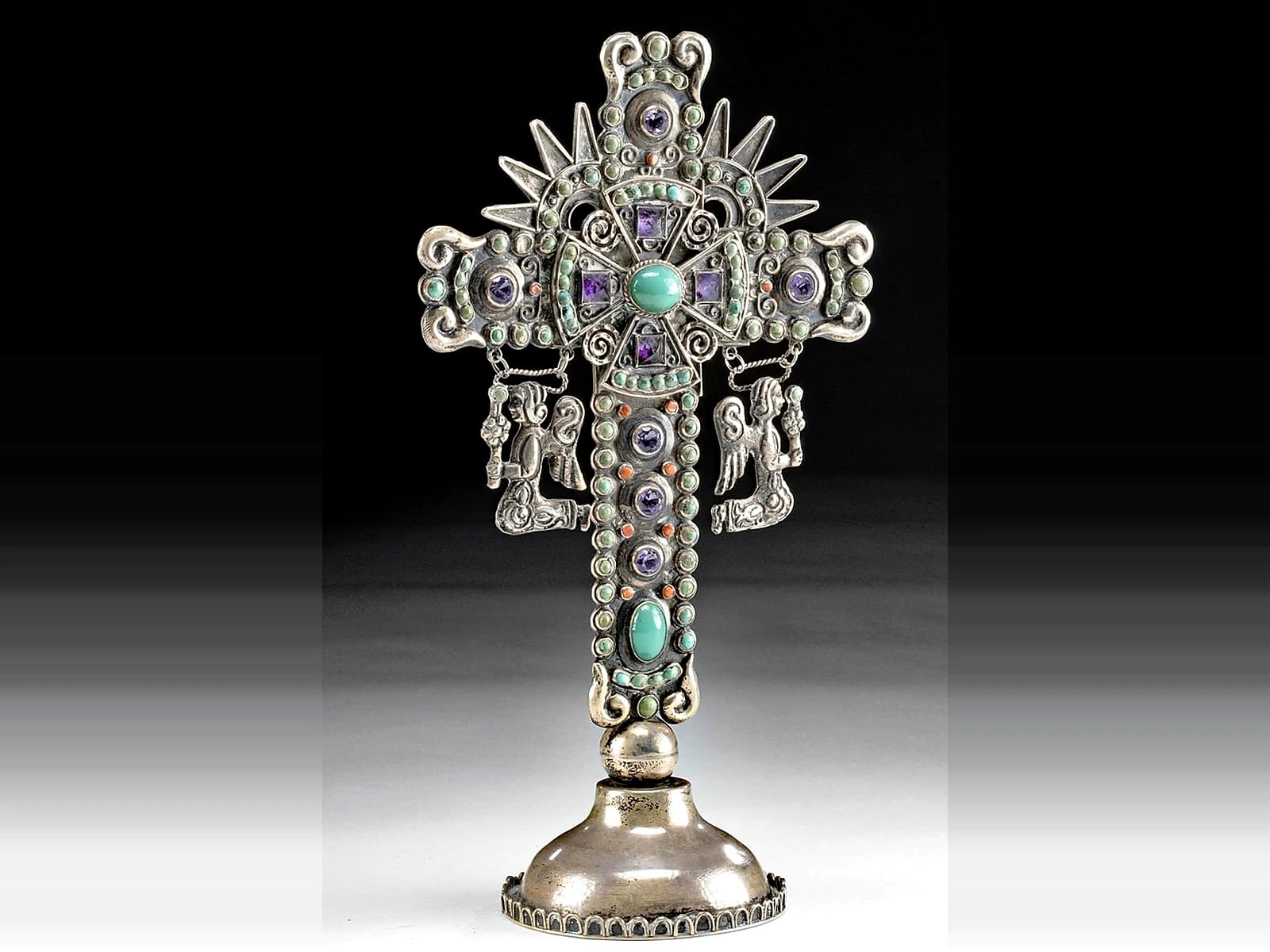
A standing cross of this density — turquoise and amethyst inlaid across every face of a heavily worked silver armature, with a radiant sunburst crest and figural pendants suspended from each arm — brings the Taller MATL's devotional vocabulary into full relief. Morrill records that the workshop catalogued one hundred different religious pieces (Morrill, p. 216), and the standing cross drew on the full range of technique the taller had developed.
Turquoise drives the palette. Large oval and round cabochons anchor the center crossing and the stem; rows of smaller stones, each bezel-set within a ring of raised silver granules, trace the arms and continue down the shaft. Amethyst — faceted square stones and smooth round cabochons — punctuates those runs at intervals, and small coral accents scatter warmth across the surface. At the apex, radiating silver points fan out from a crest of baroque cloudwork scroll; below the crossing, a second scroll rises against the stem. From each horizontal arm, a small cast silver figure hangs on a linked chain — a standing human form on one side, an animal on the other — in the simplified register of Mexican folk metalwork.
Morrill documents that Ricardo Salas, Poulat's nephew and co-designer from the time he was eleven, personally learned to carve the turquoise, coral, and other stones used in the workshop's jewelry and figurines (Morrill, p. 216). The domed base, its perimeter finished with an arcade of arched ornament, lifts the cross to altar height and anchors a composition whose visual weight is considerable. Standing religious pieces of this completeness are rarely encountered.
Museum of Mexican Silver. “Inlaid Standing Cross with Turquoise, Amethyst, and Coral.” Catalog no. MoMS-002162. https://museumofmexicansilver.com/pieces/matl-inlaid-standing-cross-li161528988
See something wrong with this record? Suggest a correction and the piece details fill in automatically.