Saves instantly, no account needed. Already a member? Sign in.
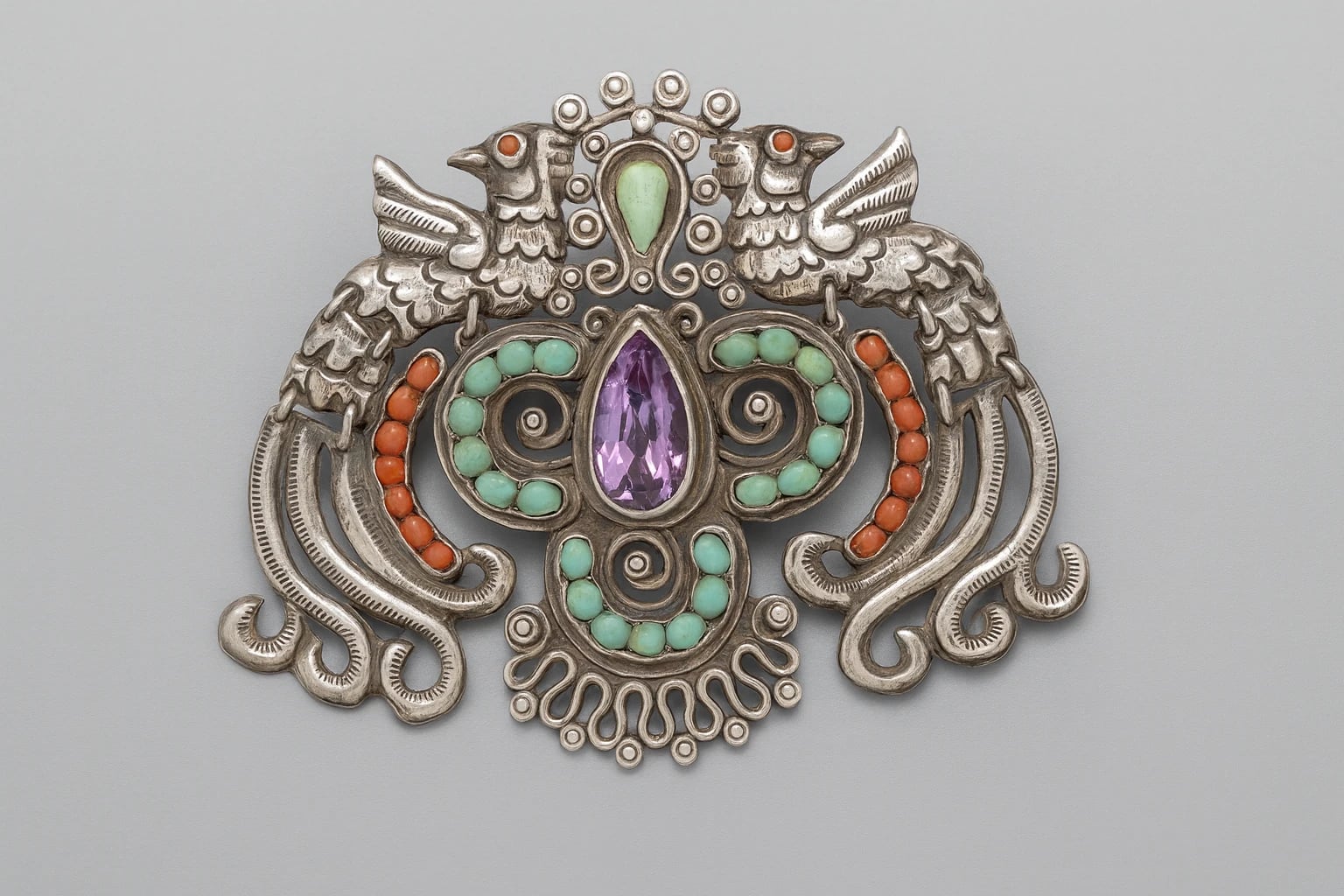
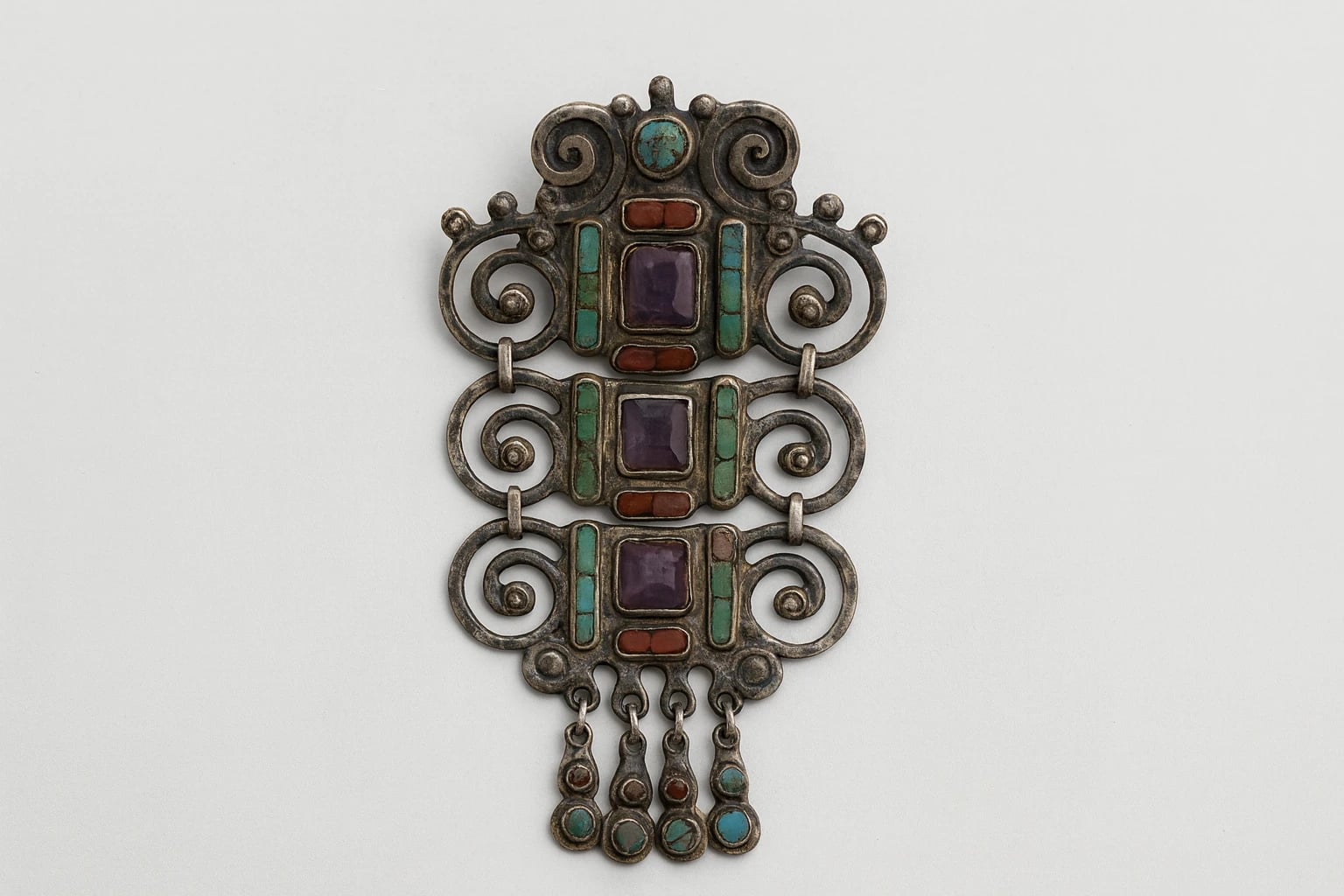
A dense field of silver scrollwork organizes this brooch, its curling wire and beaded accents framing a central turquoise cabochon with smaller stones set into the surrounding lattice. The composition belongs to the ornamental language that Matilde Poulat developed under the Matl name, in which colonial and folk motifs are rebuilt as tightly controlled decorative silverwork. The interest here lies in the discipline of the scrollwork itself: each spiral answers another, and the stones are placed to punctuate rather than interrupt the metal ground. The brooch reads as a small, self-contained field rather than a single emblem, which is characteristic of the way Poulat handled composition.
The material contrast carries much of the design. Turquoise supplies opaque, saturated color at the center, while the amethyst introduces a cooler, translucent note against the worked silver. This pairing of a stone that blocks light with one that admits it is a recurring device in Matl jewelry, and it depends on the silver scrollwork to hold the two registers together. The wirework and applied beading create a shallow but active surface, so that light moves across the metal and settles into the stones. The effect derives from Mexican colonial and popular ornament, where profuse silverwork surrounds and elevates colored stones, recast here at the scale of a wearable object.
Matilde Poulat trained as a painter and designer at the San Carlos Academy before opening her workshop in 1934, and she registered the Matl trademark, number 142093, that appears on the firm's jewelry and decorative objects. The name itself derives from a word for water, one of several ways her production drew on Mexican sources rather than European models alone. After her death in 1960, her nephew Ricardo Salas continued the Matl designs, at times supervising several dozen silversmiths who fabricated and assembled the work, so that a given Matl brooch may reflect the design vocabulary Poulat established while having been executed within the later workshop. The documented marks span this history, from the early script MATL stamps of the 1930s and 1940s through the registered-trademark forms bearing 142093 and, after 1980, the Salas-period stamps. Without a reading of this brooch's own mark, its precise place in that sequence remains open, though the design clearly belongs to the Matl idiom.
Within the broader silver renaissance, Poulat's work sits apart from the austere geometric modernism associated with much of the Taxco School. Where designers trained through Las Delicias often reduced ornament to structure, Matl jewelry retained density, color, and reference to colonial and folk precedent, offering a different account of what modern Mexican silver could be. A brooch of this kind documents that alternative current: a workshop led by an academically trained woman who built a recognizable ornamental style and a lasting trademark. It contributes to a collection less as a singular object than as a clear representative of the Matl vocabulary and its continued production across two generations of makers.
Museum of Mexican Silver. “Rectangular Scrollwork Brooch with Turquoise and Coral.” Catalog no. MoMS-002215. https://museumofmexicansilver.com/pieces/matl-rectangular-scrollwork-brooch-with-turquoise-and-coral
See something wrong with this record? Suggest a correction and the piece details fill in automatically.