Saves instantly, no account needed. Already a member? Sign in.
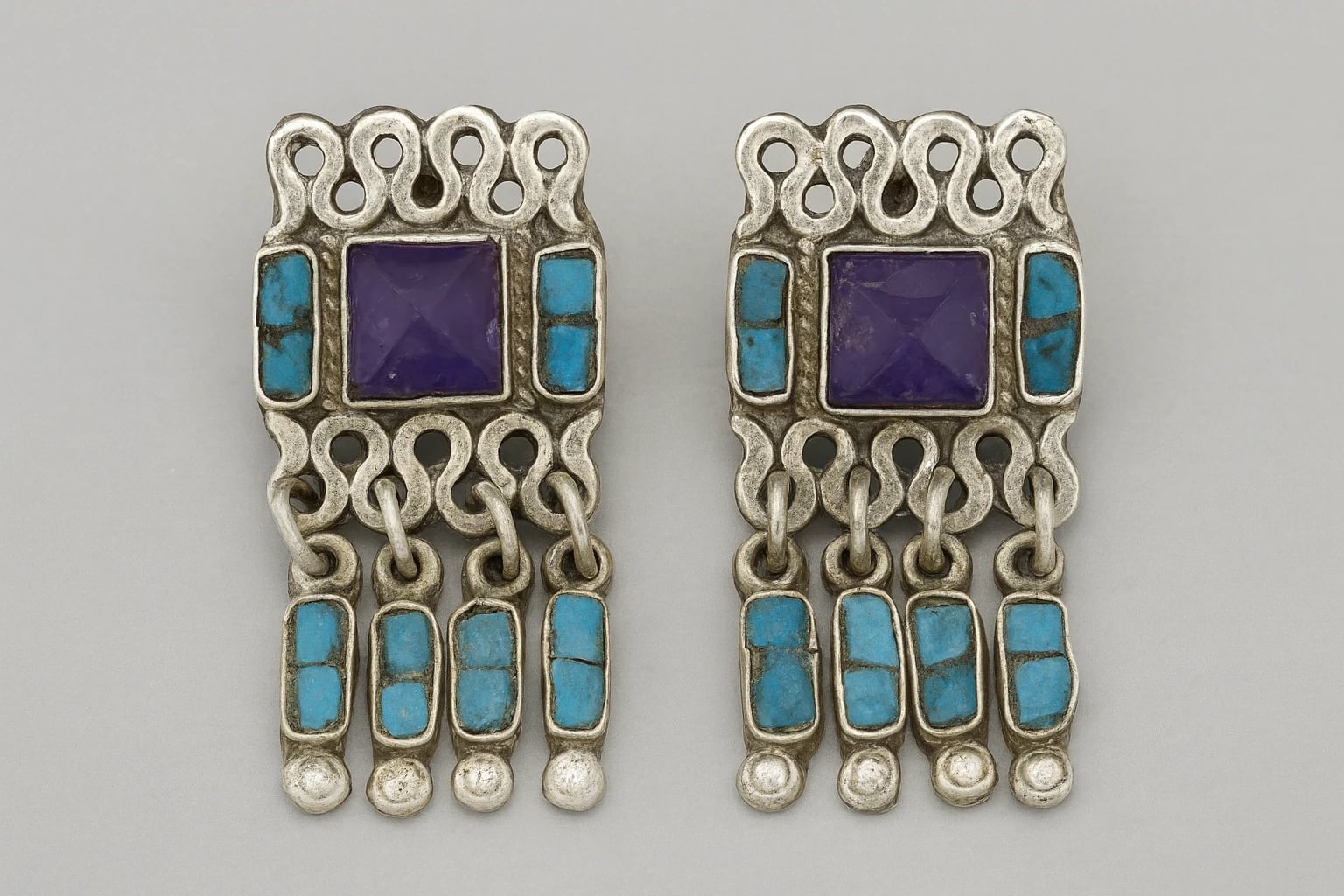
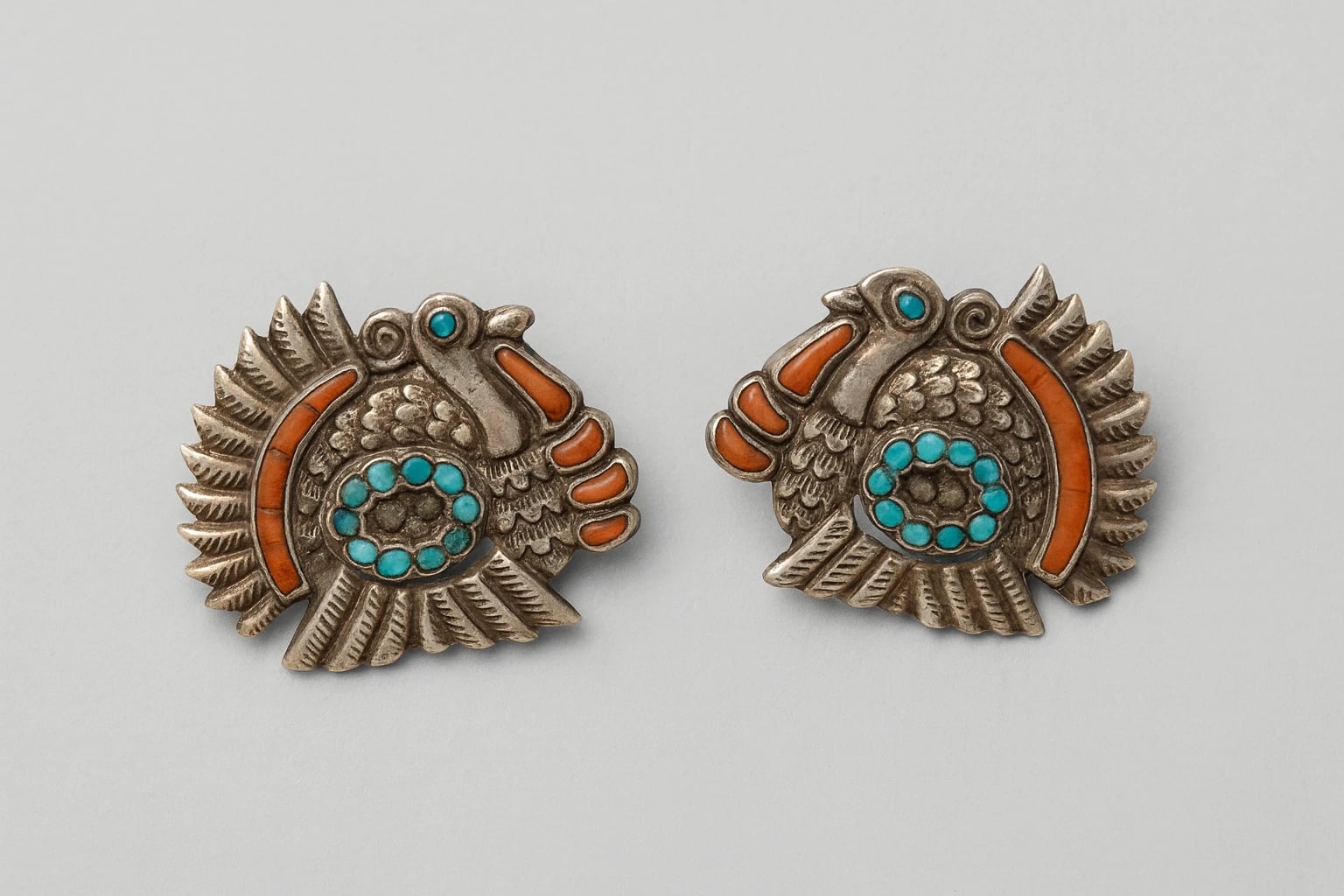
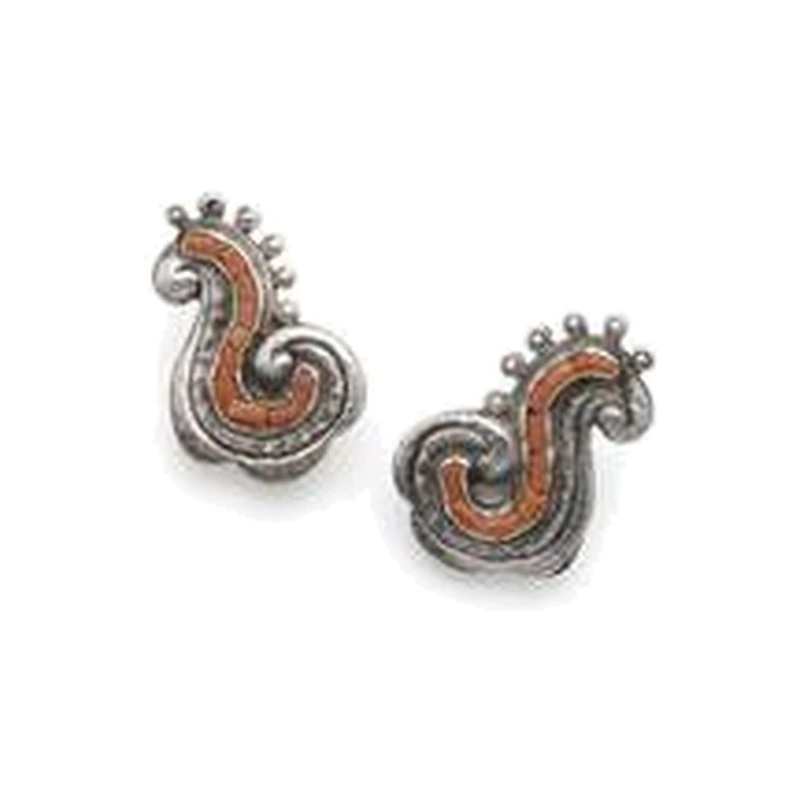
A pair of paisley teardrops holds the essence of the MATL vocabulary in a small compass: the curled ogee shape framed in scrollwork, the warm interruption of coral against the cool blue of turquoise, and the density of ornament that Matilde Poulat drew from Mexican colonial and popular sources rather than from imported modernist reduction. Where much Taxco silver of the same decades pursued smooth planes and severe geometry, these earrings work in the opposite direction. They fill the paisley field with curling silver and set stone against stone, so that the design reads as a continuous decorative surface rather than a cleared modern one.
The paisley form gives the ornament its structure. Its tapering curl establishes a direction the eye follows from the broad head to the pointed tail, and the surrounding scrollwork echoes that curve so the whole earring turns inward on itself. Turquoise carries the body of each earring, its opaque blue holding light softly rather than reflecting it, while coral supplies the accent that keeps the composition from settling into a single tone. The contrast is one of temperature and weight: the cool matte turquoise reads as the ground, the coral as the punctuation. Because the stones are opaque and closely set, the silver framing does much of the visual work, its curls catching light along their raised edges and drawing bright lines through the color.
Matilde Poulat trained as a painter and designer at the San Carlos Academy before opening her Mexico City shop in 1934, and her jewelry reflects that pictorial background in its love of pattern, symmetry, and dense floral scrollwork. She registered the MATL trademark, number 142093, a name adapted from an Aztec word associated with water, and her marks range from early block-letter fineness stamps through the script MATL of the 1934 to 1948 period to the etched registration marks of the 1950s. After her death in 1960, her nephew Ricardo Salas continued the MATL designs and eventually marked his own production with the registration number MS-12, so the paisley-and-scroll idiom persisted across two generations of the same workshop. The design is best understood as a MATL type rather than a single dated object, and the specific mark on any given pair situates it within that long continuity.
Poulat's work matters within the silver renaissance precisely because it resisted the dominant modernist current. While Spratling and his circle looked to ancient Mexican geometry and international design, Poulat elaborated the ornamental language of colonial silver and popular religious art, producing jewelry that is unmistakably Mexican in a different register. These earrings preserve that alternative in a compact, wearable form, showing how coral and turquoise were used not as neutral luxury materials but as color contrasts within a densely worked silver frame. For a collection tracing the full range of the renaissance, the MATL paisley earrings mark the ornamental pole against which the school's more austere designs can be measured.
Museum of Mexican Silver. “Paisley Earrings with Coral.” Catalog no. MoMS-002258. https://museumofmexicansilver.com/pieces/matl-paisley-earrings-with-coral
See something wrong with this record? Suggest a correction and the piece details fill in automatically.
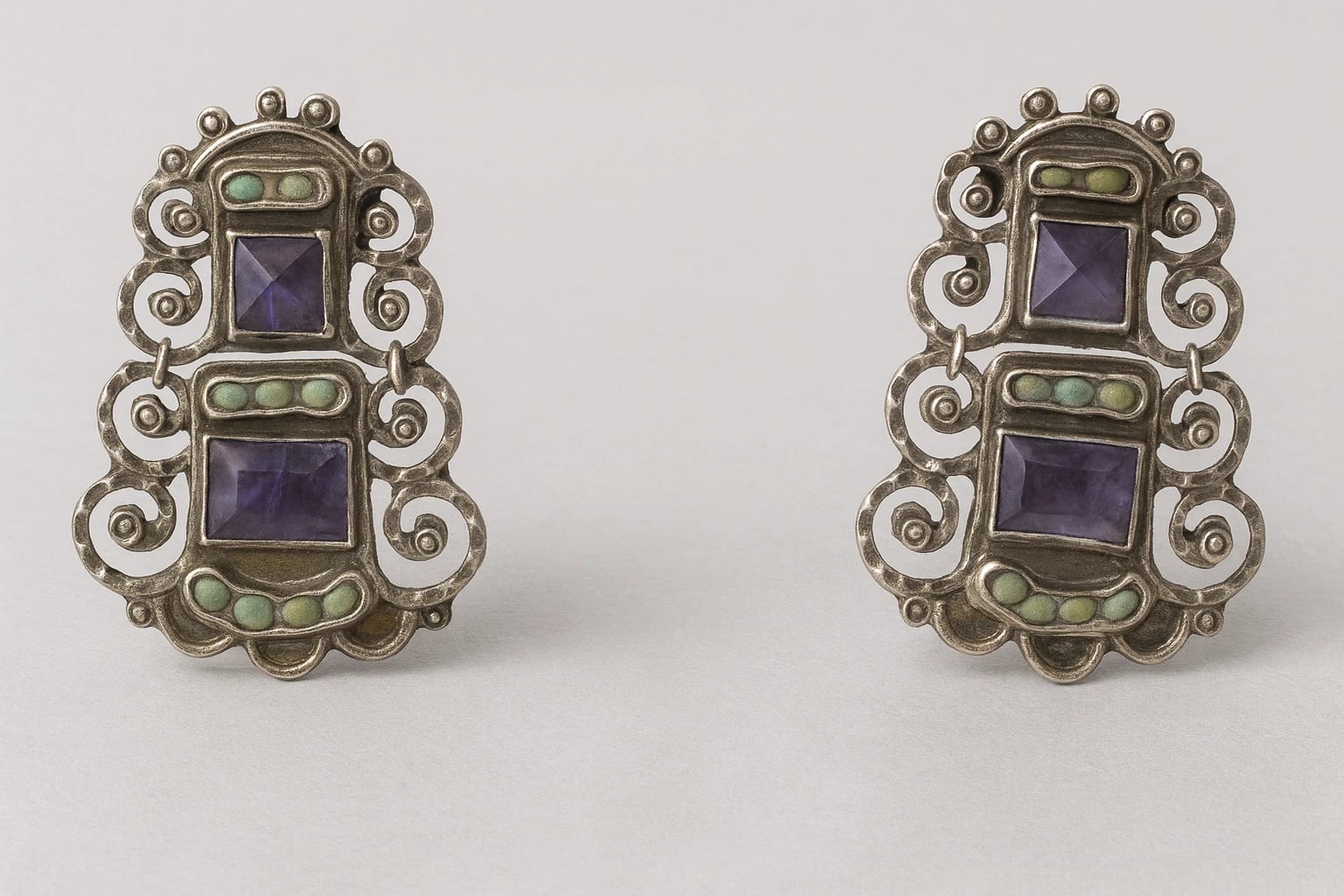
MATL (Matilde Poulat)
Rectangular Amethyst Scroll Earrings with Turquoise
1934 or later
Turquoise