Saves instantly, no account needed. Already a member? Sign in.
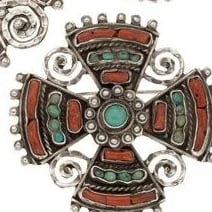
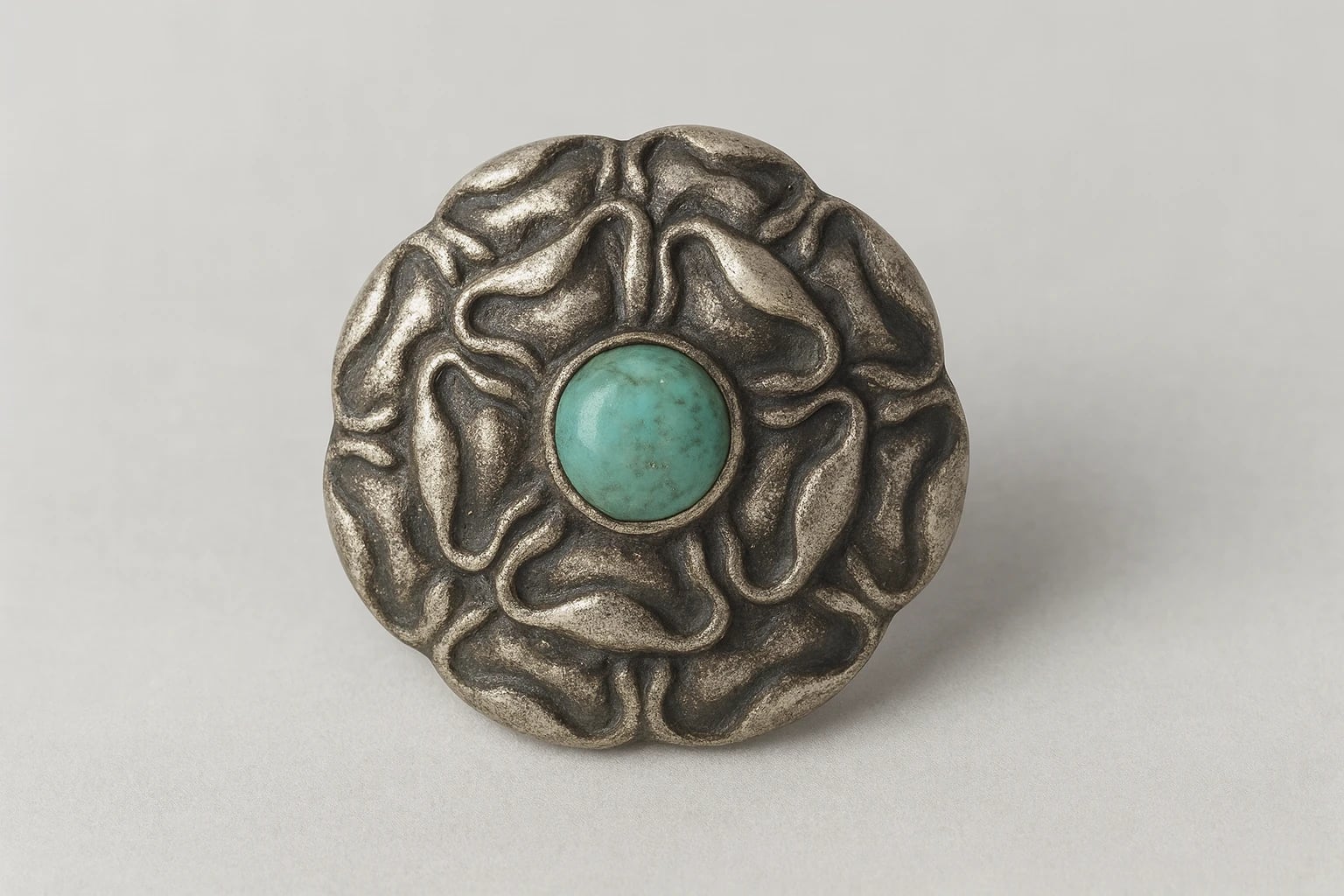
A dense wheel of silver scrollwork organizes this brooch, its tendrils coiling inward toward a central turquoise cabochon while smaller stones punctuate the surrounding curves. The composition is symmetrical and tightly packed, filling the round format with a rhythm of spirals and beaded accents that leave almost no plain ground. This is the vocabulary that made Matilde Poulat's work immediately recognizable: a Mexican folk sensibility rendered in silver, ornamental rather than austere, and closer in spirit to devotional and popular art than to the geometric modernism developing elsewhere in the Taxco renaissance.
The design depends on the interplay of curved wire, small silver spheres, and set stones. Scrollwork of this kind gives the surface its movement, each coil turning back on itself so that the eye travels around the disc rather than settling on a single focal point. The turquoise at the center anchors the arrangement through color and opacity, its matte blue reading firmly against the reflective silver, while the outlying stones extend that color into the field of scrolls. Poulat's characteristic mixing of turquoise with coral and other stones produces a polychrome effect drawn from Mexican popular ornament and colonial religious silver, where color and abundance carried meaning. The value here is decorative density controlled by symmetry, an ornamental fullness that stops short of clutter because the underlying circular structure holds it together.
Poulat trained as a painter and designer at the San Carlos Academy, and she opened her own shop in 1934, registering the mark "MATL" as trademark number 142093. The name derives from an Aztec word for water, one sign of the postrevolutionary interest in Mexico's indigenous past that shaped so much of the period's visual culture. Her workshop stood somewhat apart from the Spratling circle and its architectural, pre-Hispanic geometry. Where much Taxco silver of the 1930s and 1940s pursued clean planes and stepped forms, Poulat pursued elaboration, and her folk-derived idiom became a distinct current within the larger renaissance. Her nephew Ricardo Salas worked alongside her throughout her career and continued producing MATL designs after her death in 1960, supervising a workshop of several dozen silversmiths, so the design language outlived its originator and remained in production for decades.
That long continuity means dating a MATL brooch requires attention to the mark rather than the design alone. The museum's hallmark reference, rebuilt from Hougart, records marks ranging from an early "MATL 0.900" fineness stamp through the script forms carrying "Hecho en Mexico DF," the registration number 142093 used from about 1950, and the later Salas-era stamps combining the MATL name with MS-12 after 1980. A given design could be conceived early and fabricated much later, so the mark on any particular example, not its ornamental vocabulary, establishes when that object was made. For a collection, a MATL scrollwork brooch documents the ornamental, folk-rooted alternative within Mexican silver, a strand that ran parallel to the movement's more celebrated modernist geometry and found its own devoted audience.
Museum of Mexican Silver. “Round Scrollwork Brooch with Turquoise.” Catalog no. MoMS-002255. https://museumofmexicansilver.com/pieces/matl-round-scrollwork-brooch-with-turquoise
See something wrong with this record? Suggest a correction and the piece details fill in automatically.
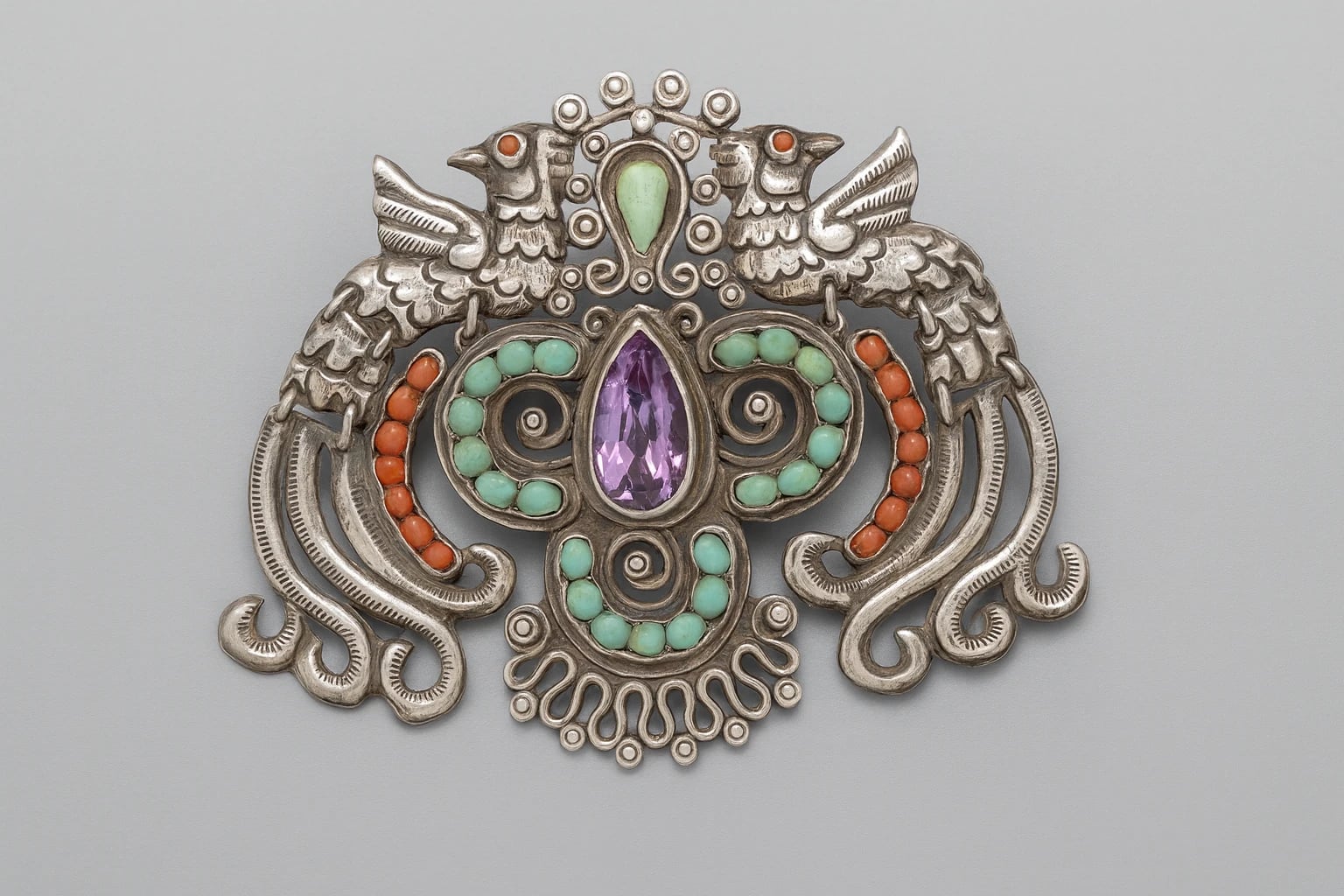
MATL (Matilde Poulat)
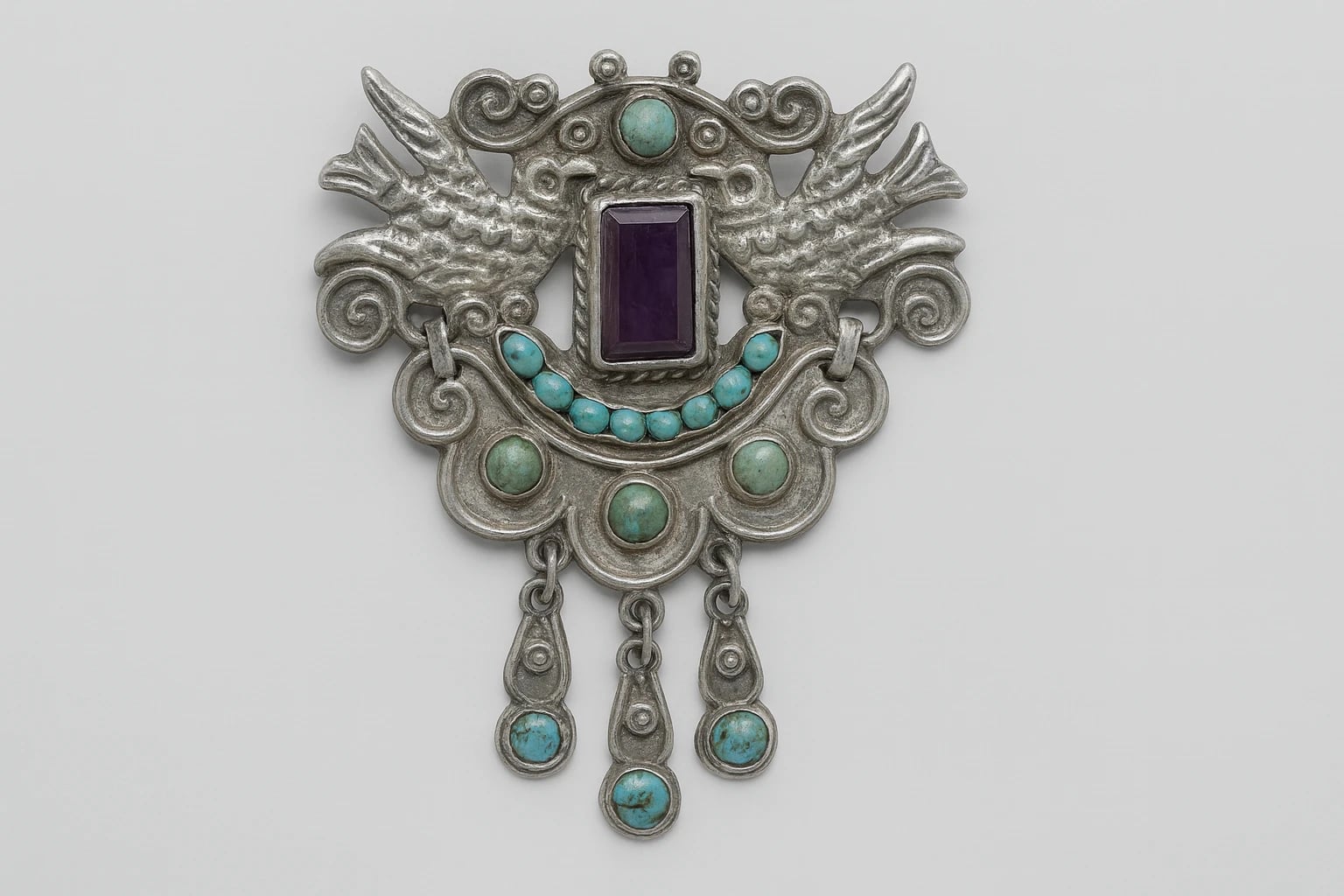
Bird Brooch with Turquoise and Amethyst
1934 or later
Turquoise