Saves instantly, no account needed. Already a member? Sign in.
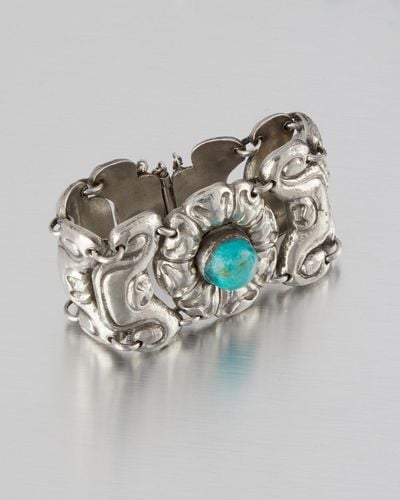
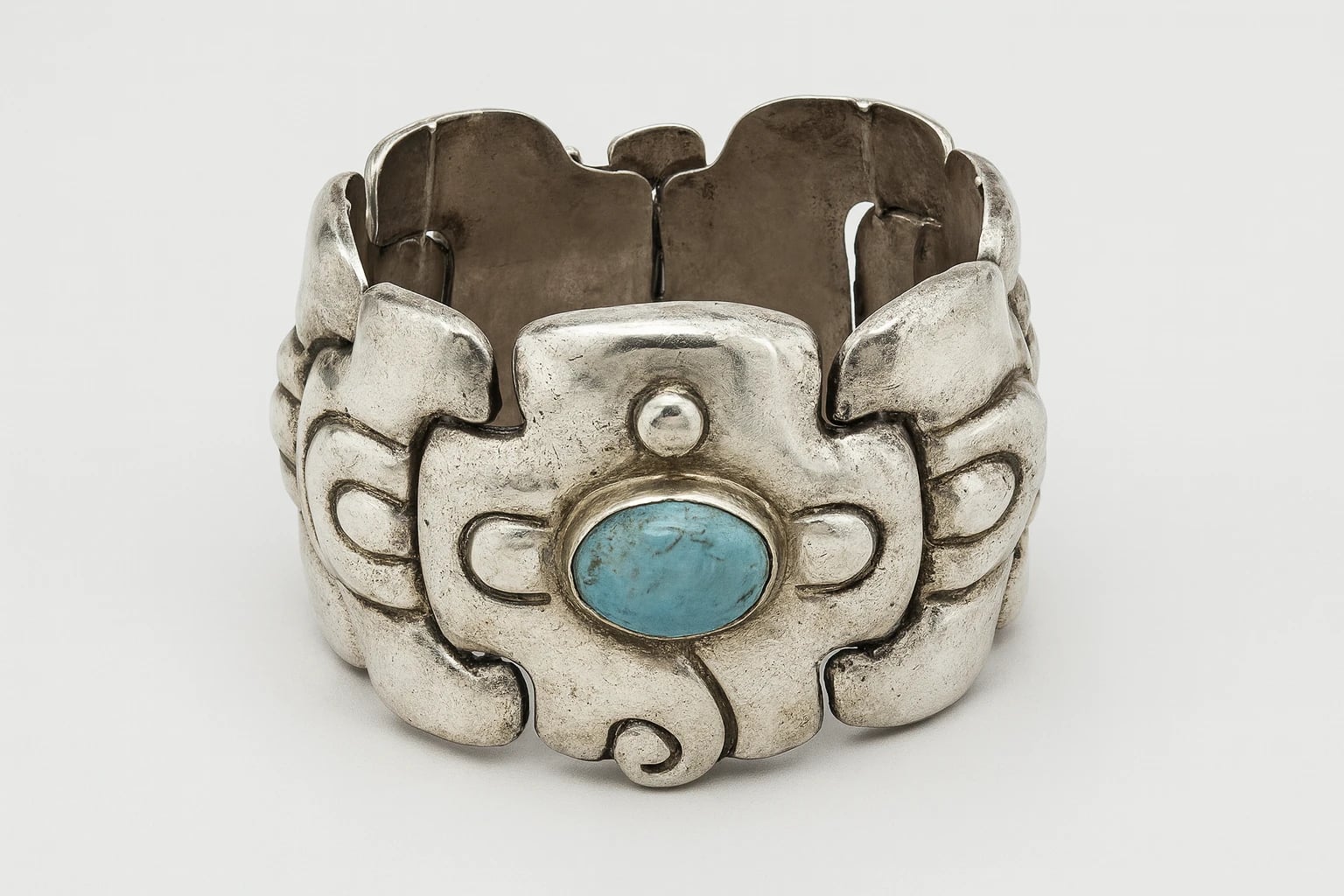
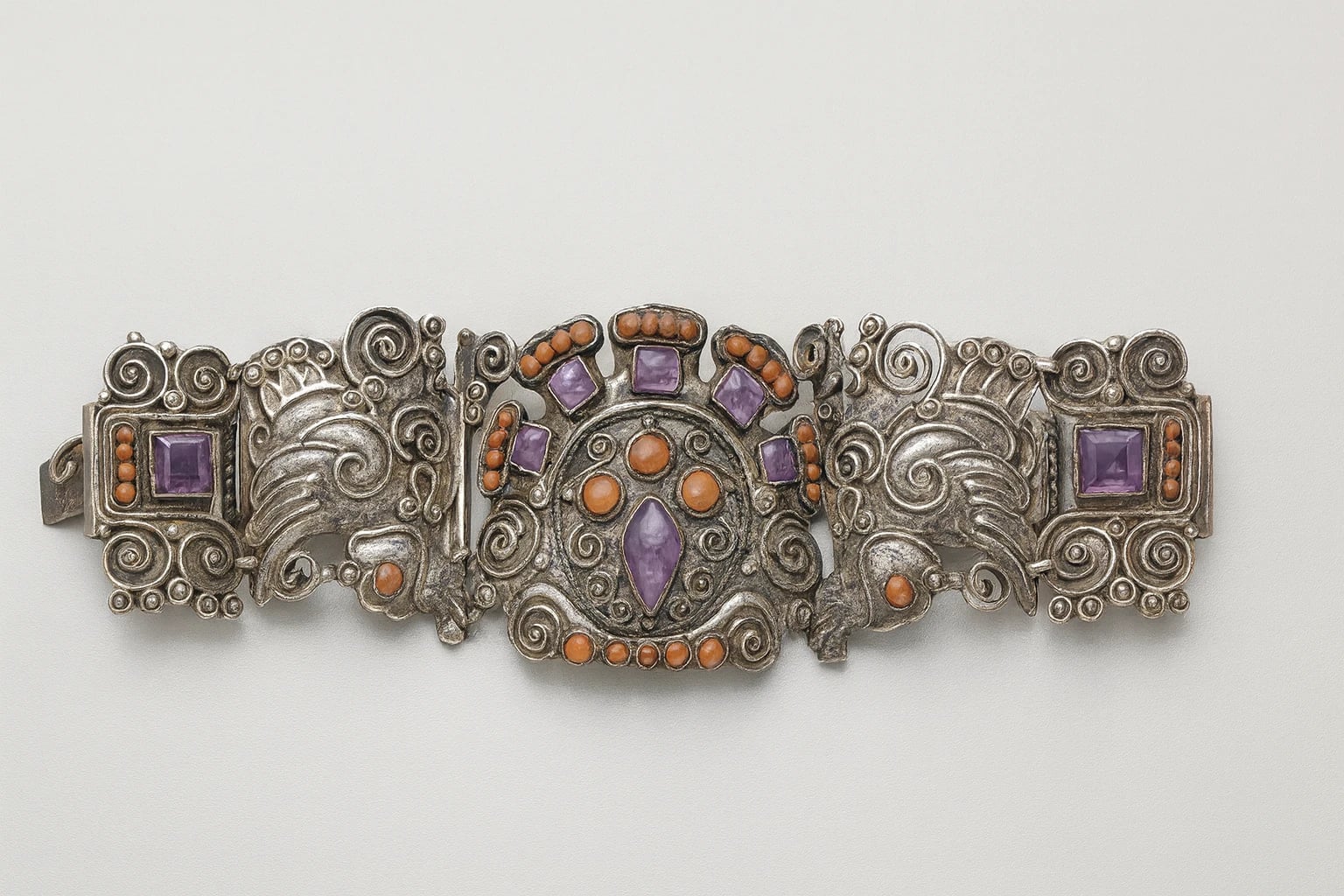
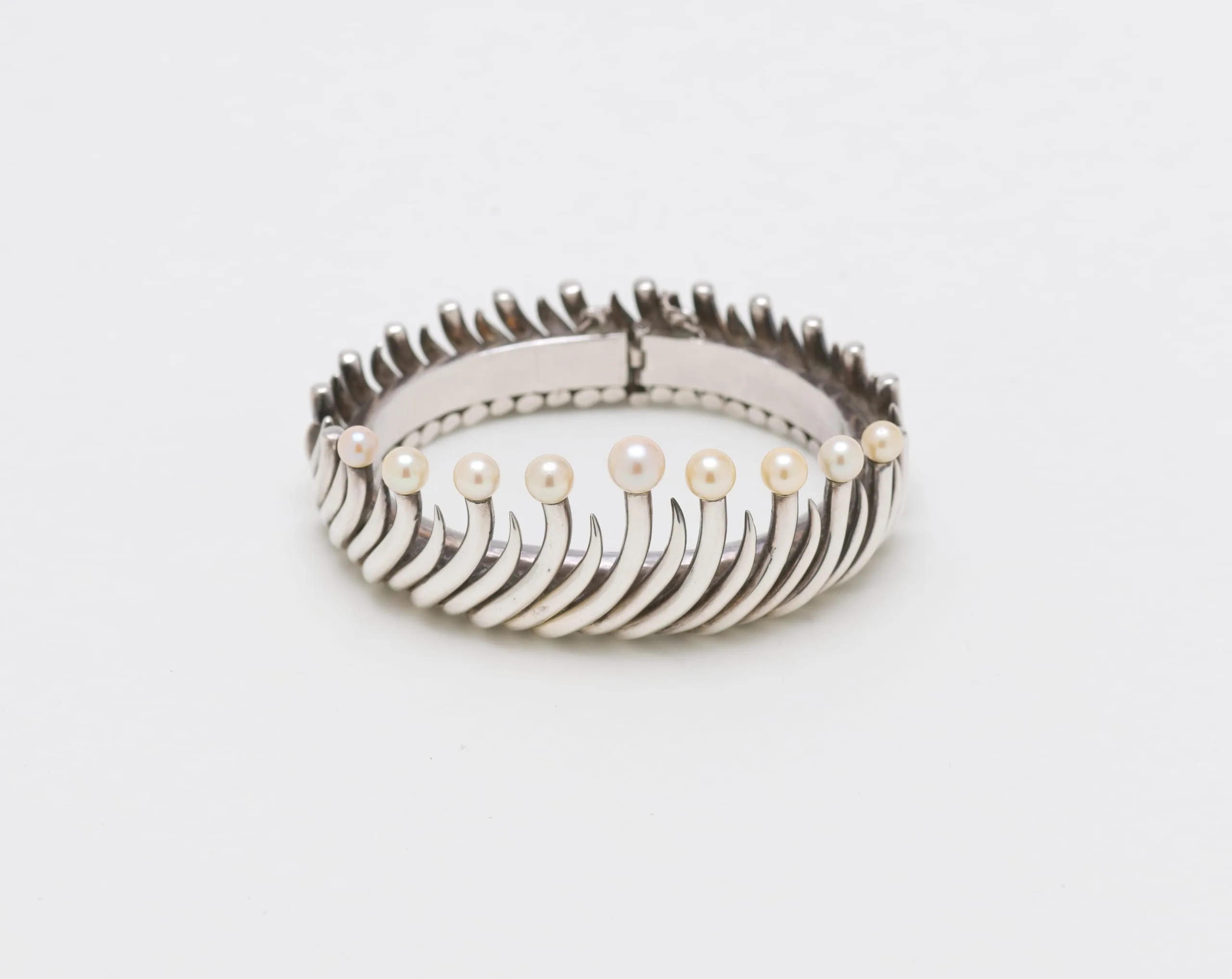
A dense band of turquoise and silver curves around the wrist, its surface organized around fish worked in the round rather than pressed flat into the metal. The stones sit in a field of scrolls, beading, and small silver droplets that fill nearly every interval, leaving little bare ground. This crowded, ornamental treatment is the signature of Matilde Poulat's workshop, where folk imagery and Mexican devotional silver were reworked into a distinctive decorative language that stands apart from the cleaner geometry associated with much of Taxco.
The bracelet builds its rhythm through repetition and small variation. Turquoise, opaque and blue-green, alternates with the pale reflectivity of silver so that color and light trade places along the band. The fish motif introduces a rounded, sculptural note into a surface otherwise composed of curls and granulation, and the stones are set close together to keep the eye moving rather than resting on a single centerpiece. This is ornament conceived as continuous fabric, with the aquatic theme carrying a quiet link to the name itself: "Matl" derives from an Aztec word for water, the trademark Poulat registered under number 142093. The turquoise reinforces that association through color as much as symbolism, though the design depends less on any single stone than on the accumulation of many small incidents across the whole surface.
Poulat came to silver from painting and design, having studied at the San Carlos Academy, and she opened her shop in 1934. Her work drew openly on colonial religious silver and Mexican popular art, favoring dense compositions, scrollwork, and figural motifs at a moment when other Taxco makers were pursuing spare modern form. That divergence is part of what makes her production historically useful: it shows that the silver renaissance accommodated more than one idea of what modern Mexican jewelry could look like. After her death in 1960, her nephew Ricardo Salas continued the Matl designs and his own, at times supervising several dozen silversmiths, so the marks and the design vocabulary persisted long past Poulat's lifetime. The specific stamp determines whether a given example belongs to her working years or to the later Salas production, since the registration number and fineness marks shifted across the decades.
Fish and turquoise recur across Matl jewelry, and this bracelet represents that established repertoire rather than a singular experiment. Its value for a collection lies in showing how Poulat translated devotional and folk sources into wearable ornament, and how a specific workshop sustained a recognizable design identity across two generations of makers. Read alongside the more austere Taxco work of the same era, it marks the breadth of the renaissance, a reminder that Mexican modernism in silver included the ornate as well as the reduced.
Museum of Mexican Silver. “Fish Bracelet with Turquoise.” Catalog no. MoMS-001443. https://museumofmexicansilver.com/pieces/matl-turquoise-fish-bracelet
See something wrong with this record? Suggest a correction and the piece details fill in automatically.
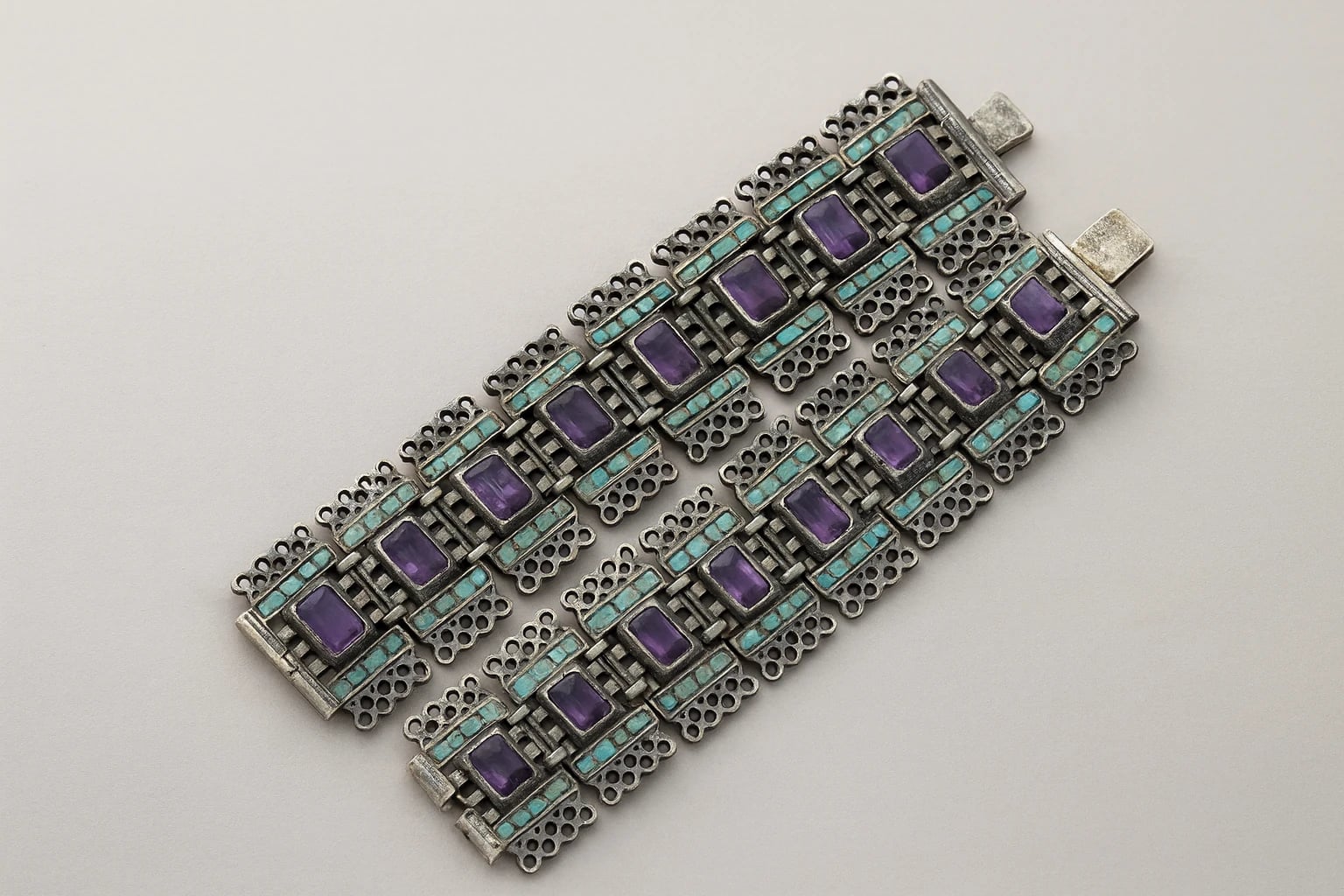
MATL (Matilde Poulat)
Multi-Row Rectangular-Station Bracelet with Turquoise and Amethyst
1934 or later
Turquoise