Saves instantly, no account needed. Already a member? Sign in.
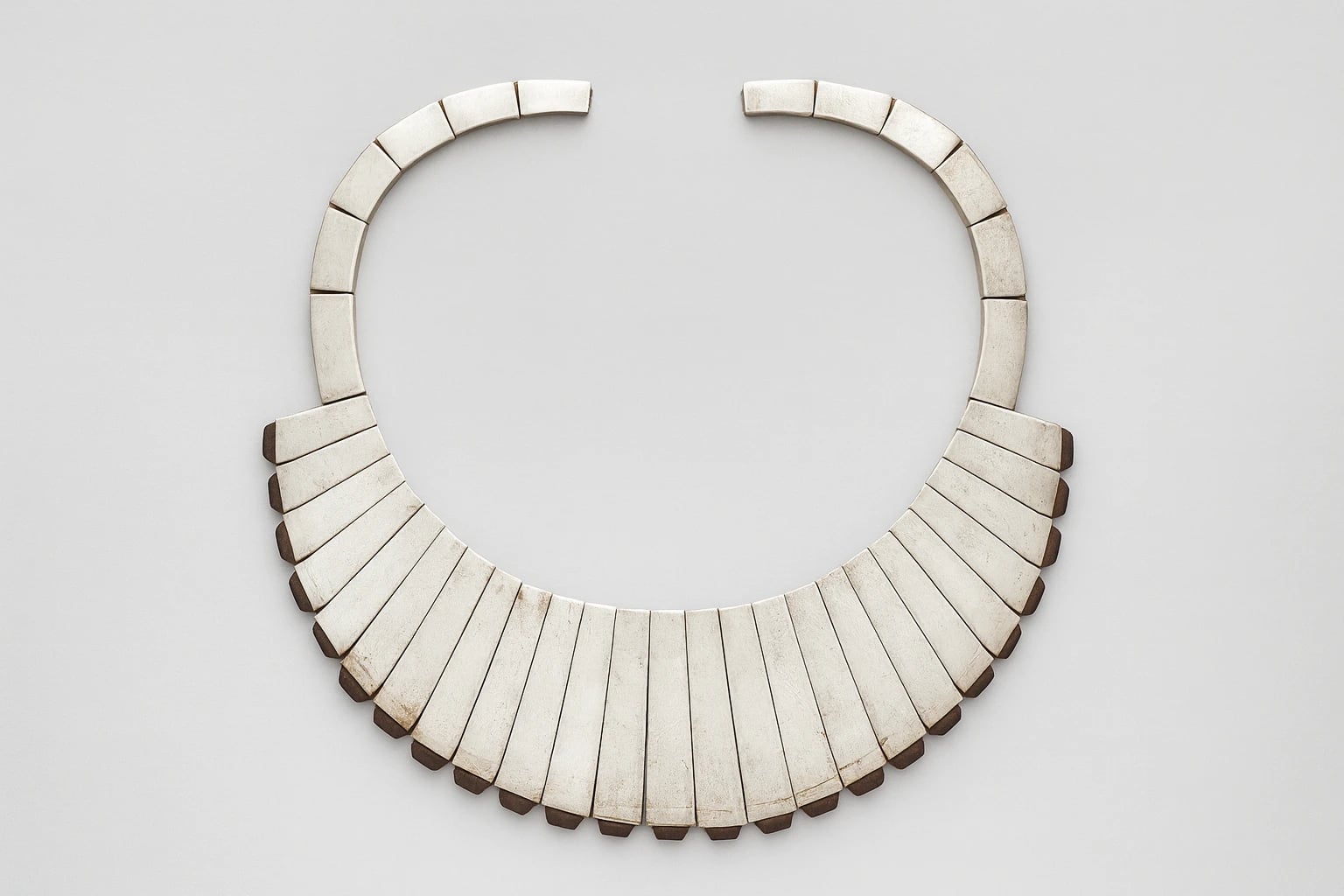
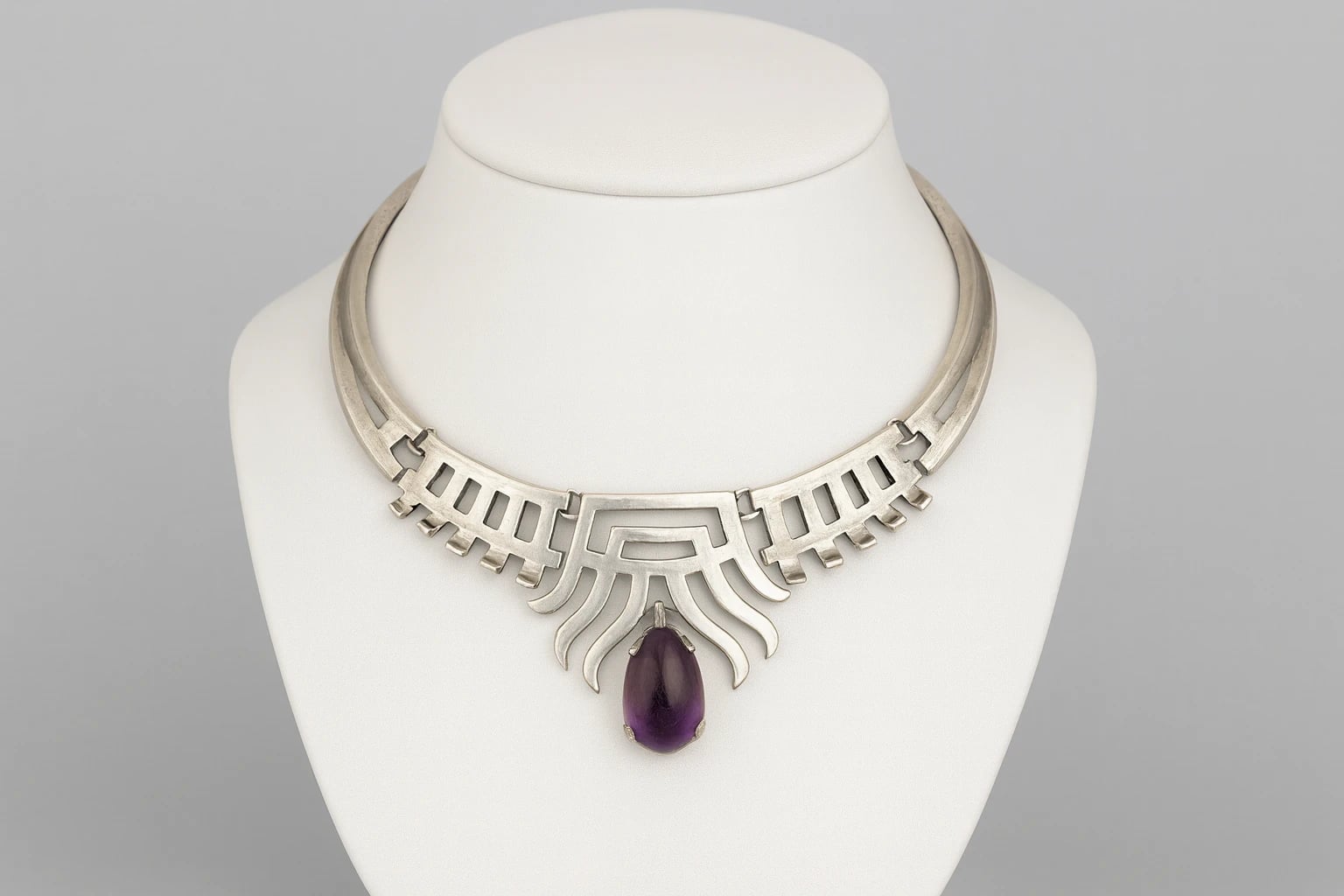
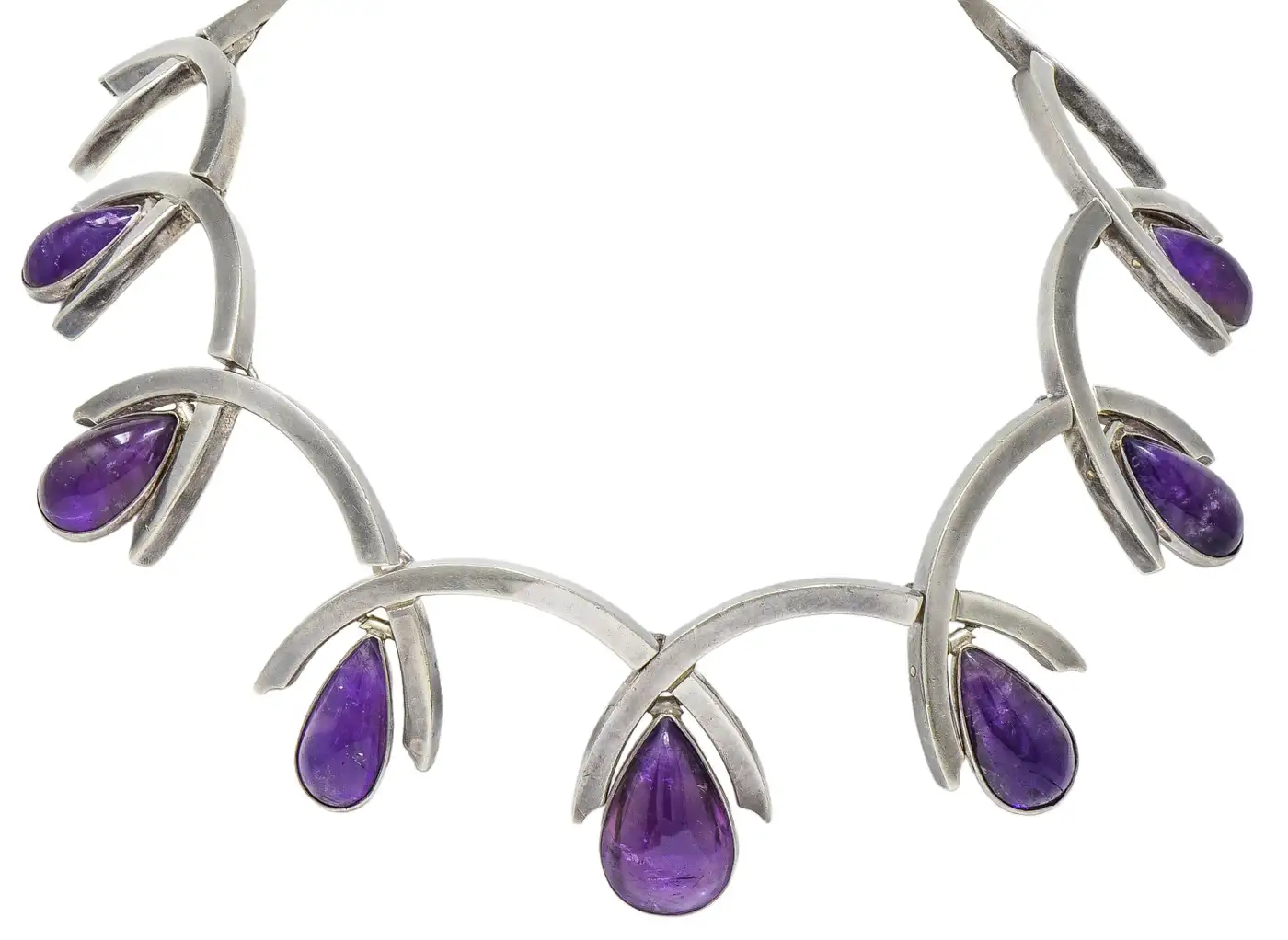
This is a major Antonio Pineda necklace: a sculptural collar of crossing silver arches, each holding a suspended teardrop amethyst. It is one of Pineda’s clearest statements of Mexican modernist jewelry as architecture. The necklace is not built around ornament alone, but around structure: repeated arcs, open space, suspended color, and the disciplined rhythm of forms moving around the neck.
The design is often described as Pineda’s “crossing arches” necklace. Its power comes from the tension between mass and lightness. The silver appears substantial, but the open construction prevents it from becoming heavy or static. Each arched unit frames the amethyst rather than merely holding it, so the stones seem to hang within a moving architectural system. The result is part necklace, part colonnade, part kinetic sculpture.
The piece matters because it represents Pineda at his most refined. He was one of the great modernists of the Taxco School, and this necklace shows why: he could take silver, stone, geometry, and bodily fit and turn them into a sophisticated design language that feels both Mexican and international. The amethysts provide color and sensuality, but the real achievement is the spatial intelligence of the silverwork — the way the arcs overlap, curve, and direct the eye from one element to the next.
It deserves to be considered wearable sculpture because it has real three-dimensional presence and is completed by the body. Laid flat, it reads as a sequence of abstract modernist forms. Worn, it becomes an architectural frame for the collarbone and throat. The necklace does not simply decorate the wearer; it occupies the neckline and changes the visual field around the body.
In museum terms, this is a concise expression of Pineda’s genius: silver treated as architecture, amethyst treated as suspended color, and jewelry treated not as accessory, but as modern sculpture scaled for the human form.
Documented in Stromberg, Silver Seduction (2008), p. 123, fig. 143a.
Record data: Stromberg, Silver Seduction: The Art of Mexican Modernist Antonio Pineda, p. 123, fig. 143a, supplies the design number YY569, the 970 silver standard, the date of 1953 or later, and a height of 19.1 cm. All four are now entered as structured fields. Materials previously read silver alone and omitted the amethysts named in the title; they now read 970 silver and amethyst.
Museum of Mexican Silver. “Arched Amethyst Teardrop Necklace.” Catalog no. MoMS-001738. https://museumofmexicansilver.com/pieces/pineda-necklace-crossing-arches-amethyst
See something wrong with this record? Suggest a correction and the piece details fill in automatically.
Antonio Pineda
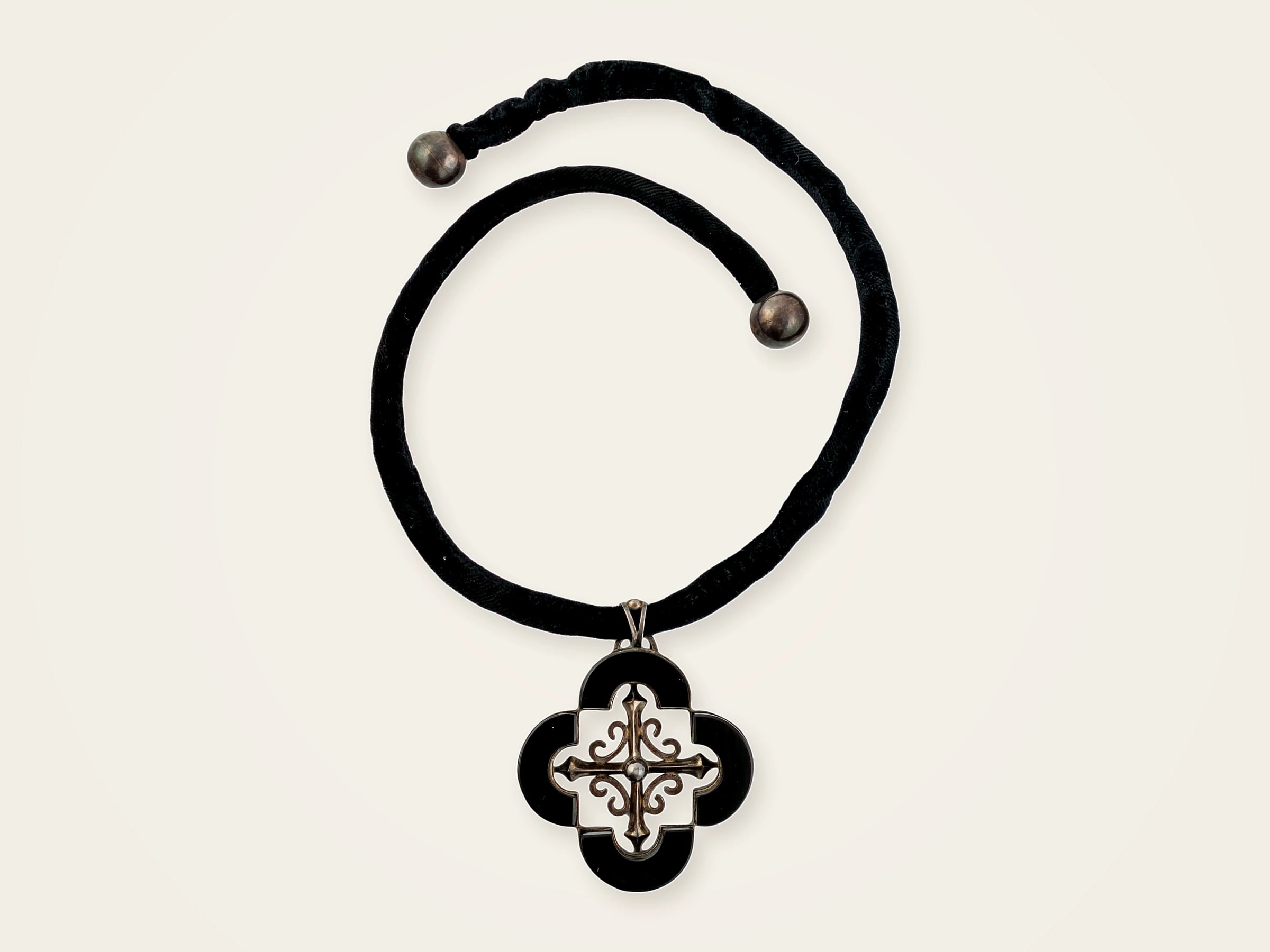
Onyx Cross Necklace
1953-1979
Onyx