Saves instantly, no account needed. Already a member? Sign in.
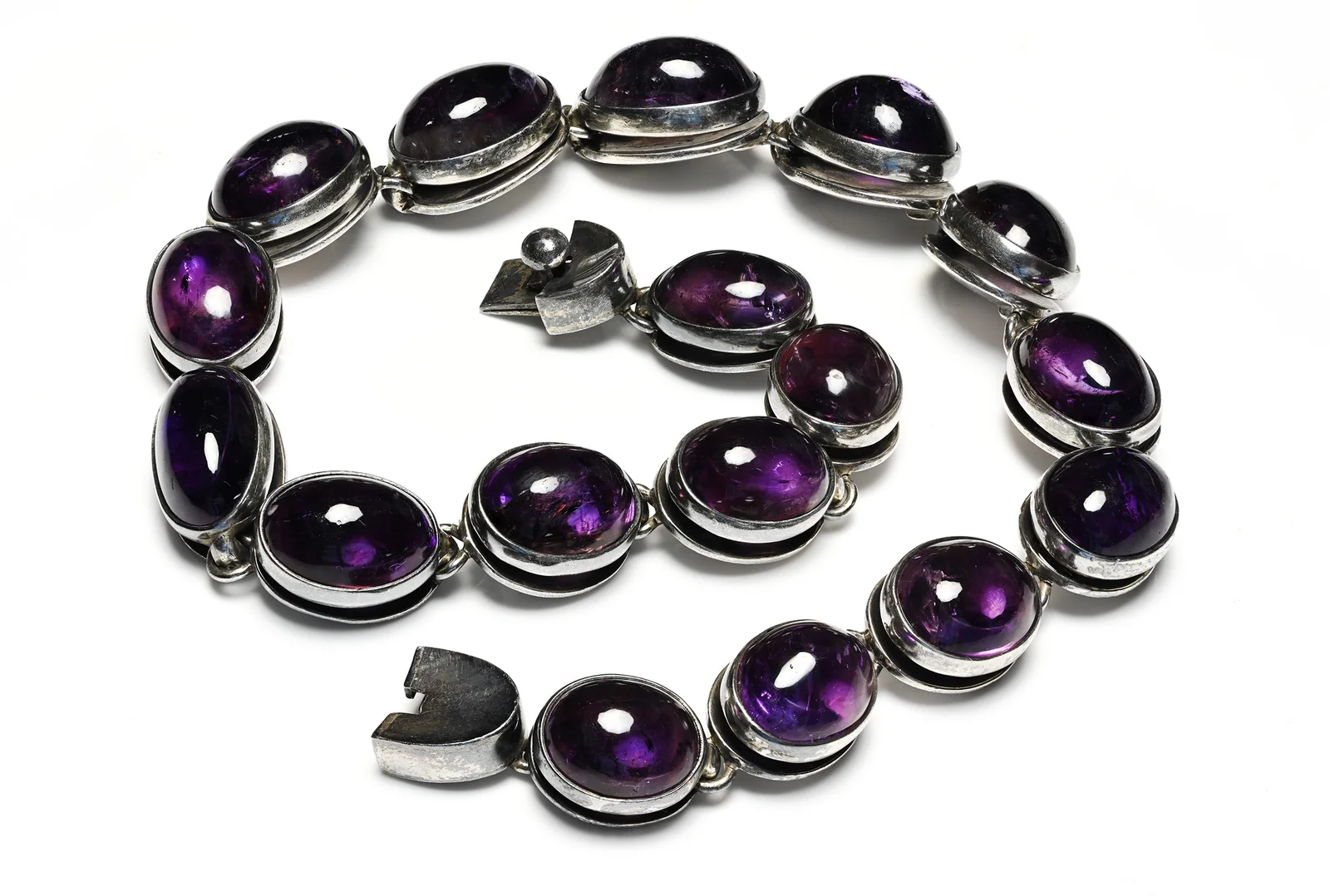
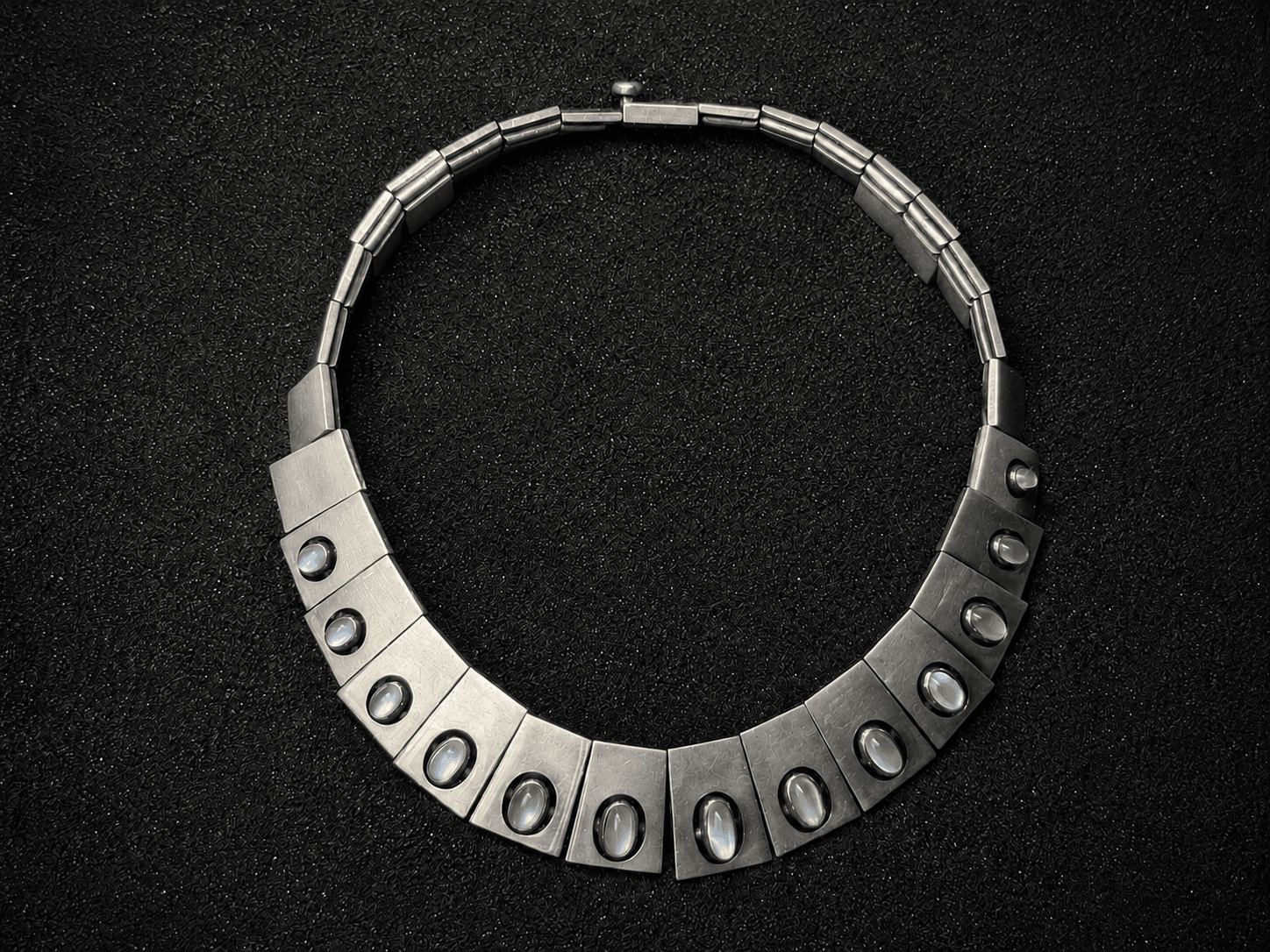
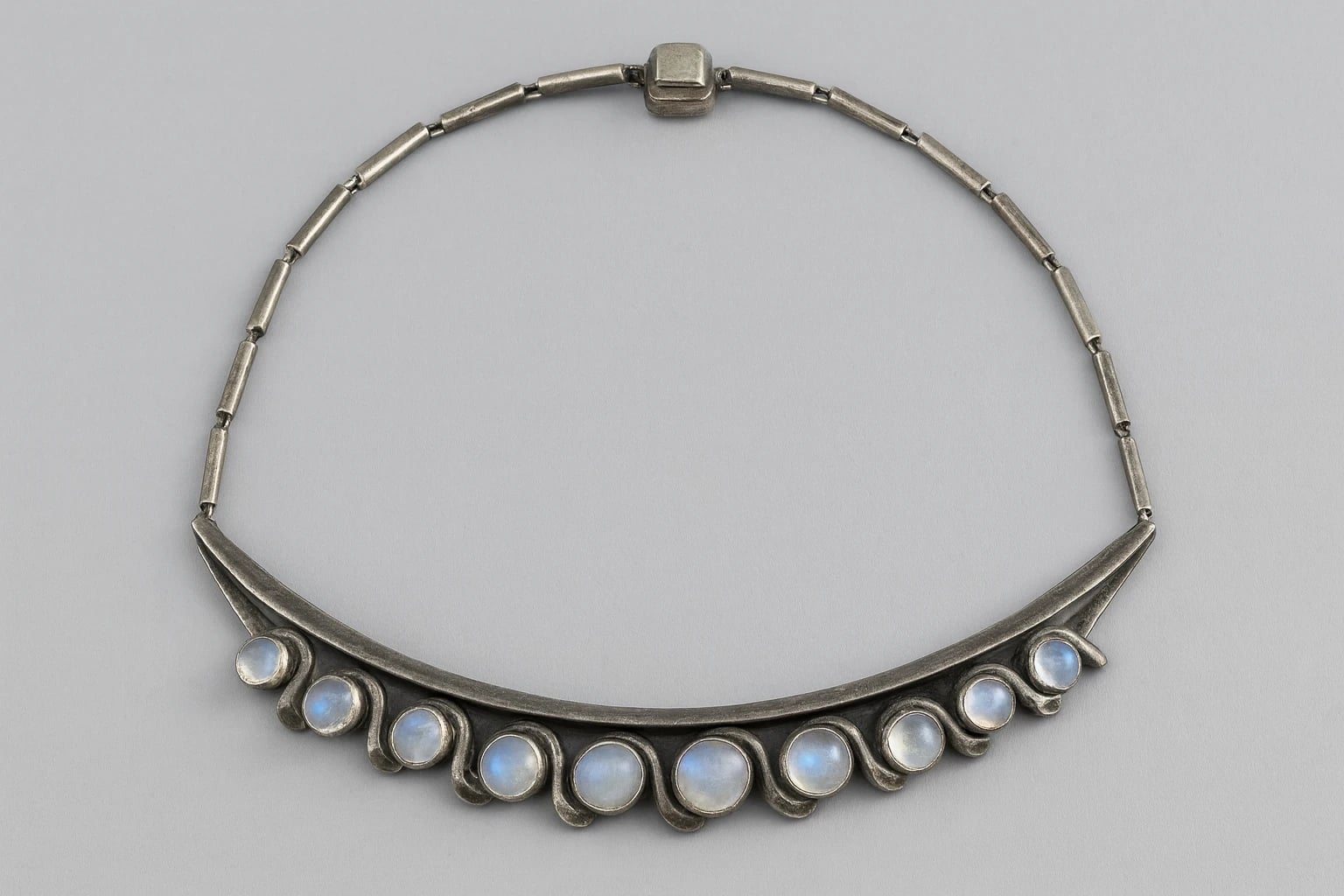
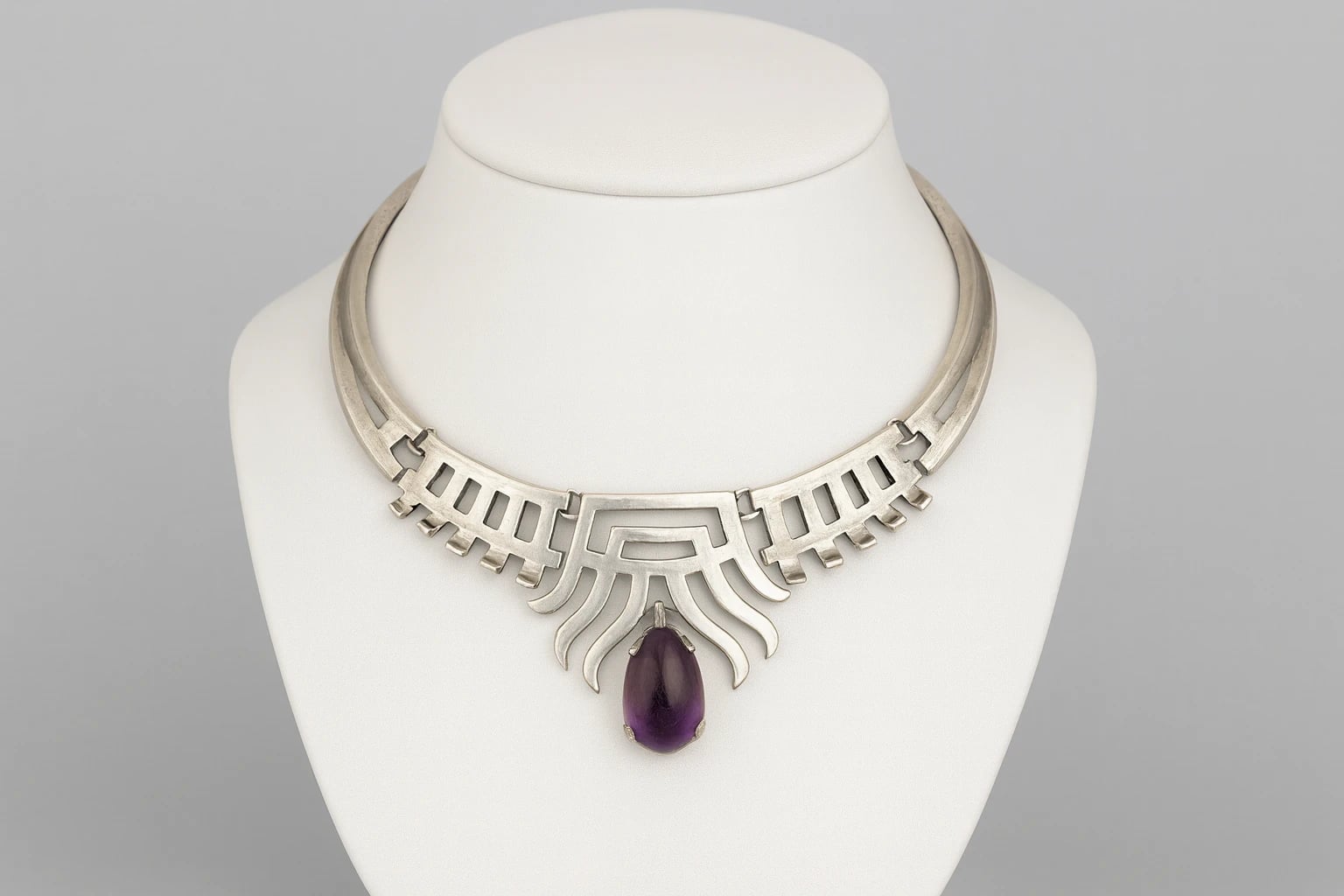
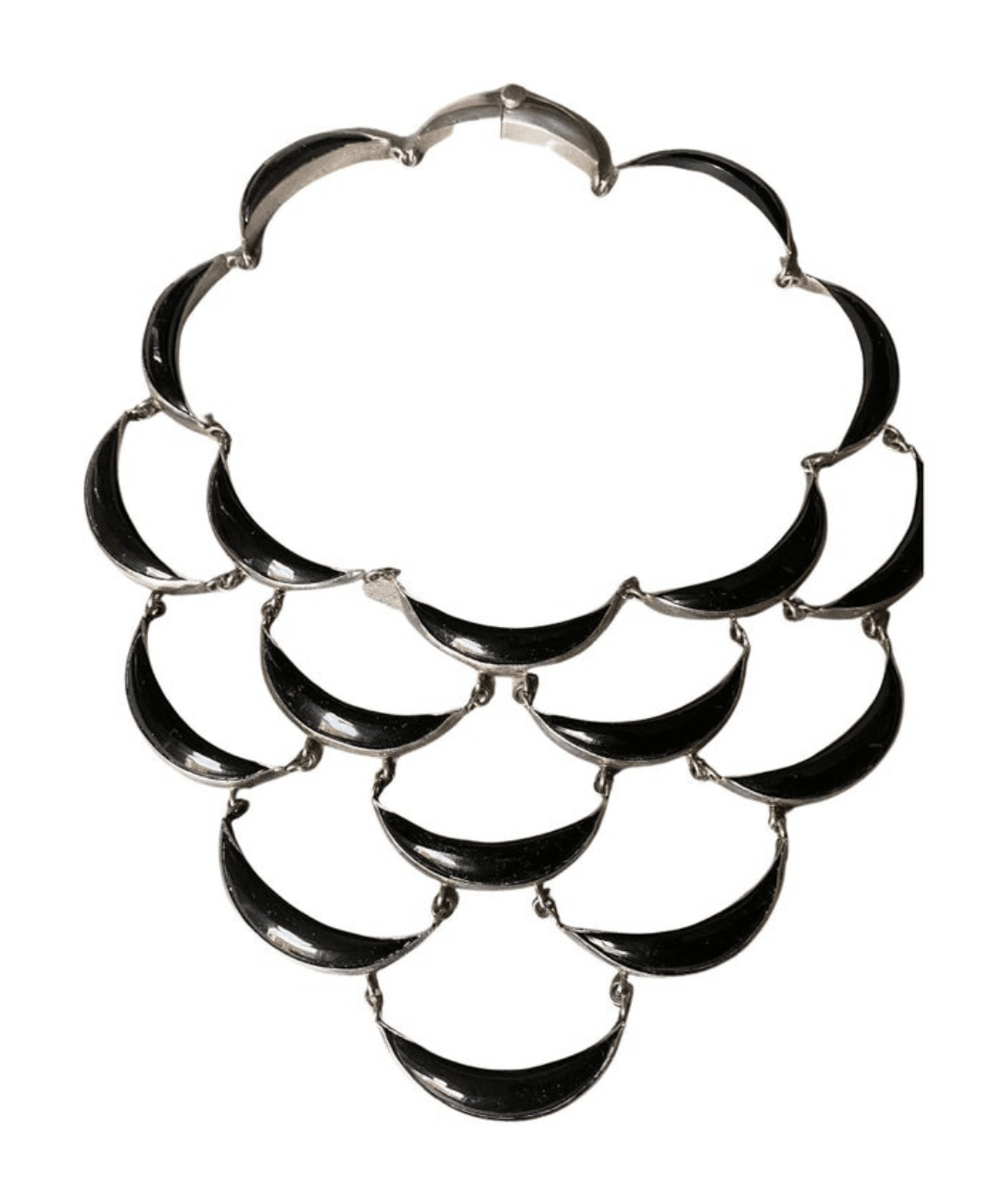
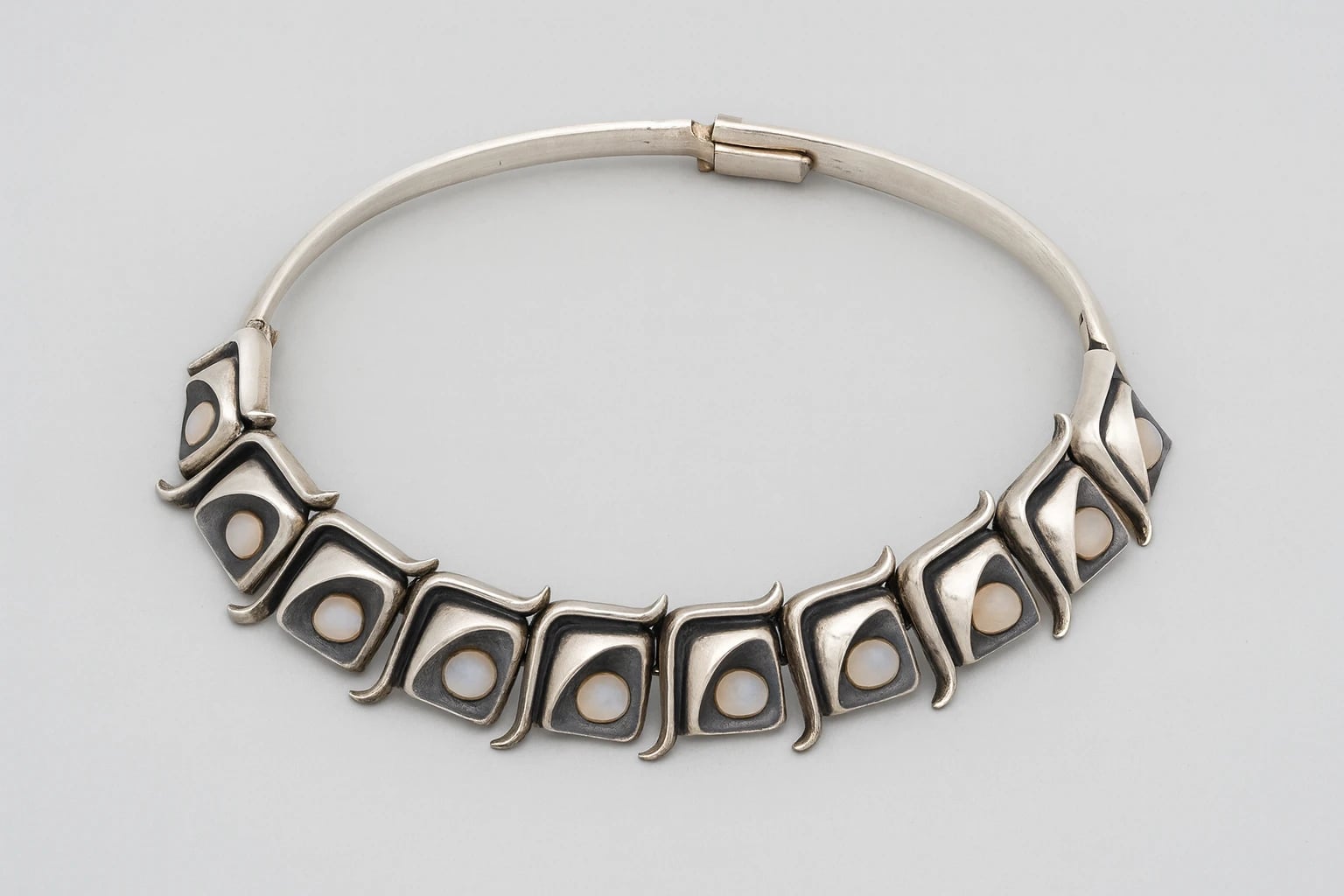
An arc of onyx across the collarbone gives this necklace its structure: a graduated bib of dark, opaque stone suspended in silver, its crescent widening toward the center where the mass hangs deepest. Antonio Pineda used onyx not as an accent but as the dominant material, letting the stone's flat black surface absorb light while the surrounding silver reflects it. The result is a study in contrast between opacity and shine, worked across a form that follows the curve of the neck.
The bib construction depends on articulation. Individual onyx elements are linked so that the necklace conforms to the body rather than sitting rigidly against it, the graduation of the stones giving the crescent its taper from the narrow ends to the fuller center. Onyx reads as a single unbroken darkness at a distance, its color doing the compositional work while the joins between elements stay quiet. Pineda favored strong, opaque stones set against clean silver throughout his mature jewelry, and here the choice organizes the entire piece: the stone carries the weight and the silver carries the light.
Pineda worked in Taxco from the early 1940s, first under the Toni's Silver and AP marks, then through the Silver by Toño and Jewels by Antonio phases, and from about 1953 under the Antonio crown mark associated with his own shop. His necklaces from that period were commonly stamped with a YY-prefixed design number, a system Hougart documents alongside eagle 17, the assay number assigned to him. That his taller ran on numbered designs and, in later years, subcontracted execution to smiths such as Mota, Hilda, and María Pineda while retaining the Antonio mark reflects the collaborative structure of the Taxco workshops. Design authority remained with Pineda even as fabrication was distributed across trained hands.
Within the broader silver renaissance, Pineda represents the generation that moved past Spratling's founding workshop toward a distinct modernist vocabulary built on bold stone and controlled geometry. This necklace shows that vocabulary applied to a large decorative form, where the dark crescent and the reflective metal are held in deliberate balance. It records how Pineda treated a semiprecious opaque stone as the governing element of a design, and how the taller translated such a design into a wearable, articulated object.
Record data: Materials now record both the metal and the stone — 970 silver with onyx — where the field previously listed onyx alone. The object carries the Antonio crown mark with the 970 standard, in use from 1953, so the date is entered as 1953 or later rather than as the workshop range 1953-1979 that stood here before. Construction is recorded under Techniques as articulated link work with bezel-set onyx. No design number is legible on the photographs held for this example and none has been entered; dimensions have not been measured and remain to be recorded.
Museum of Mexican Silver. “Onyx Crescent Bib Necklace.” Catalog no. MoMS-001008. https://museumofmexicansilver.com/pieces/pineda-onyx-link-necklace
See something wrong with this record? Suggest a correction and the piece details fill in automatically.
Antonio Pineda
Necklace of Asymmetrical Silver Panels with Moonstone Cabochons
c. 1953–1979
Sterling silver