Saves instantly, no account needed. Already a member? Sign in.
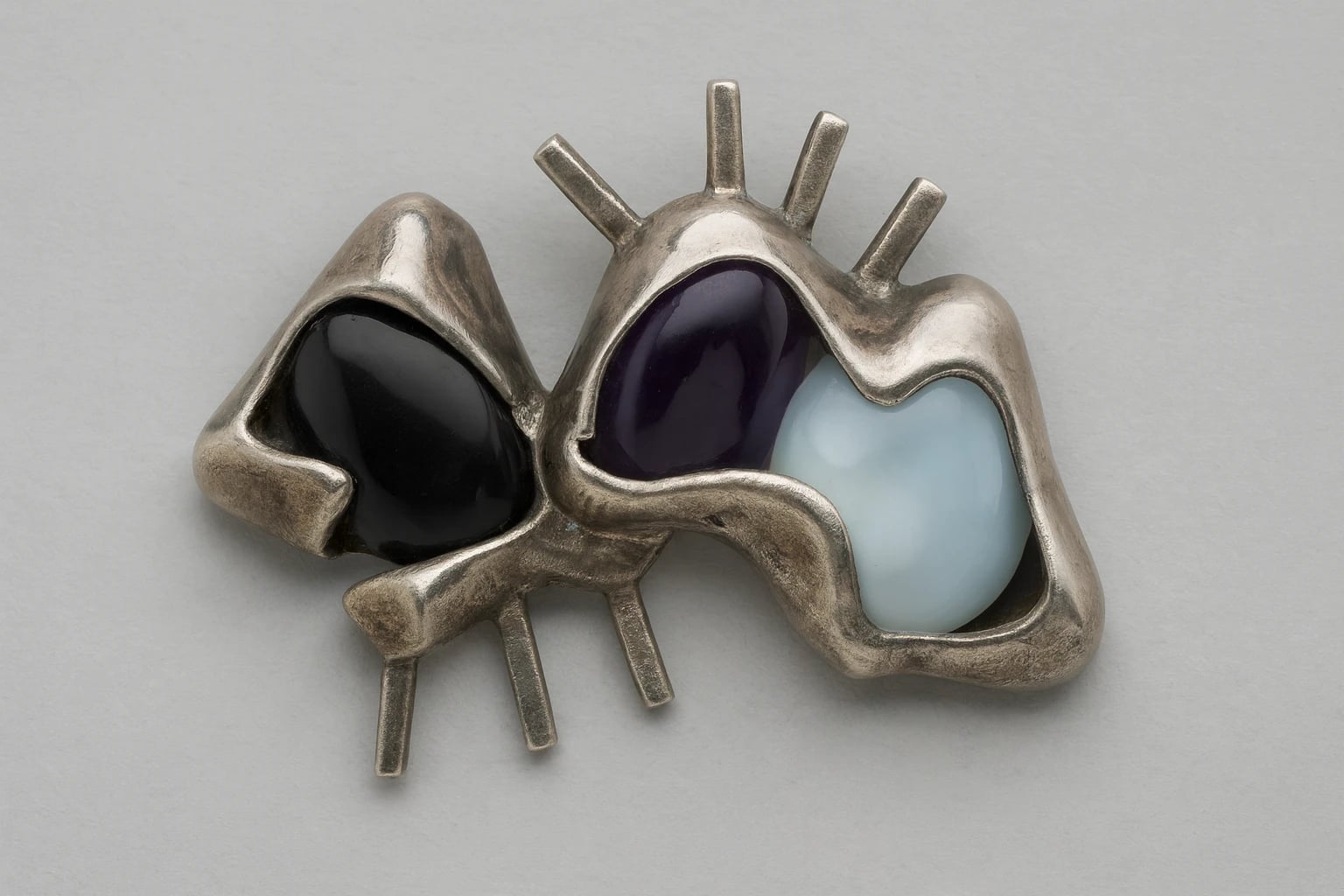
This brooch and pendant is organized around three tucked oval stones, black onyx, amethyst, and a white to light blue translucent stone, each held in a thick, uneven silver surround that seems to have grown around it. The format is compact, measuring 2 1/2 by 2 1/8 inches, but the relief gives it unusual density. Rather than arranging stones as separate ornaments on a flat support, Salvador Terán shapes the silver as a continuous sculptural field. The stones sit deep within the metal, partly enclosed by raised lips and angular folds, so that color becomes part of the structure rather than a surface accent.
The design depends on a tension between polish and interruption. The black onyx absorbs light, the amethyst gathers it into a darker violet center, and the pale translucent stone opens the right side with a cool milky tone. Around them the sterling silver swells, pinches, and changes direction. Short projecting bars at the upper and lower edges prevent the outline from resolving into a simple cluster. They give the object a flickering perimeter, part vegetal, part anatomical, part abstract diagram. This is biomorphic design in a precise sense: it does not imitate a flower, bird, shell, or body, but it borrows the asymmetry and pressure of organic form.
The marks place the object within Terán’s mature independent production: Salvador in script, Sterling, Mexico, Eagle 36, and design number 124. Hougart records Salvador Vaca Terán’s script mark, his association with Eagle numbers 34 and 36, and the regular use of design or inventory numbers on his pieces, with comparable sterling marks dated 1955 to 1970. Morrill and Berk also note that design numbers in Taxco jewelry generally functioned as inventory numbers and that, for the most part, lower numbers tend to be earlier. The number 124 should therefore be treated as useful relative evidence, not as an exact date. It sits comfortably near the published design 130 bracelet and earrings that Morrill illustrated as circa 1960, and before the higher numbered Terán pendants and pins that she placed around the mid 1950s to 1960.
Terán’s career helps explain the object’s force without reducing it to biography. He had worked at Spratling’s Taller de Las Delicias, joined his Castillo cousins in 1939, and became central to the early design intelligence of Los Castillo before establishing his own Mexico City taller in 1952. Morrill and Berk describe his jewelry as especially concerned with overlapping planes, an observation that suits this brooch and pendant closely. The piece turns that concern inward. Its planes do not simply overlap as decorative layers. They press against stones, bend around voids, and create small passages of shadow between color and metal.
Museum of Mexican Silver. “Biomorphic Pendant with Amethyst and Onyx.” Catalog no. MoMS-002324. https://museumofmexicansilver.com/pieces/salvador-teran-biomorphic-sculpted-brooch-pendant-high-sculptural-relief-with-tucked
See something wrong with this record? Suggest a correction and the piece details fill in automatically.
Within the Mexican silver renaissance, this object is valuable as a concentrated example of Terán’s sculptural approach to jewelry. It shares the Taxco School’s confidence in sterling silver as a modern material, but its sensibility is distinct from the more linear, glyphic, or floral vocabularies associated with many contemporaneous workshops. Here modernism arrives through compression: stones, relief, edge, and mechanism are drawn into a single irregular mass that can be worn either as brooch or pendant. The result is a small object with the spatial ambition of relief sculpture, and a clear reminder that some of the most inventive modern Mexican design entered the world at the scale of the body.
Salvador Terán
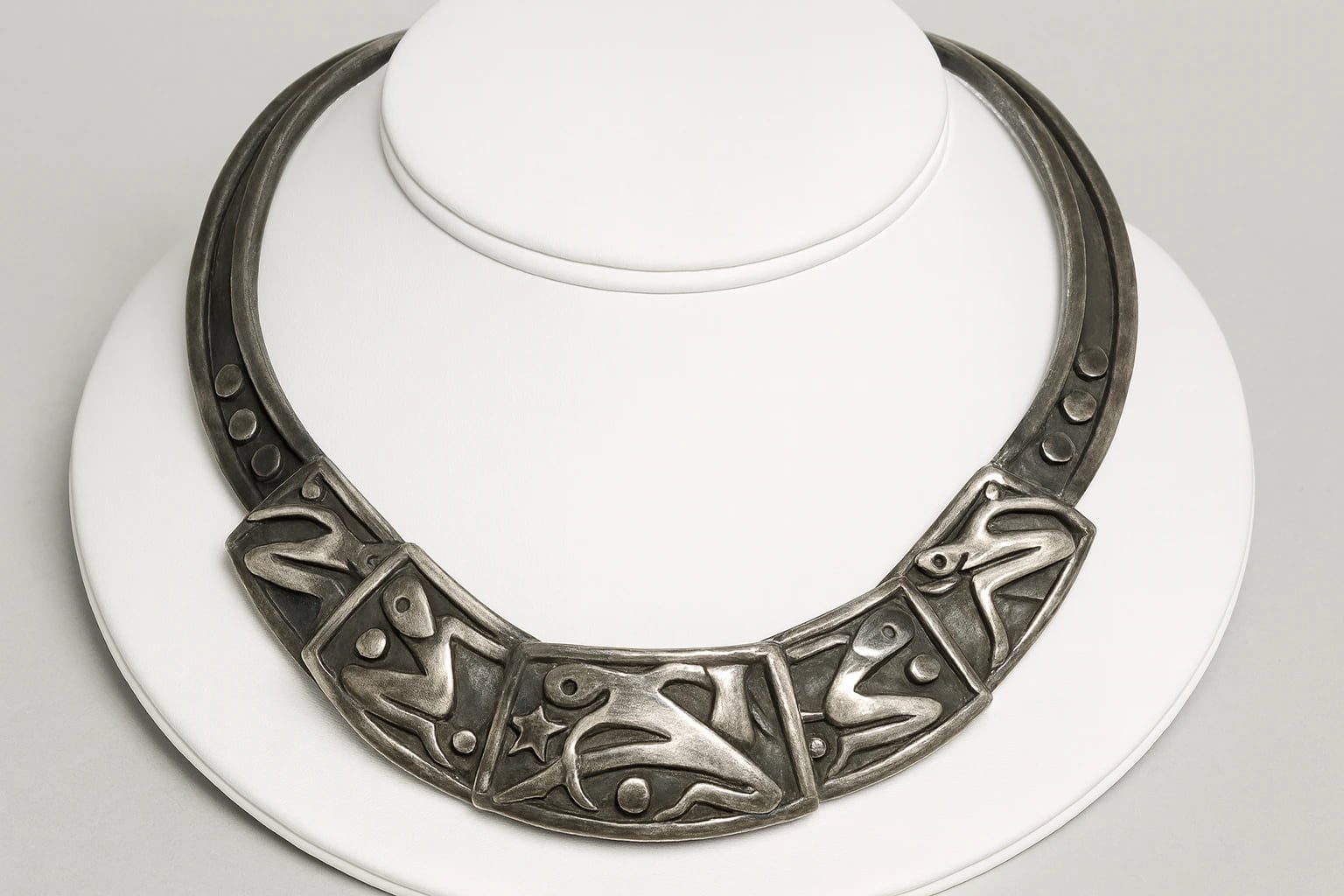
Dancers and Stars Necklace