Saves instantly, no account needed. Already a member? Sign in.
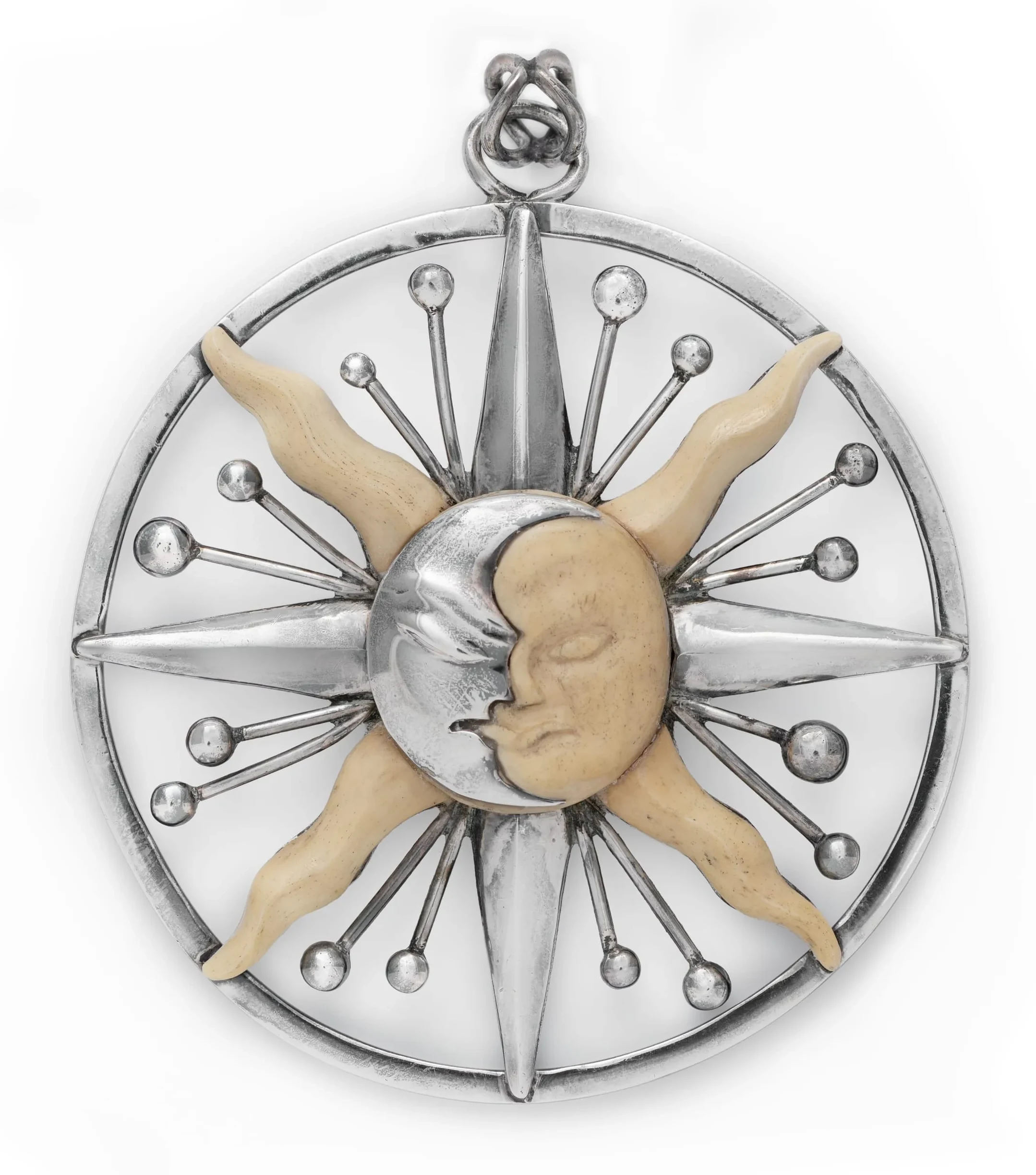
A sun and moon face occupies the center of this pendant, but the design is organized as much by open air as by silver. Salvador Terán sets the paired profile within a broad circular frame and fills the space around it with radiating rods, rounded terminals, pointed silver rays, and pale bone flames. The pendant reads first as a celestial emblem, then as a carefully engineered structure of intervals. The circle steadies the composition while the spokes push outward, giving the small object the frontal authority of a wall relief or devotional plaque reduced to the scale of the body.
The materials sharpen that effect. Silver carries the cool, reflective half of the face and the linear armature that surrounds it. Bone gives the sun face and curling rays a warmer, matte surface, with small tonal variations that keep the carved forms from becoming flat signs. The moon’s polished crescent overlaps the bone face rather than simply dividing it, so the image depends on layered planes. This was one of Terán’s most characteristic habits as a designer. Morrill and Berk describe his jewelry in terms of overlapping planes, and the observation is especially apt here: the face, crescent, rays, and wirework are stacked into a shallow relief that keeps changing as light catches the raised silver surfaces.
The design belongs to Terán’s mature work after his move beyond Taxco’s first generation of talleres. Hougart records that Salvador Vaca Terán left William Spratling’s Taller de Las Delicias in 1939 to work with his cousins at Los Castillo, where he was responsible for many early designs, and that in 1952 he moved to Mexico City, where he helped start India Bonita: Platería Joyería on Avenida Juárez. Hougart also notes that Terán’s designs, often abstract interpretations of Mexican cultural icons, are highly prized. Morrill published a closely related Sun and Moon Pendant, marked Salvador, eagle 36, Sterling, Mexico, design number 179, dated circa 1955 to 1960 and described as vermeil on 925 silver and ivory. The LACMA pendant, accession M.2018.68.51, is recorded as silver and bone, with no hallmark visible in the available image, but it clearly belongs to this documented design family.
The pendant shows how Terán translated Mexican iconography into a modern object without reducing it to quotation. The sun and moon motif has deep resonance in Mexican visual culture, but Terán’s treatment is neither archaeological copy nor folkloric illustration. He uses symmetry, repetition, and voids to make the emblem legible from a distance, then complicates it through material contrast and relief. The result is a work of jewelry that also belongs to the broader field of twentieth century Mexican design: portable, graphic, sculptural, and tied to the workshop networks that carried modern silver from Taxco into Mexico City and beyond.
Museum of Mexican Silver. “Sun and Moon Pendant.” Catalog no. MoMS-002282. https://museumofmexicansilver.com/pieces/salvador-teran-sun-and-moon-pendant
See something wrong with this record? Suggest a correction and the piece details fill in automatically.
Salvador Terán
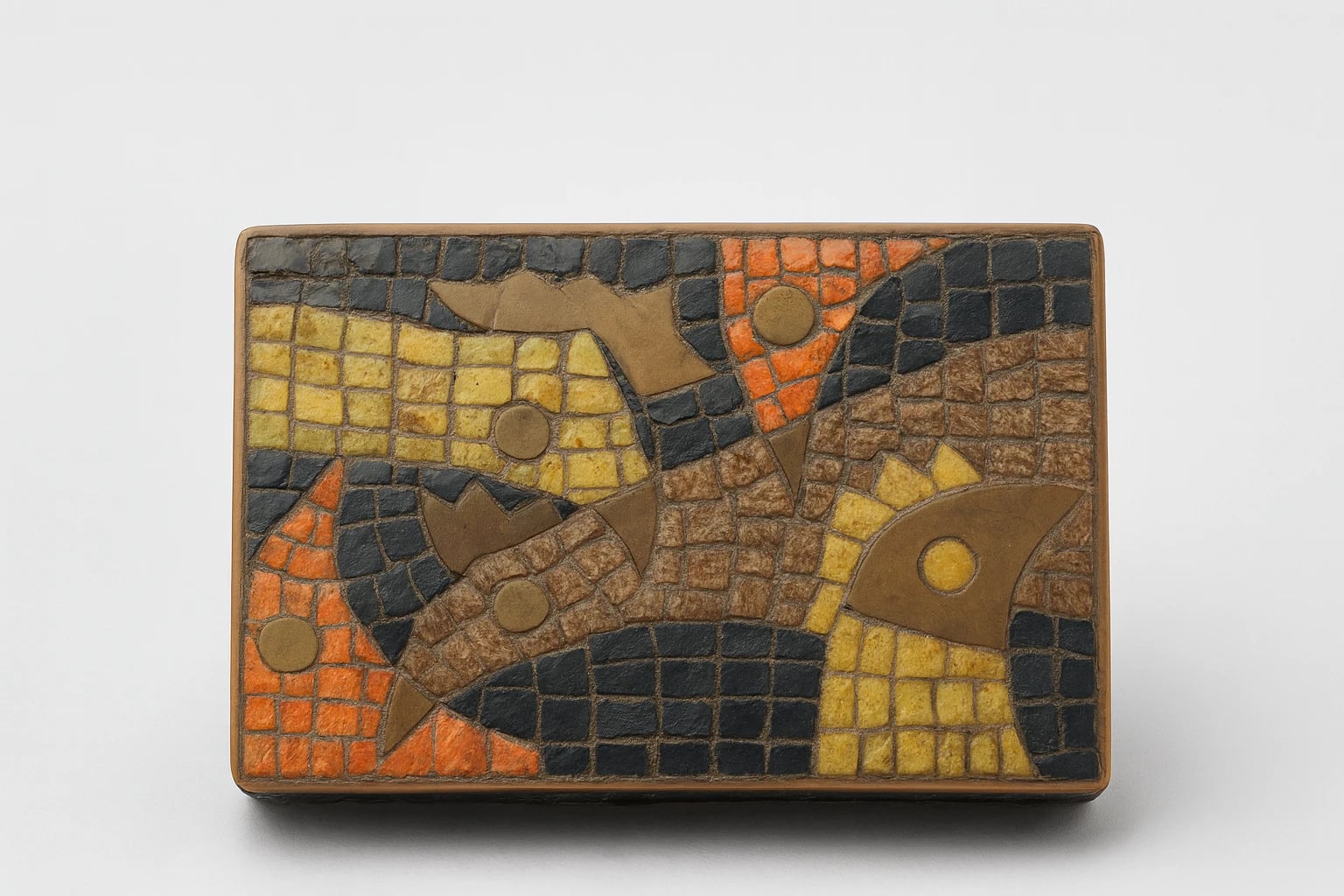
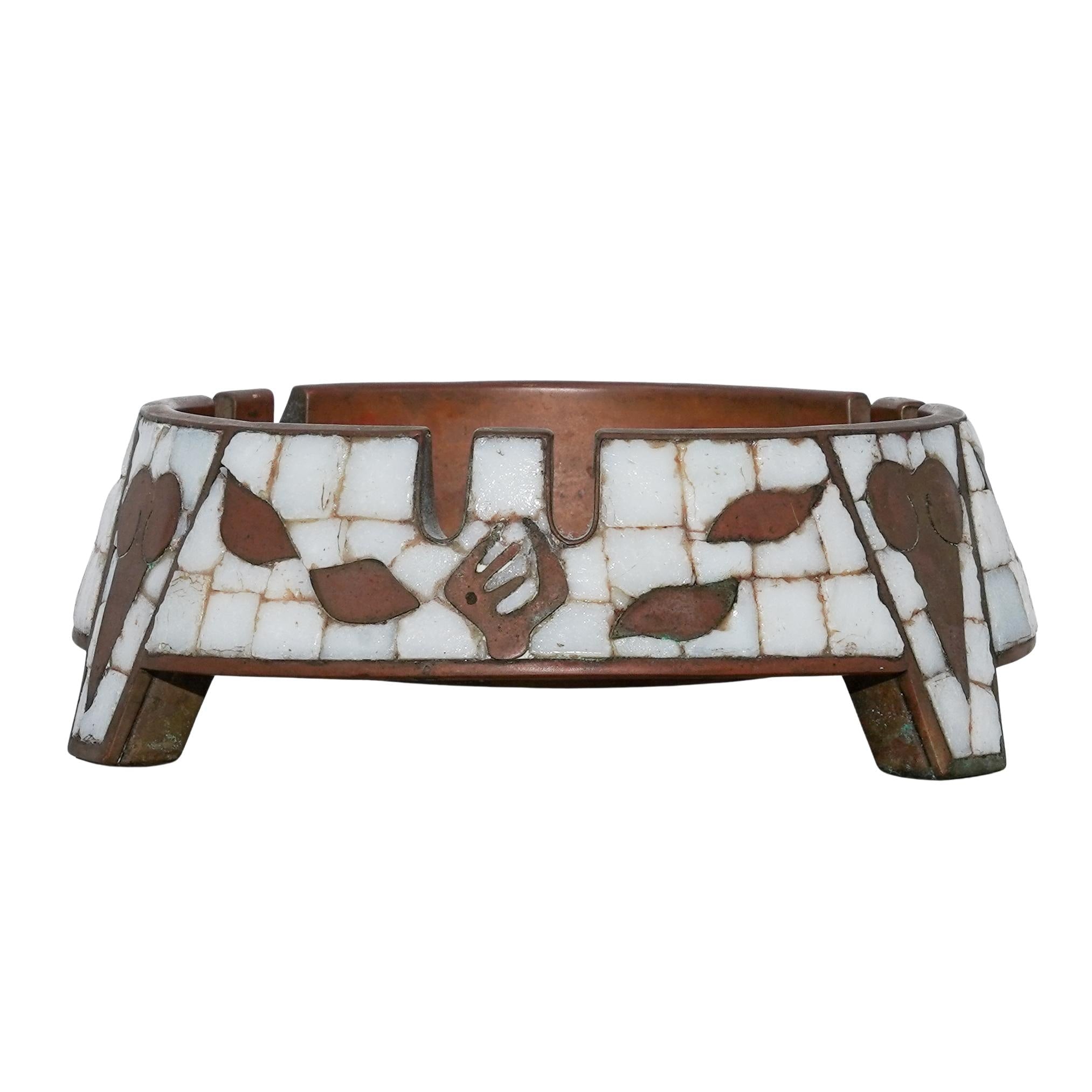
Mosaic Brass Footed Bowl
1952-1974
Brass