Saves instantly, no account needed. Already a member? Sign in.
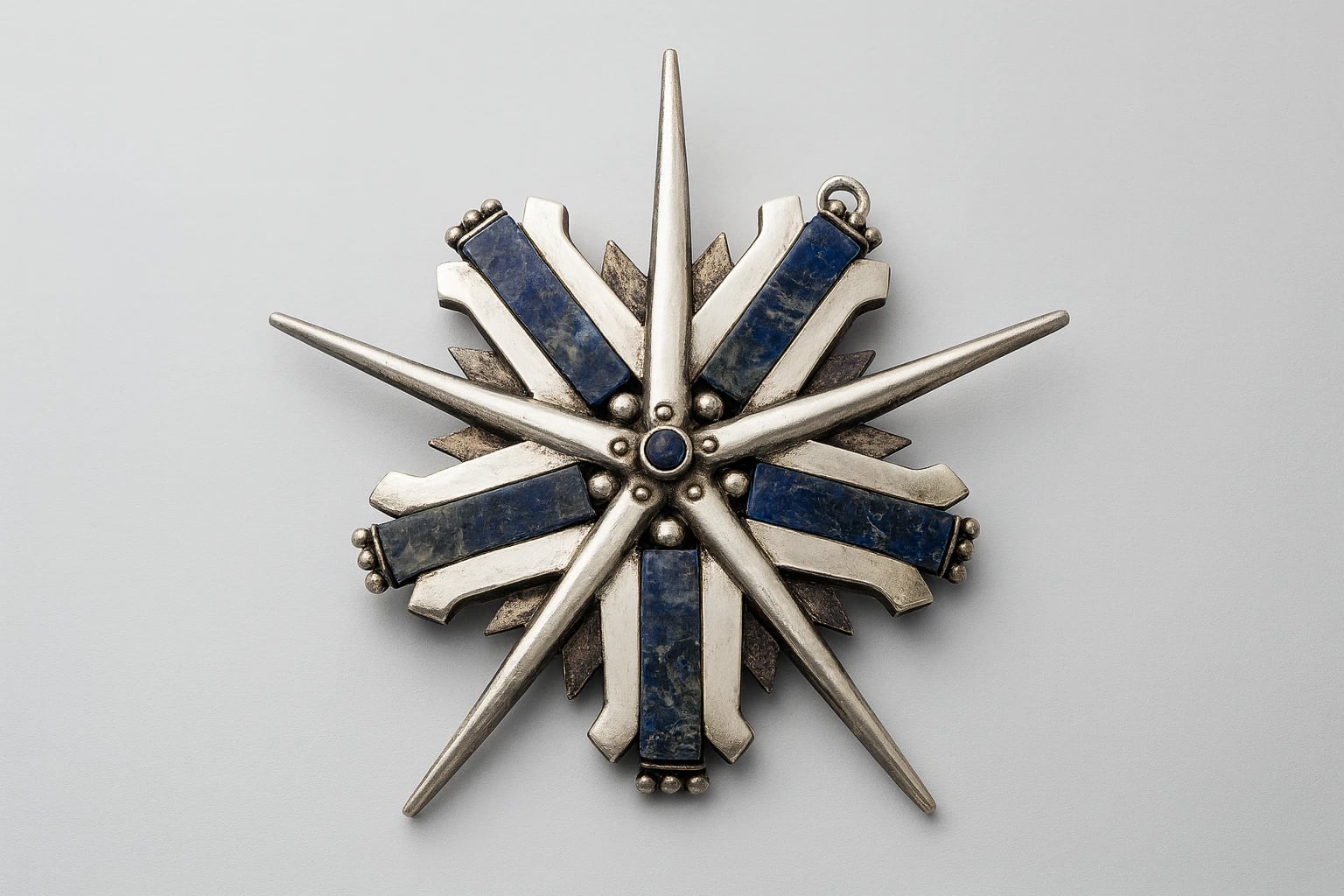
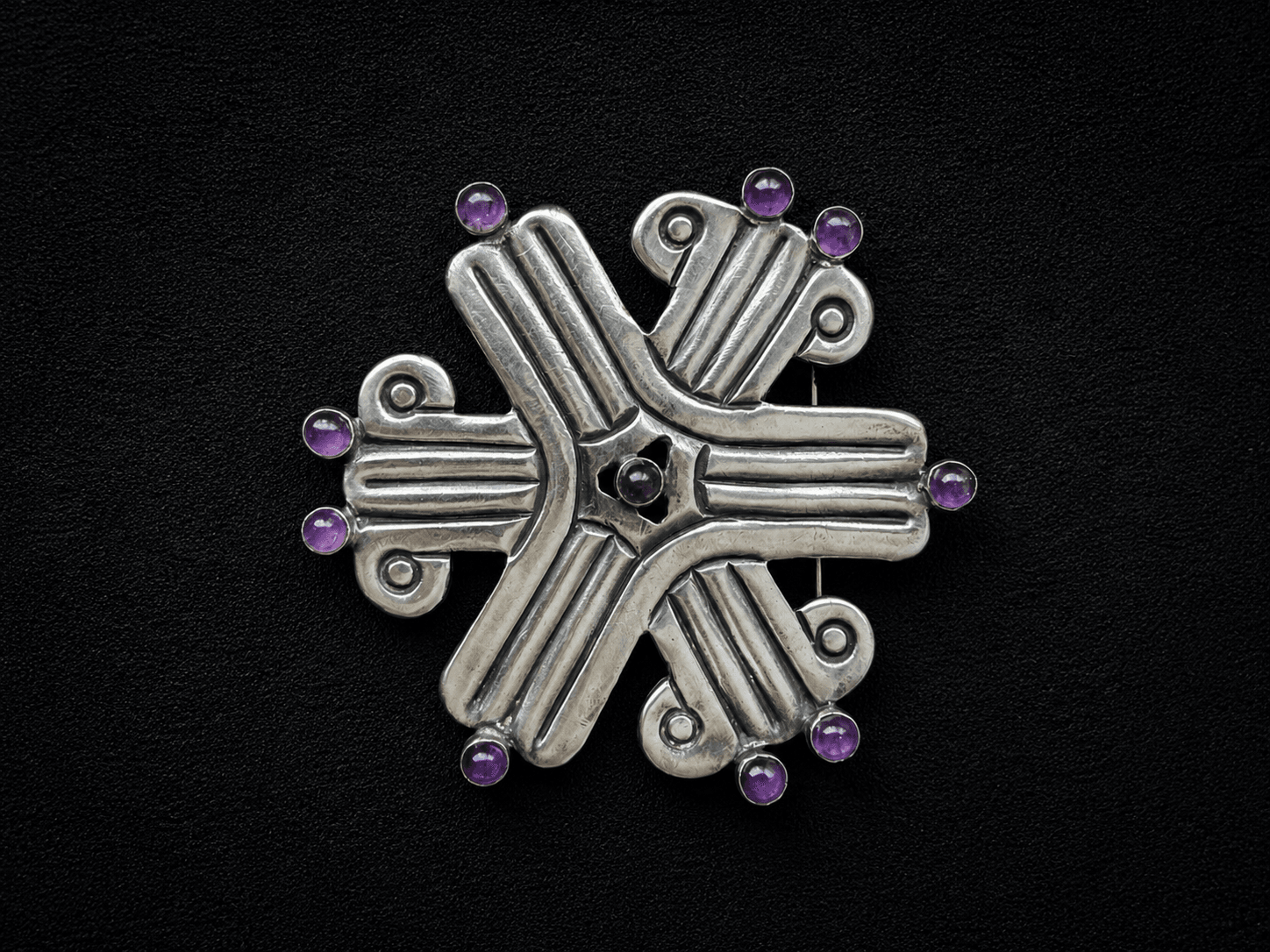
One of Spratling rarest and most famous pendants, this radiating medallion built from four pairs of ribbed silver bars that interlace at the center and break outward into paired C-scrolls, the whole reading at once as a cross, a star, and a coiled solar glyph. Round amethyst cabochons punctuate each scrolled terminal, and a single amethyst is set at the crossing where the bars meet, so that the violet accents trace the geometry of the design rather than merely decorate it. Worn from an oval open-link chain, the pendant carries the weight of an amulet while remaining wholly architectural in its logic.
The vocabulary is unmistakably Spratling's. The play between raised, fluted ridges and the deep oxidized channels that separate them, the disciplined symmetry, and the scrolled forms abstracted from ancient ornament all belong to the design language he drew from Mexico's Pre-Columbian past and made the foundation of the Taxco revival he launched in the 1930s. Morrill, in Mexican Silver (1994), describes exactly this kind of marriage of a Pre-Columbian motif to a wearable object, with its interplay of curved and ridged planes given emphasis through oxidation, an effect this piece achieves in the contrast between bright silver and shadowed recess. Signed with the maker's mark and carrying the eagle assay stamp, it sits within the body of his work made under federal hallmarking.
The integration of stone and structure here, where the cabochons mark the rhythm of the design rather than sit apart from it, is what gives the medallion its presence. It is a compact statement of the principles that made Taxco silver a modern art form rather than a souvenir trade: indigenous geometry, handwrought ridging, and color used with restraint.
Museum of Mexican Silver. “Hexagon Amethyst Pendant.” Catalog no. MoMS-000415. https://museumofmexicansilver.com/pieces/spratling-1977
See something wrong with this record? Suggest a correction and the piece details fill in automatically.
William Spratling
Rosewood Link Necklace
Silver