Saves instantly, no account needed. Already a member? Sign in.
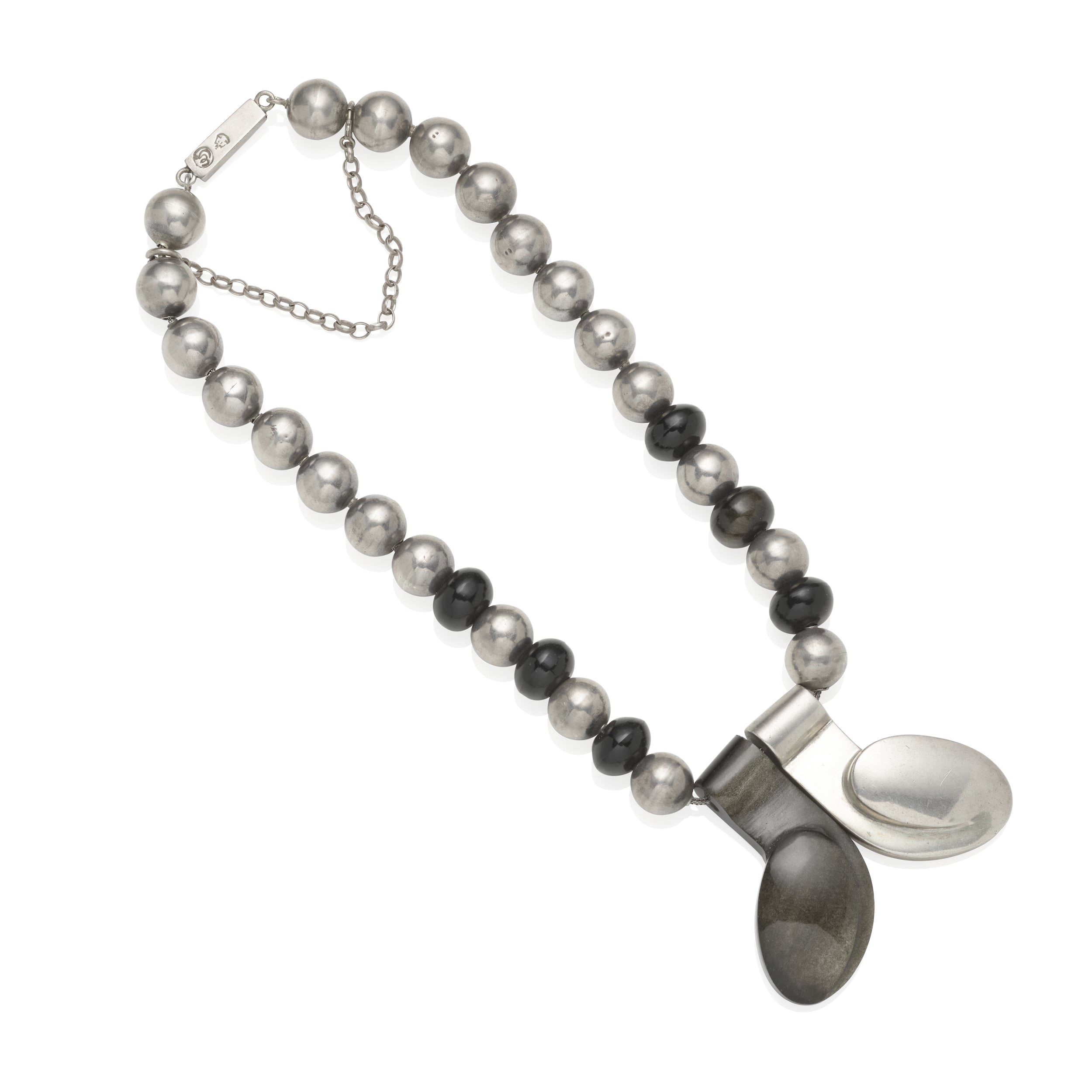
A rope of silver spheres carries six obsidian balls that alternate with their silver counterparts near the front, and the necklace turns a simple strung form into a study of light and weight. The polished silver returns bright reflection while the obsidian absorbs it, and the two materials, similar in scale and roundness, read almost entirely through their opposition of surface. Spratling described this treatment as "rococo repousse," a phrase that acknowledges the raised, worked quality of the silver globes while gesturing toward an ornamental abundance not usually associated with his more austere Aztec-derived pieces.
The construction is organized around repetition and controlled variation. Uniform spheres establish a steady rhythm along the length of the chain, and the substitution of obsidian for silver at intervals near the pendant breaks that rhythm exactly where the eye settles when the necklace is worn. Obsidian, a volcanic glass long worked in central Mexico, carries a dense black that reads as depth rather than color, and here it functions as a series of dark punctuation marks against the reflective metal. Spratling produced the same design with gold plate substituted for the obsidian, a variant that exchanges this optical contrast for a warmer play of two metals and confirms that the alternating-sphere structure, not the specific dark material, was the governing idea.
The necklace belongs to a body of work Spratling produced at the Taller de las Delicias, the Taxco workshop he founded in 1931 and through which he reorganized design and production for an expanding market. Morrill records an example of the type in silver and obsidian, marked with the Spratling stamp and dated to around 1944, and notes its resemblance to assembled bead necklaces made by Héctor Aguilar in the same period. That comparison places the piece within a shared Taxco vocabulary of strung silver and stone rather than isolating it as a singular invention. Within Spratling's own output, it sits apart from the carved amethyst and figural silver for which the Taller was known, showing his interest in the plain sphere as a modular unit and in obsidian as a specifically Mexican material with ancient use.
For a collection, the necklace documents Spratling's willingness to build ornament from simple geometric repetition and from the contrast of a local volcanic glass against worked silver. It records a design that circulated in more than one material combination, and it preserves the maker's own term for the effect he sought. The piece adds a quieter, more abstract register to the record of Spratling's work, one that depends on rhythm and reflectivity rather than on figuration or carved stone.
Museum of Mexican Silver. “Obsidian Lenguas Necklace.” Catalog no. MoMS-000758. https://museumofmexicansilver.com/pieces/spratling-2391
See something wrong with this record? Suggest a correction and the piece details fill in automatically.
William Spratling
Narrow Silver Tube Link Necklace
Silver