Saves instantly, no account needed. Already a member? Sign in.
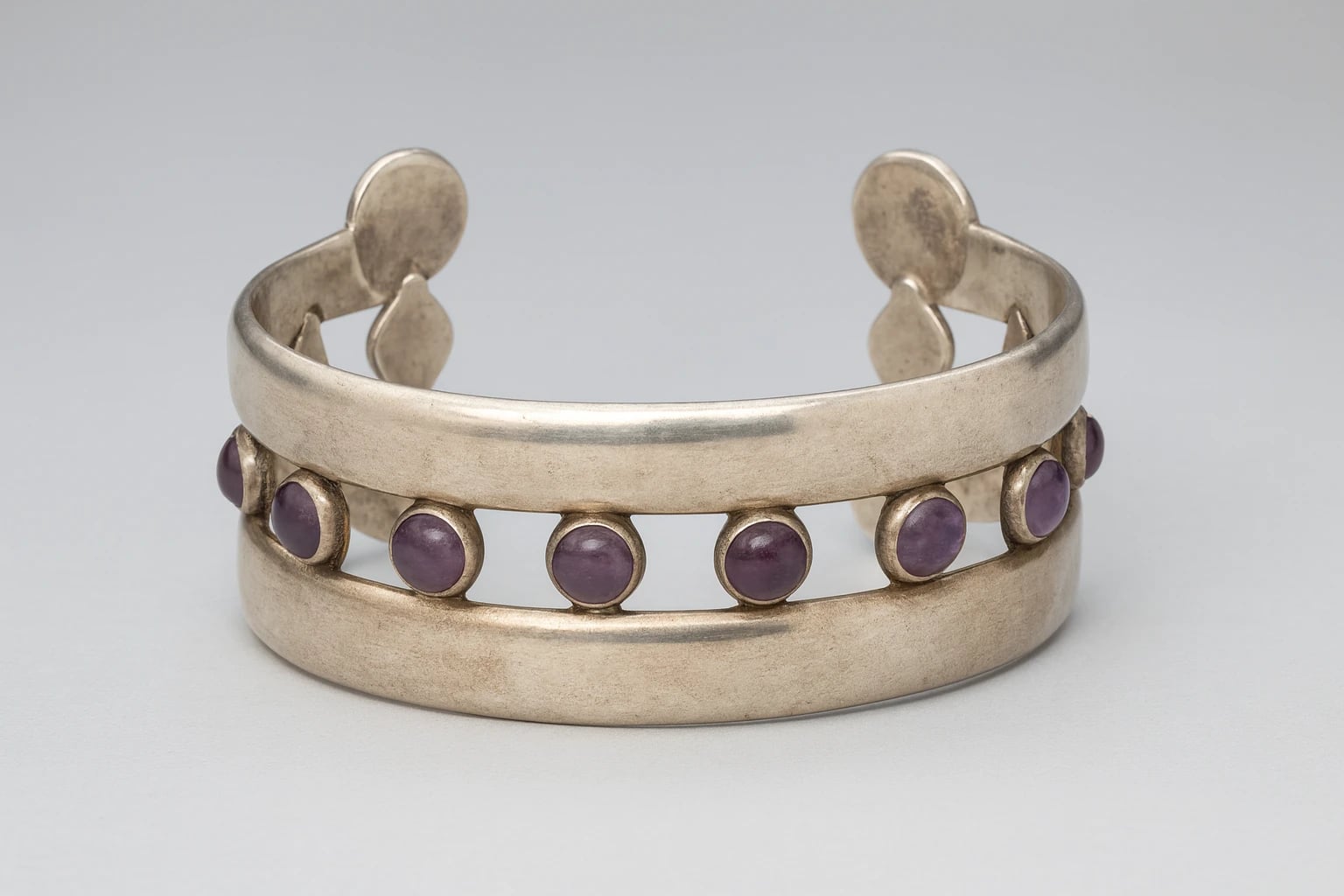
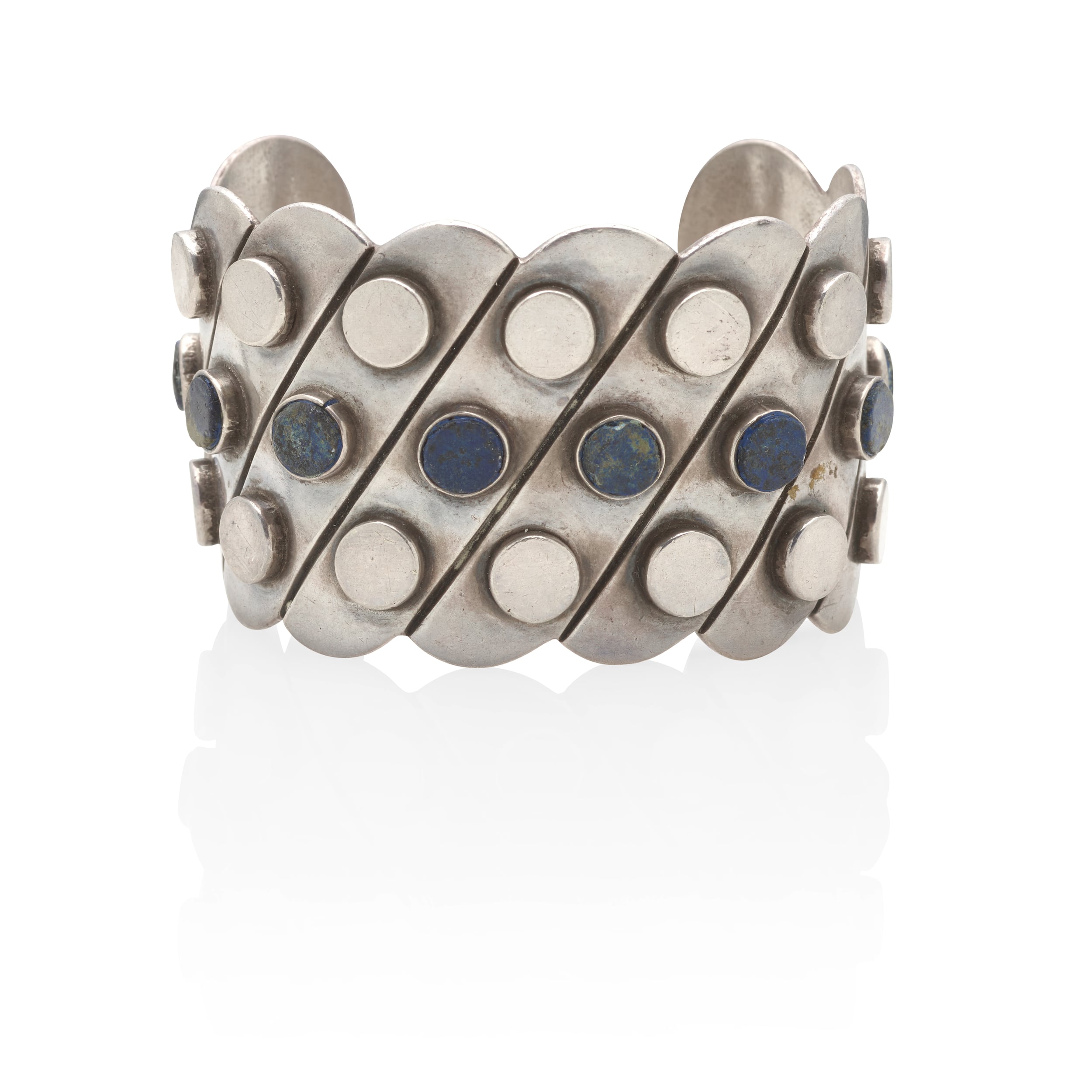
A scalloped edge tracing the upper and lower perimeter gives this wide cuff an architectural profile, while the face organizes itself around a motif of raised circular silver discs and round azurite cabochons arranged in a precise diagonal repeat. The deep cobalt of the mineral — its surface mottled with the characteristic greens and blues of azurite — holds its own against the polished silver, the two materials reading as equal partners in a surface that is at once planar and rhythmically textured. Diagonal channels incised across the band set a measured cadence, binding the circular elements into a composition that feels disciplined without being rigid.
Spratling incorporated azurite into his stone vocabulary during the final years of the First Design Period, when his workshop had relocated to the restored hacienda La Florida, which opened as his new taller in 1944 (Morrill, Silver Masters of Mexico, 1996). The azurite designs were produced there for only a brief window, lending pieces like this cuff a relative scarcity within his pre-war output. The mineral's rich blue coloration, uncommon in the Taxco silver tradition, signals an experimental sensibility at work — a willingness to move outside the more familiar stone palette of the era.
The combination of an unusual mineral and a confident circular geometry places this bracelet firmly within the most resolved phase of Spratling's First Design Period.
Museum of Mexican Silver. “Scalloped Azurite Bracelet.” Catalog no. MoMS-000450. https://museumofmexicansilver.com/pieces/spratling-2479
See something wrong with this record? Suggest a correction and the piece details fill in automatically.
William Spratling
Beryllium/Copper Bracelet
Third Design Period: 1951 - 1967
Silver