Saves instantly, no account needed. Already a member? Sign in.
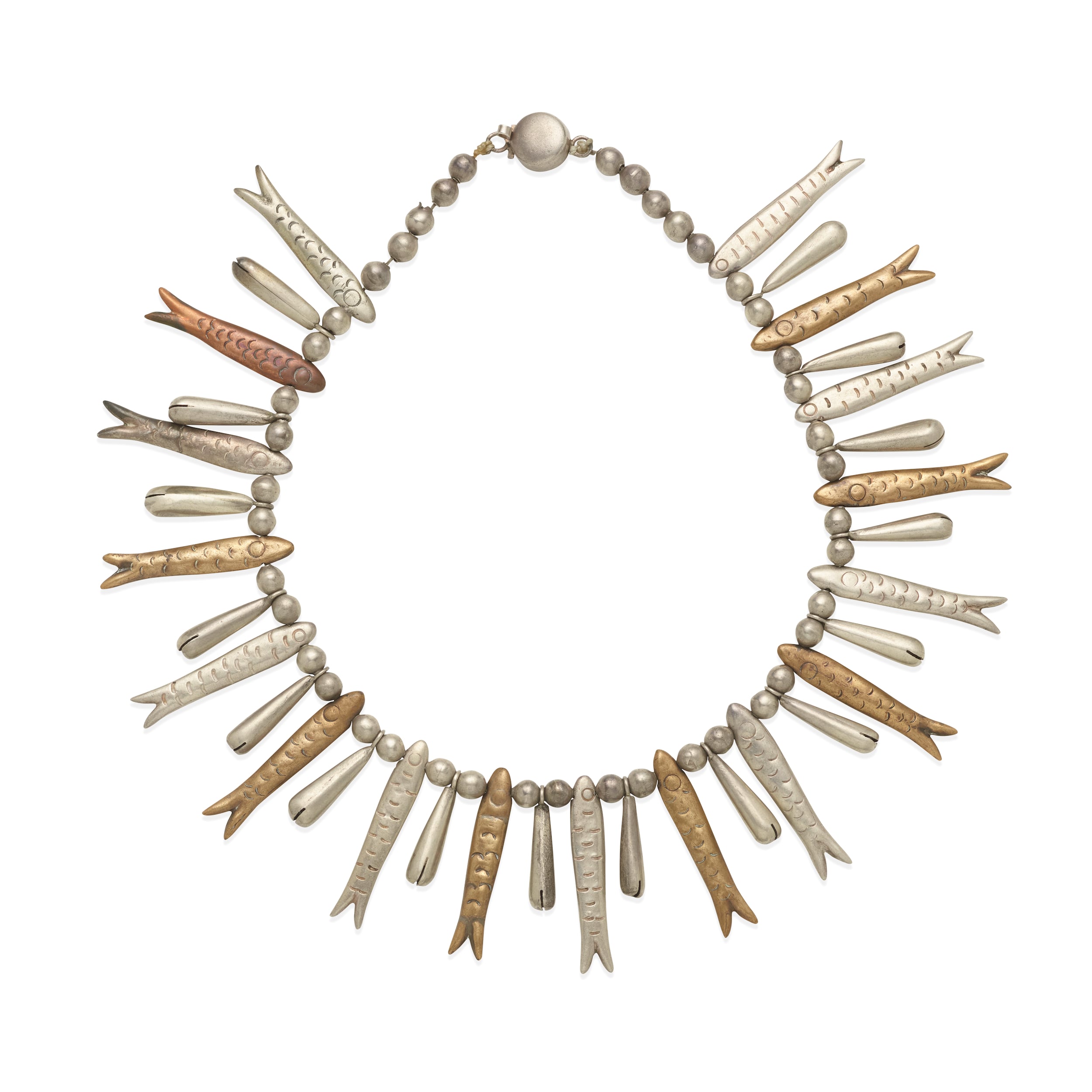
Sixteen fish — eight in silver, eight in bronze — fan outward from a strand of round silver beads in this bib necklace, their elongated bodies chased with a circular scale pattern and their forked tails establishing a rhythmic, aquatic silhouette around the full collar. Fifteen elongated cascabels interspersed between the pendants give the piece a sonic dimension, the small bells completing a composition that shifts and sounds with the wearer. A circular clasp at the nape closes the necklace in its original cotton stringing.
The alternation of two metals — silver and bronze in adjacent fish — produces a visual rhythm that a single-metal composition could not achieve, the warm patina of the bronze playing against the cooler silver so the eye moves continuously around the necklace. Fauna were a constant presence in William Spratling's design vocabulary; Morrill records parrots, owls, and jaguars among the zoomorphic forms he was fashioning in silver (Morrill, Silver Masters of Mexico, 1996, p. 84), and the fish here receive the same degree of individual attention — each body characterized by its chased scales, each tail precisely shaped.
Spratling inaugurated the Taller de Las Delicias in 1931, the workshop that remade Taxco into the center of a handwrought silver industry (Morrill, Silver Masters of Mexico, 1996, p. 2). His sustained turn to Pre-Conquest art for design source was a philosophical stance — what Morrill describes as an affirmation of Mexico's ancient heritage in the spirit of the muralist movement (Morrill, Mexican Silver, 1994, p. 39). Dated to circa 1940–46, this necklace belongs to the final years of that founding period, when bimetal construction at this scale was well within the taller's reach.
Sixteen individually wrought fish pendants and fifteen cascabels demand careful calibration of weight and visual rhythm across the full collar, and the survival of the piece in its original cotton stringing reflects the care with which it has been kept over the better part of a century.
Museum of Mexican Silver. “Necklace of 8 Silver Fish.” Catalog no. MoMS-000122. https://museumofmexicansilver.com/pieces/spratling-2590
See something wrong with this record? Suggest a correction and the piece details fill in automatically.
Ebony Tube Necklace
Silver