Saves instantly, no account needed. Already a member? Sign in.
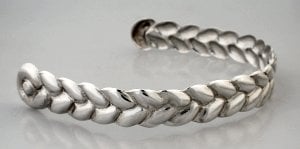
A silver headband that imitates plaited hair moves ornament onto the head, an unusual site in Taxco silver, which concentrated on necklaces, bracelets, brooches, and hollowware. Worn across the brow or crown, the band reads as three interwoven silver strands, a braid rendered permanently in metal. The conceit is direct: a form associated with hair and cloth is translated into a rigid precious material, so that the ordinary gesture of braiding becomes a fixed sculptural line encircling the head.
The braided effect is achieved through repoussage, in which the silver is worked from behind to raise the surface into relief. Here that raising builds the rounded, over-and-under passages that give the band its convincing sense of interlaced strands, each swell of metal catching light along its crest and falling into shadow at the crossings. Repoussage is one of the core techniques the Taxco silversmiths named and explained in their own vocabulary, alongside piercing and chasing, and it suited a workshop culture that prized surface modeling over applied ornament. The result is a continuous rhythm of light and dark that animates a plain silver ground without any added stones or color.
This band belongs to Spratling's first design period, the years between the founding of the Taller de Las Delicias in 1931 and the mid-1940s, when the workshop was defining a Mexican modern idiom drawn from indigenous form and popular craft. Braided hair carries strong associations with Mexican indigenous dress, and rendering that braid in silver aligns with the wider postrevolutionary interest in Mexico's indigenous heritage that ran through Taxco's silver age. Spratling directed a collaborative taller in which master smiths translated designs into finished objects, and a repoussé band of this kind depended on that system of specialized hand skill. The braid motif also connects to a broader Taxco practice of taking a familiar object or gesture from daily life and reworking it in precious metal.
Headbands are scarce within Spratling's known output, and the object records a moment when the workshop was still testing where silver ornament could sit on the body. It preserves a first-period exercise in pure surface modeling, showing what repoussage alone could accomplish when a single technique carries the entire design. For a collection tracing the range of Spratling's early work and the Taxco School's ways of translating Mexican life into metal, the band documents both an uncommon object type and a characteristic method of that formative decade.
Museum of Mexican Silver. “Repoussage Silver Head Band.” Catalog no. MoMS-000108. https://museumofmexicansilver.com/pieces/spratling-3075
See something wrong with this record? Suggest a correction and the piece details fill in automatically.
William Spratling
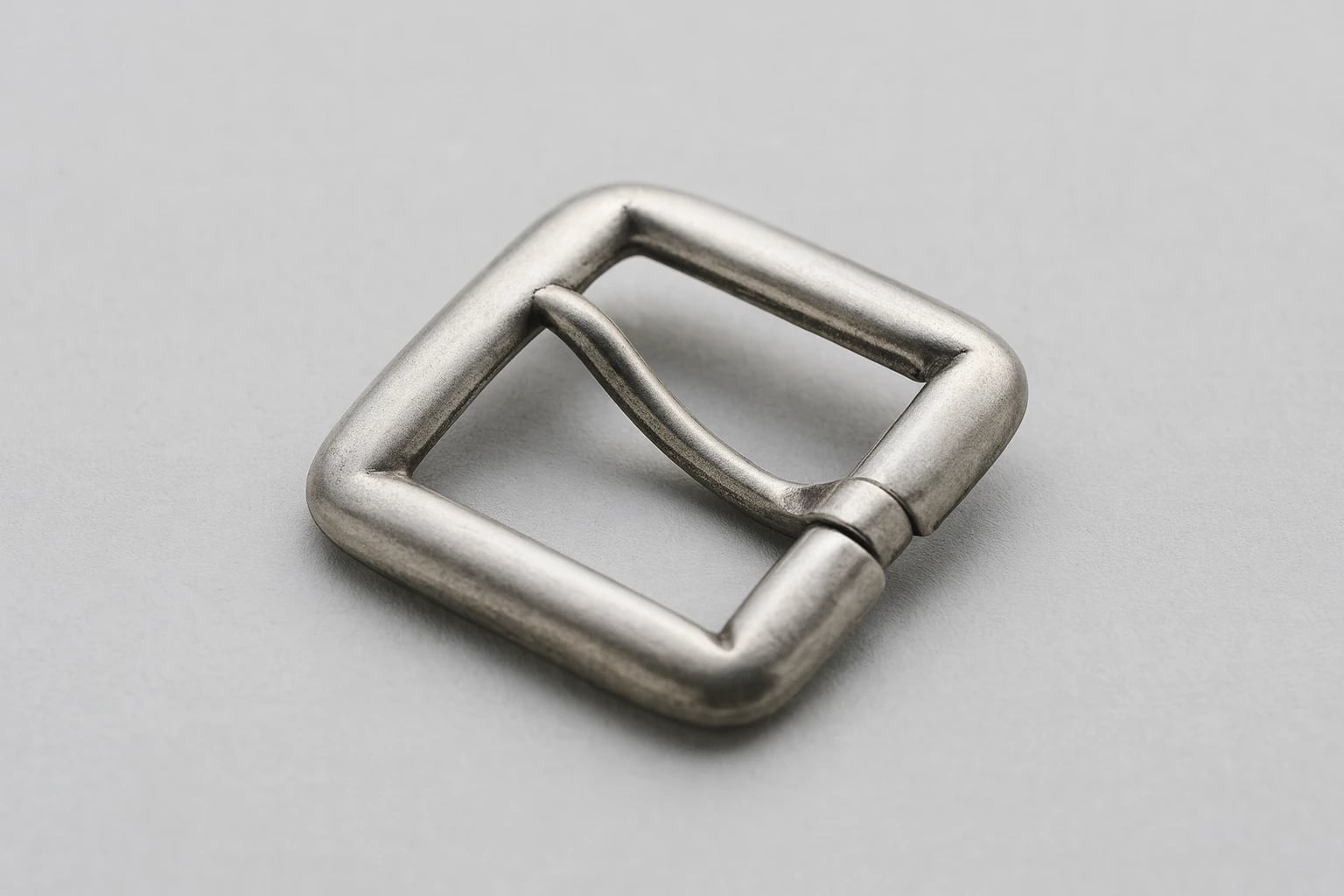
Square Silver Belt Buckle
First Design Period: 1931 - 1946
Silver