Saves instantly, no account needed. Already a member? Sign in.
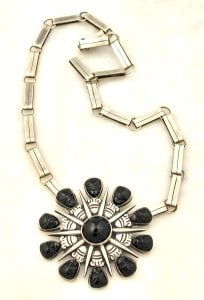
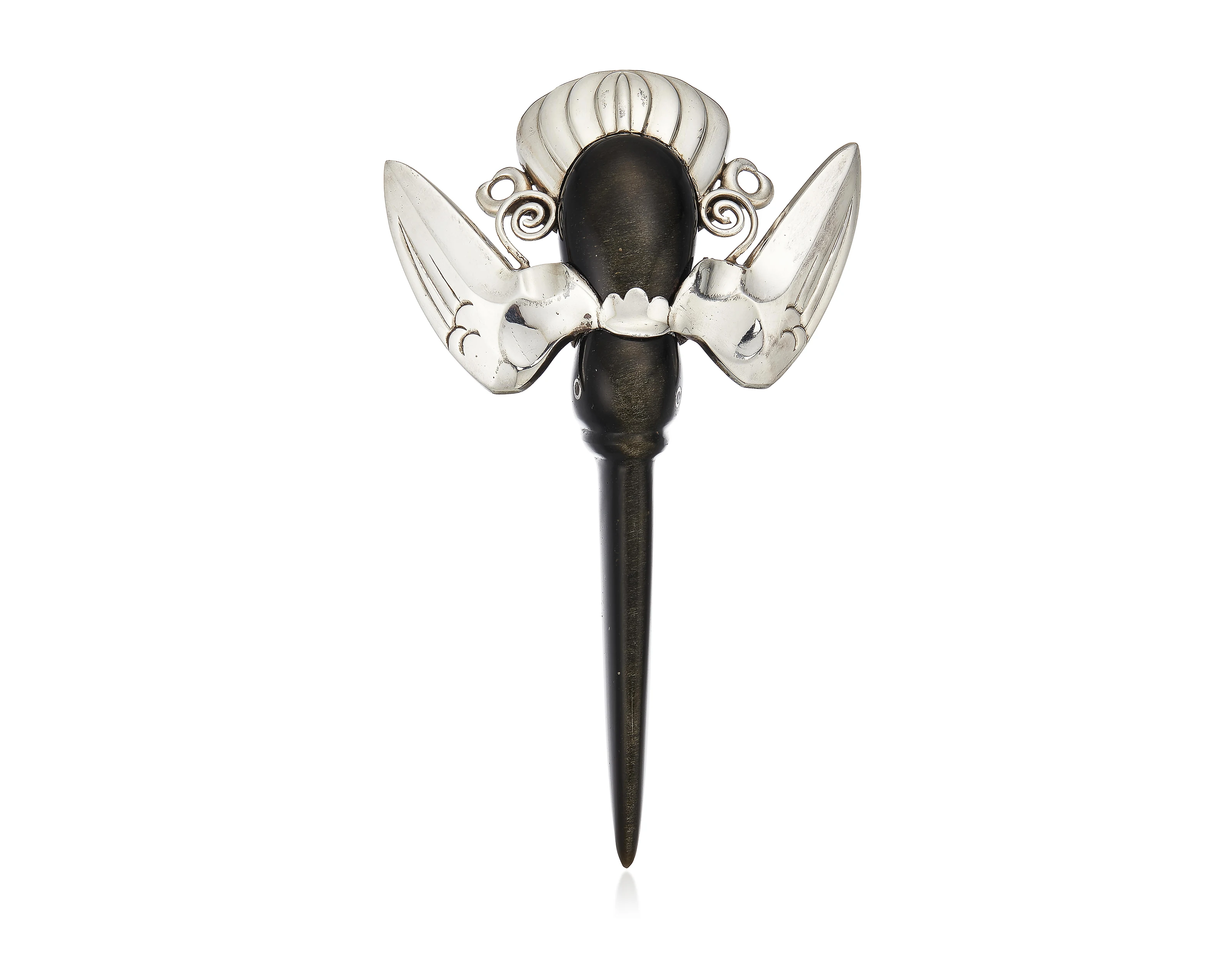
The pendant reduces a hummingbird to a compact silver body with a single wing and a beak that tapers toward a bloom, its central mass carved from obsidian. The stone is not an accent here but the creature itself, its volcanic black giving the bird weight and darkness while the silver frames and articulates it. Spratling built much of his reputation on animal subjects rendered as clean sculptural signs, and the hummingbird belongs to that current, translated into a form small enough to hang at the throat yet legible from a distance.
Obsidian carried particular meaning for Spratling, who drew steadily on ancient Mexican material culture in his silver. The stone was worked in central Mexico long before the colonial period, prized for the way it takes a mirror polish and holds a saturated black. In this pendant, the obsidian supplies the bird's rounded torso, the polished surface catching light against the matte and reflective passages of the surrounding silver. The contrast is structural rather than decorative: the silver reads as line and edge, the obsidian as solid mass. That division of labor between metal and stone recurs across Spratling's work, and the hummingbird demonstrates it at intimate scale, where the balance between a carved stone and its silver mount had to be resolved within a few centimeters.
The design earned recognition from the Banco de México before 1957, an award that places it within the period when Spratling's second wave of production had reestablished his standing after the difficult 1940s. Phyllis Goddard's field guide to Spratling silver records the design among his identifiable work, which helps distinguish it from the many later objects that borrow his manner. Recognition from a Mexican national institution is worth noting because it locates the pendant inside official postrevolutionary approval of Taxco silver as a national art, not simply a tourist commodity. Spratling worked within a workshop system in which he directed design while trained silversmiths executed the pieces, and a small carved and mounted pendant of this kind depended on that collaboration between his drawing and a maestro's hand at the bench.
Among Spratling's fauna, the birds and animals that survive in silver alone are more common than those built around a substantial carved stone, and the obsidian body gives this hummingbird a density that a hollow silver form would lack. For a collection, the pendant records how Spratling used a specifically Mexican stone to carry both the color and the volume of a design, joining his interest in ancient materials to the modern discipline of his line. It is a modest object that shows his method clearly: a familiar living subject pared to essentials, then given substance by the stone at its center.
Museum of Mexican Silver. “Obsidian Hummingbird Pendant Necklace.” Catalog no. MoMS-000681. https://museumofmexicansilver.com/pieces/spratling-3087
See something wrong with this record? Suggest a correction and the piece details fill in automatically.
William Spratling
Turquoise Aztec Sunburst Necklace
Silver