Saves instantly, no account needed. Already a member? Sign in.
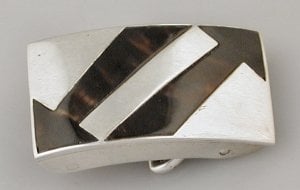
The tortoise-shell version of Spratling's two-arrow buckle pairs the dark, mottled shell against polished silver, a Third Design Period (1951 to 1967) object in which the contrast of materials is the whole point. The same model was also produced with azur-malachite arrows, so the two read as a matched pair of material experiments on one form.
The arrow motif came out of the prototype buckles Spratling worked up in connection with his Alaskan crafts project. He traveled to Alaska in 1945 at the request of the Arts and Crafts Board, and Alaskan smiths were trained in Taxco in 1949 (Morrill, Mexican Silver, 1994, pp. 28, 62), a sequence that left its mark on his buckle designs of the following decade.
Tortoise shell was a material Spratling returned to repeatedly in this period. Morrill describes his fondness for the "richness and textural contrast in the interplay of silver with tortoiseshell" in the 1950s work (Morrill, p. 73), and this buckle is a plain, direct statement of that idea, with the shell inlaid as two arrows against an otherwise unadorned silver field.
Because the design exists in both shell and azur-malachite, it gives a clear view of how Spratling treated a single form as a vehicle for different materials. Such paired variants are exactly what collectors and the standard field guides track when documenting his output.
Museum of Mexican Silver. “Tortoise Shell Arrow Buckle.” Catalog no. MoMS-000596. https://museumofmexicansilver.com/pieces/spratling-3093
See something wrong with this record? Suggest a correction and the piece details fill in automatically.
William Spratling
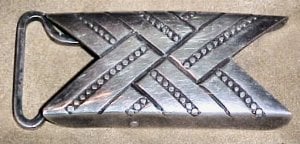
X Belt Buckle
First Design Period: 1931 - 1946
Silver