Saves instantly, no account needed. Already a member? Sign in.
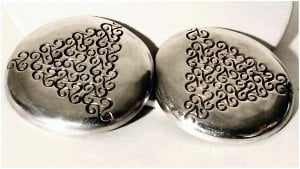
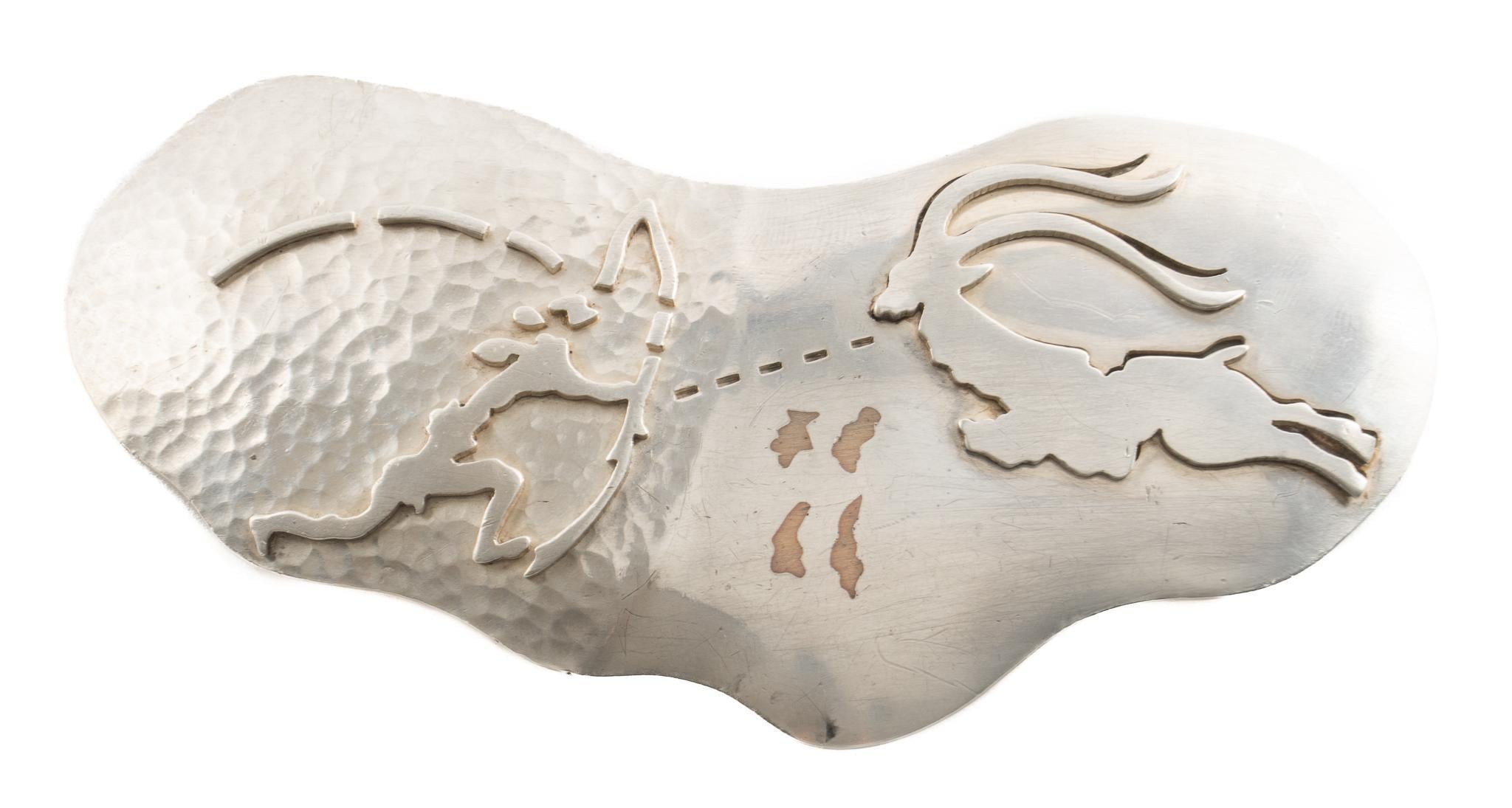
Discovered in the Dordogne in 1940, the Lascaux cave paintings entered postwar consciousness as a vivid confrontation with Paleolithic image-making; this sterling silver buckle places Antonio Pineda's workshop directly in dialogue with that discovery. Buckles appear rarely in Pineda's documented production, which runs heavily to bracelets, necklaces, and holloware, and an example whose motif reaches beyond Mesoamerican sources into the European Paleolithic occupies an unusual position in his body of work.
Gobi Stromberg, citing Morrill, identifies a "profusion of cultural influences" in Pineda's practice, describing his design work as a process of mining the past to build a vocabulary that remained distinctly his own. Stromberg also notes that Pineda trained under the Best Maugard drawing method, which sought universal visual laws in the motifs of ancient and regional craft — a foundation that may underlie his comfort reaching into imagery from the cave walls of southern France. Morrill observes, in her 1996 study, that Pineda consistently added texture and dimension to borrowed historical forms to yield "a sophisticated twentieth century interpretation."
Pineda established his taller on the Taxco zócalo in 1941, and Stromberg situates the full arc of his production between the 1930s and the 1970s. Examples that document his engagement with imagery outside the standard Mesoamerican repertoire help trace the full range of his visual thinking.
Museum of Mexican Silver. “Lascaux-Motif Buckle.” Catalog no. MoMS-000965. https://museumofmexicansilver.com/pieces/pineda-lascaux-motif-buckle
See something wrong with this record? Suggest a correction and the piece details fill in automatically.

Antonio Pineda
Arched Amethyst Teardrop Necklace
1953 or later
970 silver