Saves instantly, no account needed. Already a member? Sign in.
Guitar-form brooches represent a departure from the Aztec and colonial-revival subjects that anchored William Spratling's earliest output at the Taller de las Delicias. Spratling himself described those initial designs in 1955 as "almost literal copies of Aztec and Colonial motives" — a "point of departure," as he called them, for increasingly refined work. By the post-war decade, Morrill documents, the designs showed "greater refinement and strength," individual objects "pared down to their simplest outline." This guitar brooch belongs to that later register: a figurative subject, far from the pre-Columbian canon, handled with the economy that the mature workshop had mastered.
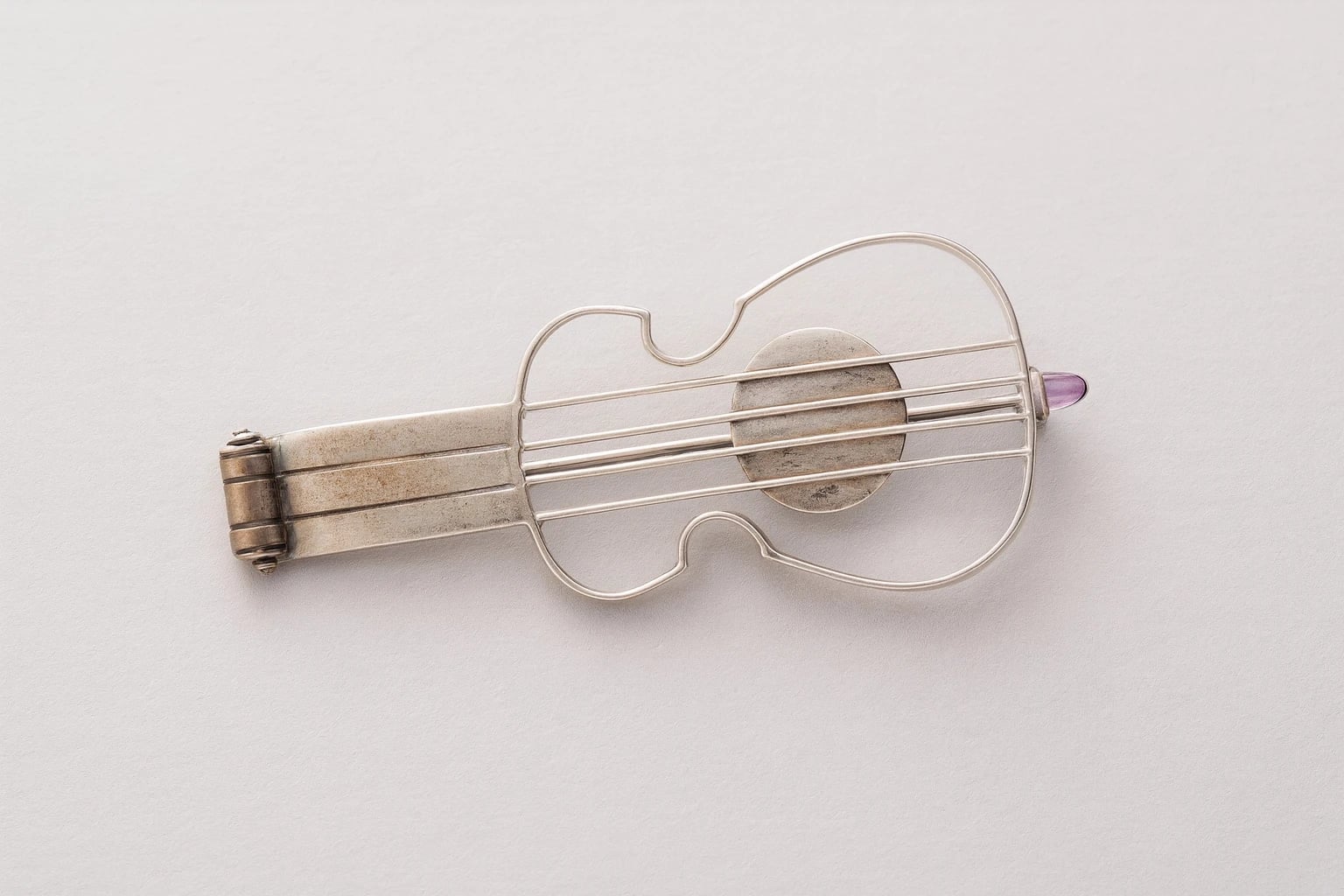
The brooch is constructed entirely in open silverwork. A continuous flat silver frame traces the guitar's hourglass silhouette, with f-holes carved into the outline at the upper and lower bouts; four fine parallel wire strings span a solid circular disk set at center to suggest the soundhole. A small pale amethyst cabochon is mounted at one terminal, the single note of color against warm silver. At roughly three and a half inches in length, the piece is scaled for presence without heaviness, the openwork construction holding its form while admitting light.
The William Spratling script mark appears alongside an eagle assay stamp — a Mexican government certification introduced in 1948 — placing this brooch in the post-war years of the taller. Stringed-instrument motifs are rarely encountered among Spratling brooches, and the combination of openwork draftsmanship with the amethyst accent reflects the range of subject matter the workshop produced alongside its better-known pre-Columbian modes.
Museum of Mexican Silver. “Amethyst Guitar Brooch.” Catalog no. MoMS-000850. https://museumofmexicansilver.com/pieces/spratling-3104
See something wrong with this record? Suggest a correction and the piece details fill in automatically.
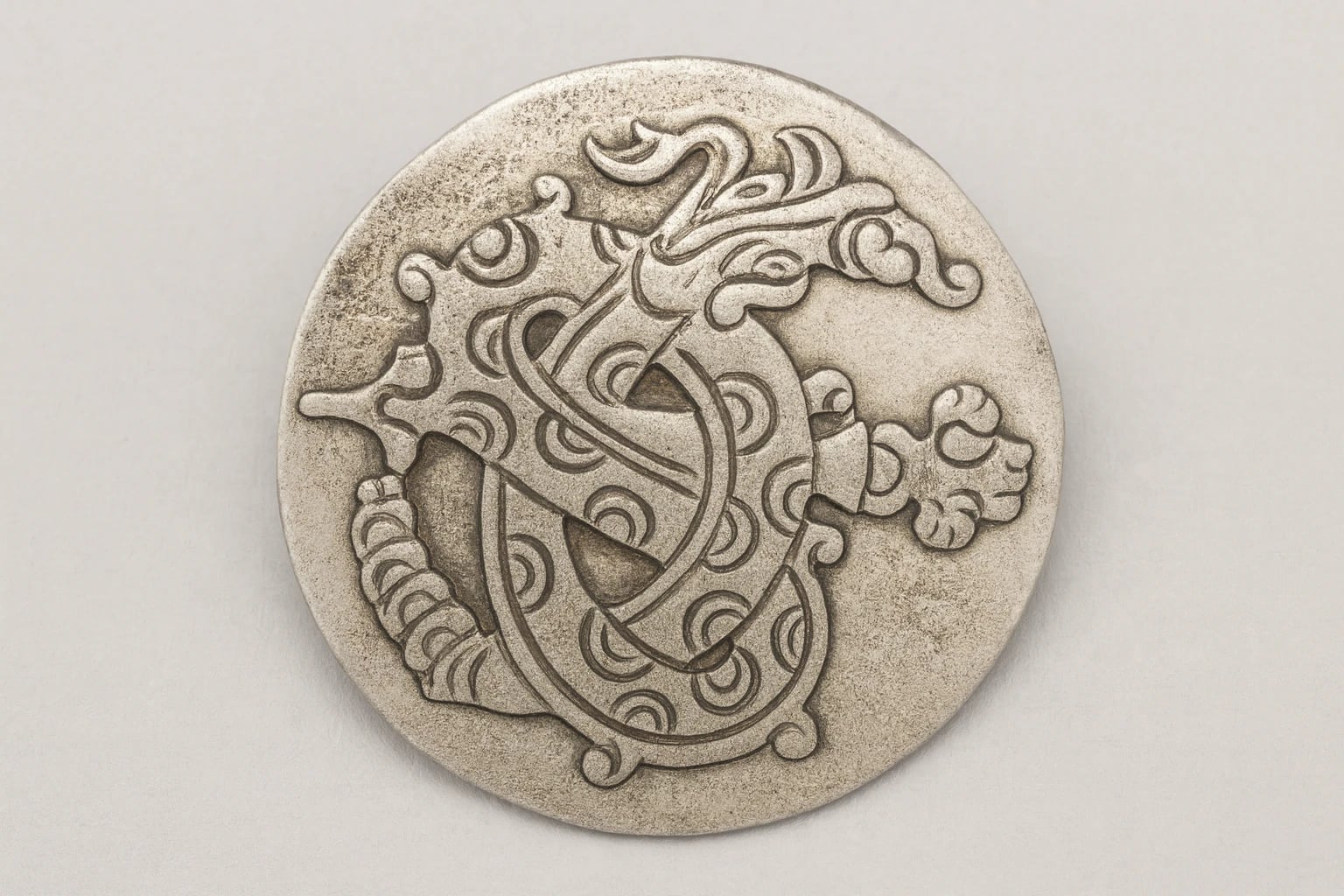
Silson Serpent Disc Brooch
Silver Plate