Saves instantly, no account needed. Already a member? Sign in.
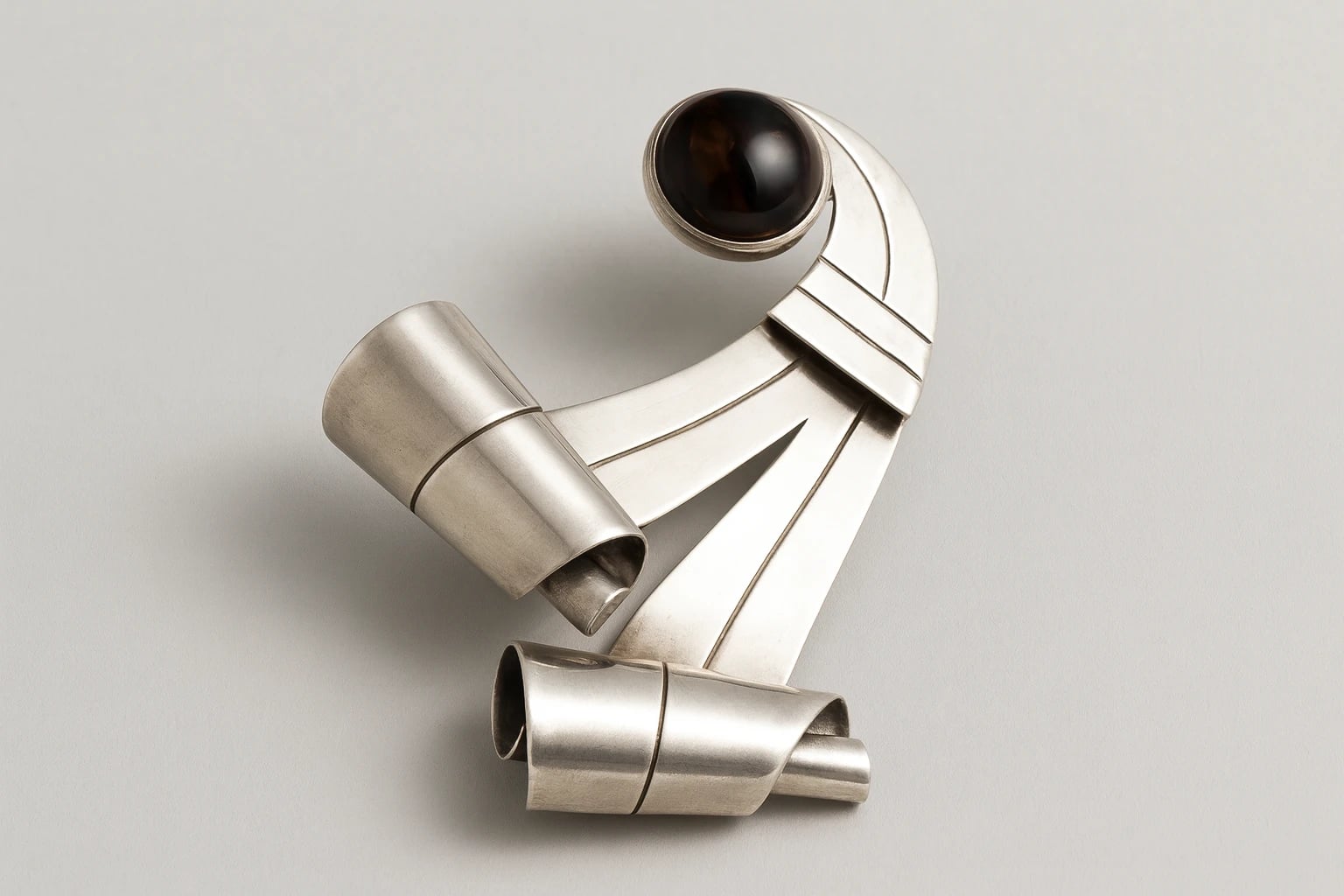
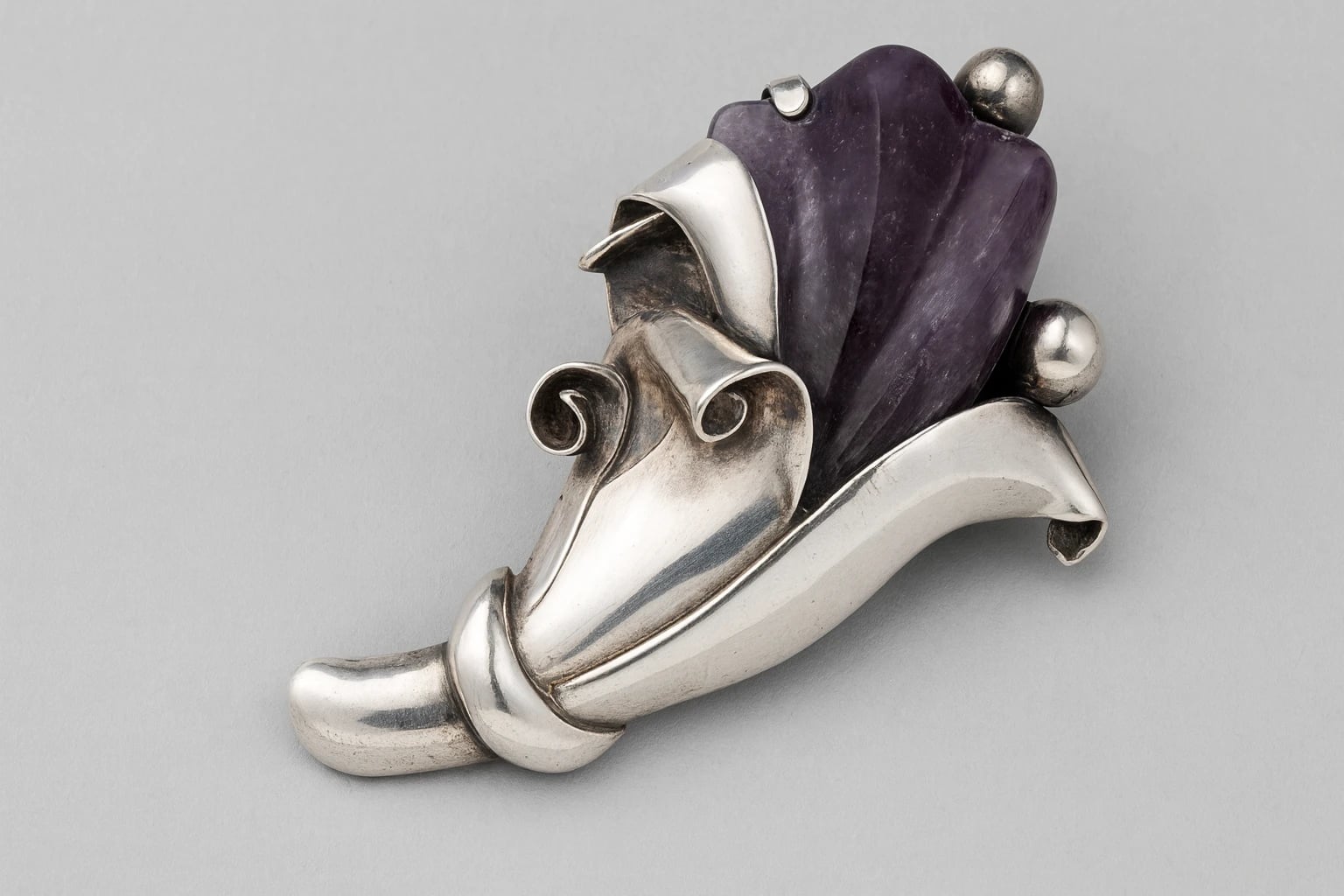
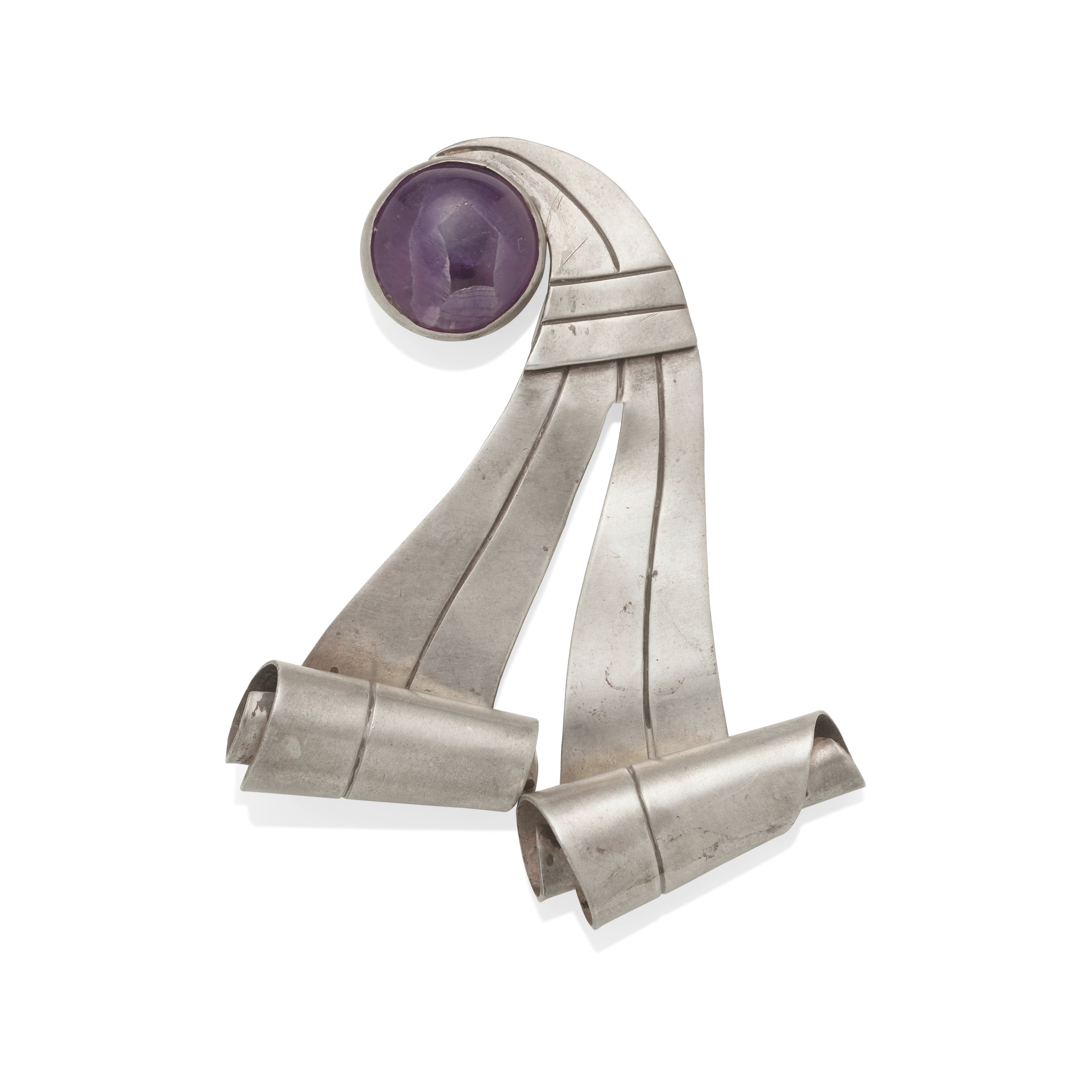
The broad silver ribbon of this brooch gathers into a tight volute, holding a round amethyst cabochon, then unspools downward in two curled terminals. Along its length, parallel incised channels give the flat metal the feel of gathered cloth — a textile gesture translated into heavy sterling. That move, softening the rigidity of metal through reference to supple material, marks this piece as a product of William Spratling's First Design Period, when his Taxco workshop, Las Delicias, was first defining the visual language of modern Mexican silver.
Spratling's approach to form in these early years drew on the Art Deco modernism circulating through the wider silversmithing world. Penny Morrill has noted the possible influence of the great Parisian silversmith Jean Puiforcat — who worked in Mexico between 1941 and 1945 — on how Spratling handled silver's sculptural potential. What Spratling made from those encounters was distinctly his own: architectural ribbon forms that hold their geometry without becoming stiff, and cabochon stones that anchor a composition rather than merely decorate it.
The swirl ribbon design appeared in several configurations — with a copper circle, gold circle, green stone, agate, or, as here, amethyst — and an adaptation served as earrings, a sign of how thoroughly the workshop extended a successful form. Morrill, who first came to Spratling's work through a chunky amethyst-set piece discovered in a London shop in the 1980s, found in those designs a quality she described as timeless — as contemporary then as they had been when made.
Museum of Mexican Silver. “Swirl Ribbon Brooch with Copper Circle.” Catalog no. MoMS-000469. https://museumofmexicansilver.com/pieces/spratling-321
See something wrong with this record? Suggest a correction and the piece details fill in automatically.
William Spratling
Tortoise Shell Fish Brooch
Silver