Saves instantly, no account needed. Already a member? Sign in.
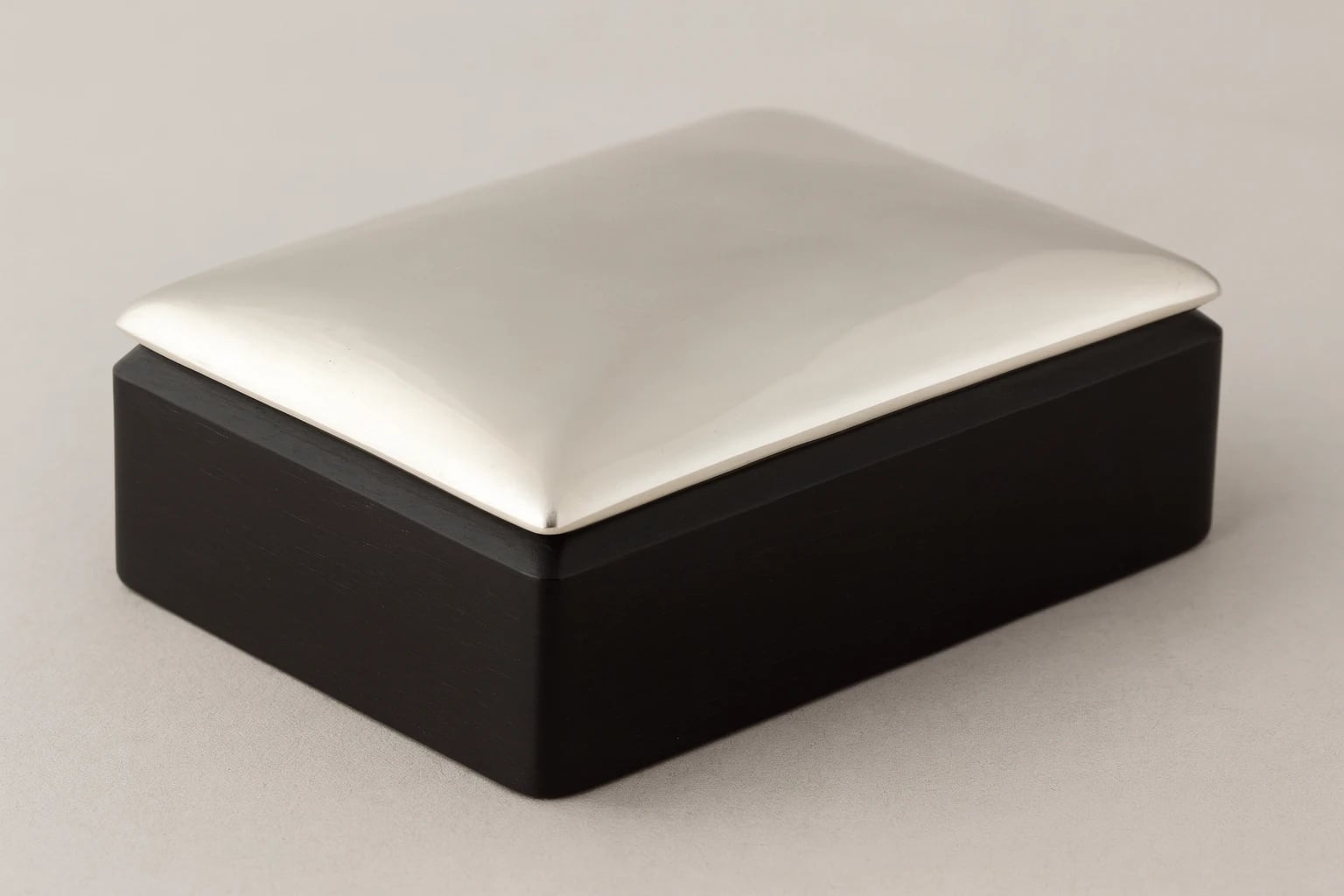
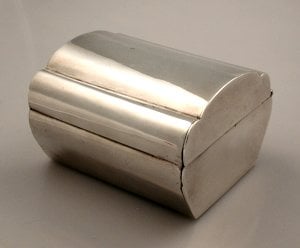
The scalloped lid gives this box its character. Its curved silver surface swells like a cushion, the edges gathered into rounded lobes that soften what could have been a plain rectangular container. Spratling worked the top so that the eye reads volume before it reads geometry, an effect closer to a stuffed pillow than to a lid of sheet silver. This is a domestic object handled at close range, and the pillow form rewards that intimacy: the play of light across its rounded scallops changes as the box is turned in the hand.
The construction organizes the piece around the contrast between the quiet base and the animated top. The lower body holds a simple rectangular geometry, providing a stable foundation that lets the lid do the expressive work. A hinge joins the two, allowing the lid to lift while keeping the closed silhouette taut. The scalloping along the perimeter breaks the hard line where a box lid would ordinarily meet its base, and the resulting soft edge draws the fingers as much as the eye. Silver serves the design not as display of monetary weight but as a reflective, malleable surface that can be coaxed into swelling curves and made to catch light along each lobe.
The box belongs to Spratling's first design period, the years between the 1931 founding of the Taller de Las Delicias and 1946, when he was reorganizing production and developing a vocabulary that would shape the wider Taxco School. Silversmiths in his workshop used the language of their craft with precision, distinguishing techniques such as calar, cutting or piercing silver to create a design, and cincelar, marking the surface with a hammered tool. A pillow lid depends on shaping and finishing the metal into rounded volume, closer to raising and forming than to piercing. Spratling directed a taller in which designers worked alongside master smiths who translated a design into a finished object, and a box like this one reflects that collaboration between conception and skilled hand execution rather than the labor of a single solitary maker.
Hollowware occupies a smaller share of Spratling's surviving output than his jewelry, and a box that treats its lid as a soft sculptural form shows how his sense of design carried into functional silver for the home. The piece records a moment in the Taxco renaissance when a workshop could take an ordinary container and make its most utilitarian element, the lid, the site of invention. It preserves, in a modest domestic object, the material intelligence and formal wit that ran through Spratling's first period and helped establish the standards later designers of the Taxco School would build upon.
Museum of Mexican Silver. “Box with Hinged Scalloped "Pillow" LID.” Catalog no. MoMS-000033. https://museumofmexicansilver.com/pieces/spratling-56
See something wrong with this record? Suggest a correction and the piece details fill in automatically.
William Spratling
Silver Casket Box
First Design Period: 1931 - 1946
Silver