Saves instantly, no account needed. Already a member? Sign in.
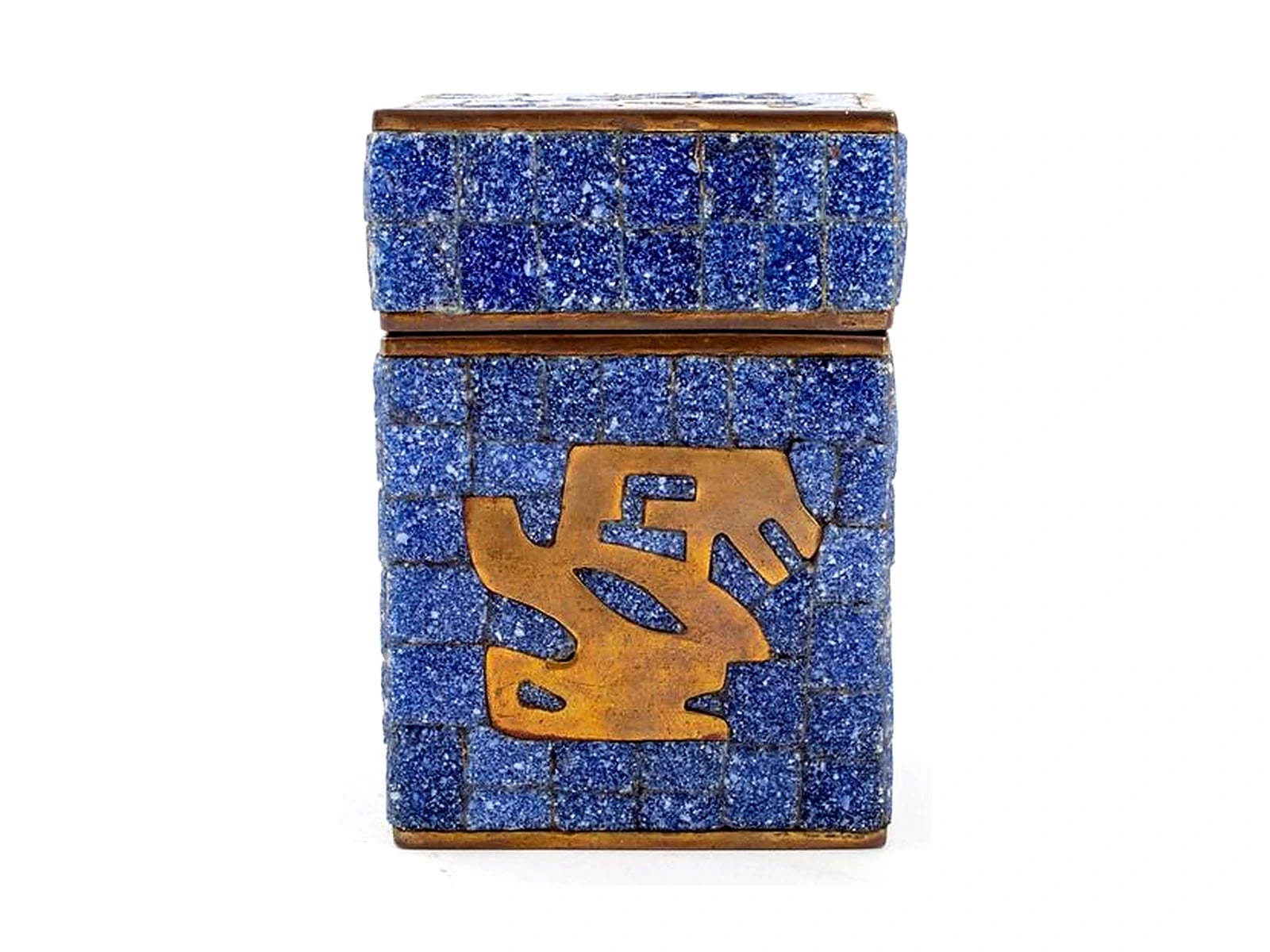
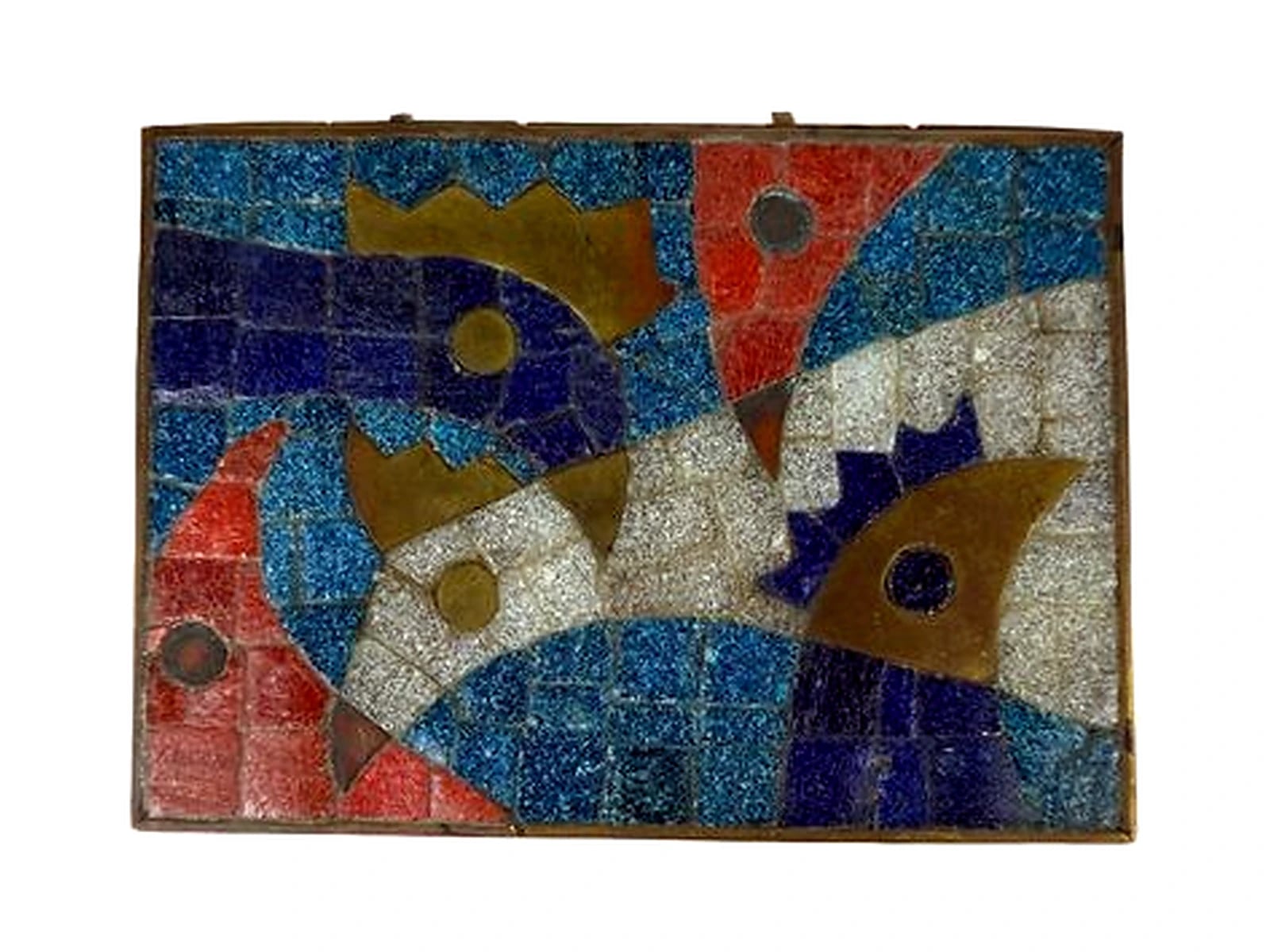
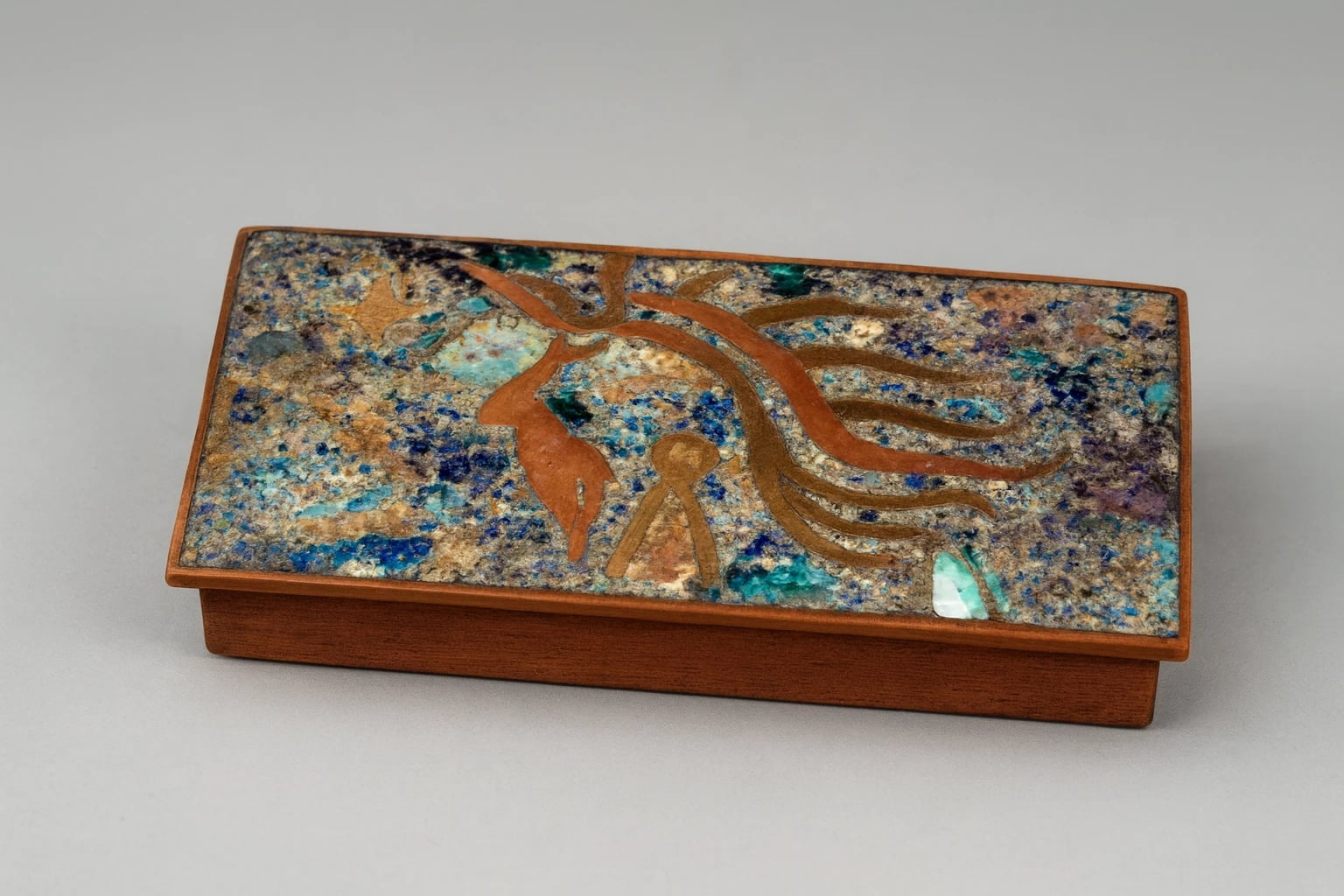
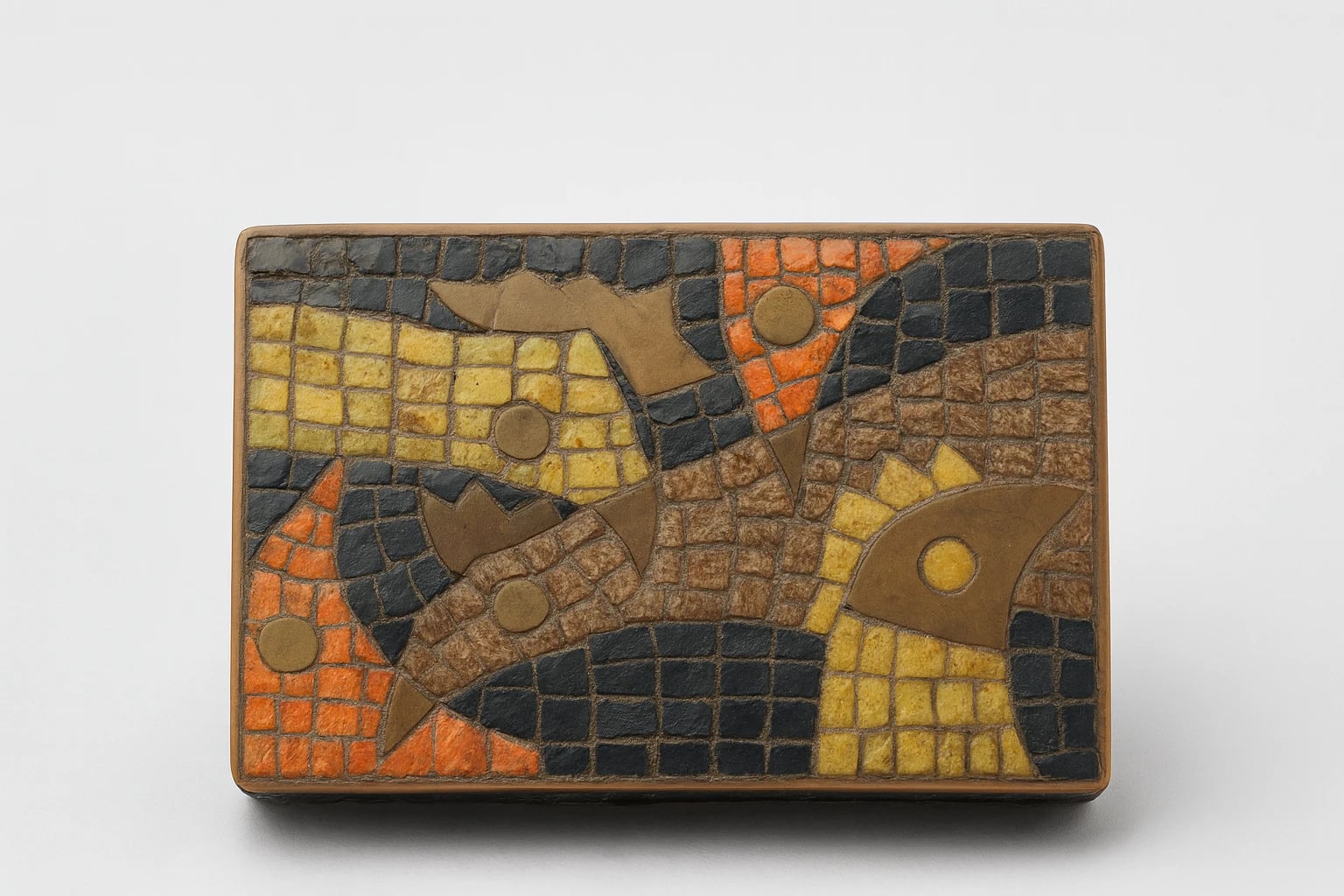
A rooster assembled from cut glass tesserae spreads across the lid of this brass box, its body a mosaic of colored fragments set into a plain metal ground. The chicken is not incised or repoussé but built, tile by tile, from pieces of glass whose irregular edges and shifting color catch light differently across the surface. Salvador Terán treated the box itself as neutral territory: a simple hinged brass form that exists to hold and frame the mosaic. The result gives a humble domestic object the deliberate composition of a small panel painting, with the farmyard bird recast as a subject worthy of careful chromatic arrangement.
The design depends on a controlled contrast between two materials that behave in opposite ways. Brass is continuous, warm, and reflective, reading as a single unbroken plane wherever the mosaic does not cover it. The glass is fractured, opaque or semi-opaque in patches, and matte where the metal is bright. Terán exploited that difference by letting the rooster's silhouette sit as an island of texture and color within an otherwise quiet expanse. The tesserae are individually small, so the eye reconstructs the bird from an aggregate of pieces rather than reading a drawn outline, a technique closer to true mosaic than to inlay. The box's brass mark records this as handwrought work in Mexico, and the surface bears out a maker thinking about how fragments of glass could carry an image at the scale of the hand.
Terán came to this medium after a long formation in silver. He left William Spratling's Taller de Las Delicias in 1939 to help his cousins found Los Castillo, where he was responsible for many early designs before establishing his own taller in Mexico City in 1952. His silverwork is known for overlapping planes that suggest three dimensions, but in glass mosaic he pursued a different problem, using the plain form of a pitcher, tray, or box as a background for color and texture, as Morrill describes in Silver Masters of Mexico. The rooster belongs to a recurring habit in his output, the abstract or stylized interpretation of Mexican cultural subjects, here a common bird of Mexican rural life given the dignity of considered ornament. Hougart records his brass mark, "HANDWROUGHT Salvador HECHO EN MEXICO," in use across roughly 1952 to 1970, which places this box within the working life of his independent Mexico City shop rather than his Los Castillo years.
The box matters as evidence that Terán's ambitions extended well beyond the silver bench that made his name. It documents the moment when a designer trained in the Taxco renaissance turned to brass and glass to make color, rather than the reflectivity of precious metal, the central event of an object. Hougart notes that Terán's designs, often abstract readings of Mexican icons, are highly prized, and the mosaic pieces show why: they carry his sensibility for composition into an inexpensive, unpretentious medium without losing rigor. For a collection tracing the full range of the Mexican silver renaissance, this box records the parallel current of mosaic and mixed metal that ran alongside the more famous jewelry and hollowware, and it shows a Taxco-trained hand insisting that a barnyard rooster could be a modern design subject.
Museum of Mexican Silver. “Chicken Motif Mosaic Brass Box.” Catalog no. MoMS-001545. https://museumofmexicansilver.com/pieces/teran-box-chicken-motif
See something wrong with this record? Suggest a correction and the piece details fill in automatically.
Salvador Terán
Rooster Mosaic Brass Box
1952-1974
Brass