Saves instantly, no account needed. Already a member? Sign in.
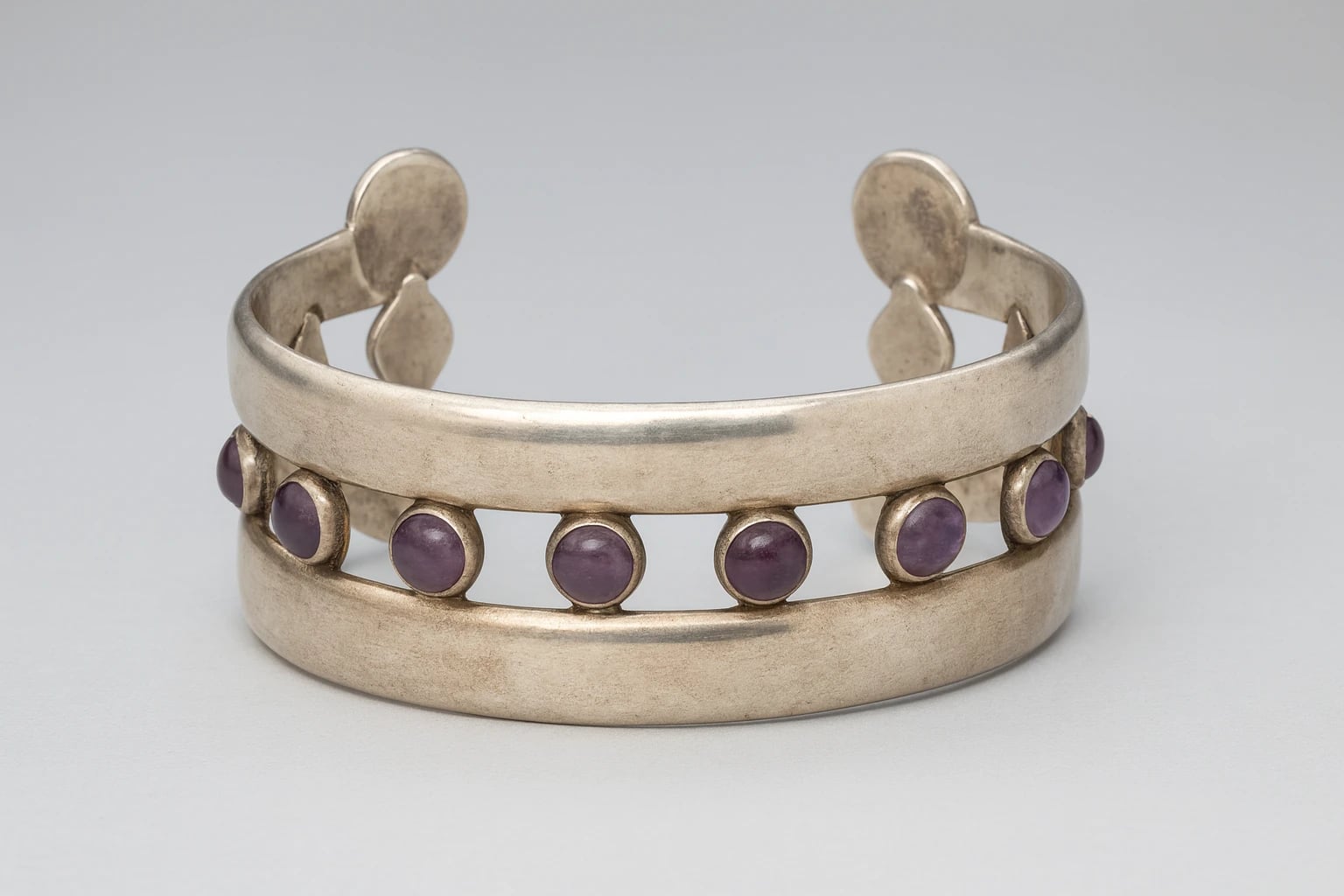
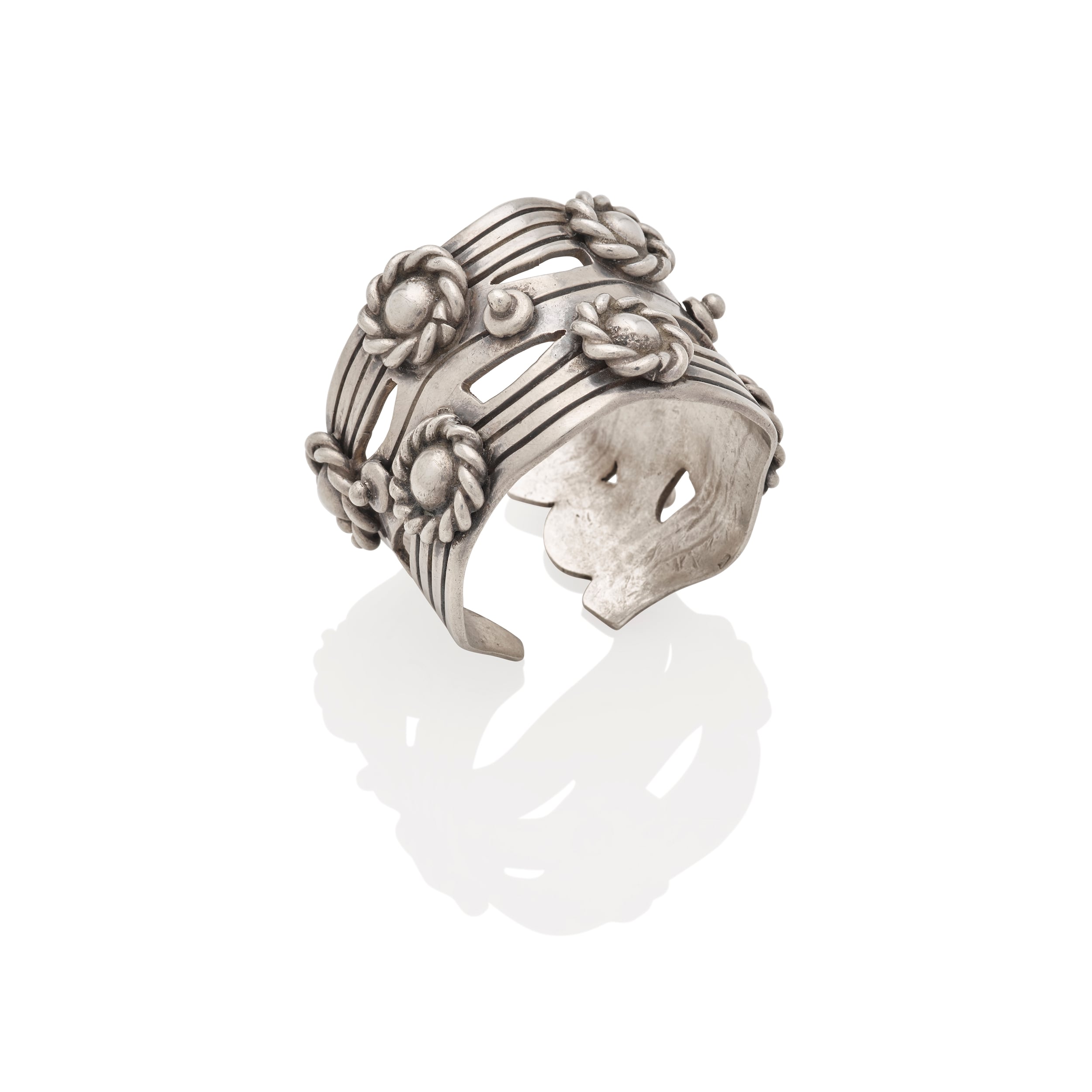
The heavy silver cuff builds its entire effect from a single rhythmic idea: a row of framed round buttons marching across the wrist, each disk raised and set within a border so that light catches the domes while the recessed grounds hold shadow. Spratling described the design as a wide Aztec bracelet with framed buttons, and the phrase captures its ambition. This is ornament conceived as architecture, a band of repeated masses given weight and cadence rather than delicacy. Among Spratling's earliest designs, it was one of his most sought after in the 1930s and into the mid 1940s, and the reasons are legible in the object itself.
The vocabulary here belongs to Spratling's first design period, when he was assembling a modern idiom from simple, forceful elements. Silver balls and beads, twisted rope trim, and heavy incised carving are the whole of the design, and their power comes from repetition and mass rather than from any single flourish. The framed buttons read as a colonnade in miniature, while the beaded and roped borders keep the eye traveling along the length of the cuff. The carved lines, cut with a cincel, the engraving chisel that Mexican silversmiths used to mark the surface with controlled hammer blows, break the reflectivity of the silver into deliberate passages of light and dark. Nothing is applied for prettiness. The bracelet asserts itself through the frank display of solid material, the tactile insistence of raised domes under the fingers, and the substantial presence it brings to the wrist.
Spratling's decision to name the design Aztec is worth taking seriously, because it points to the source he was mining rather than to a vague antiquity. His first period at the Taller de Las Delicias, founded in 1931, developed a modern language by looking hard at ancient Mexican form, translating the density and frontal authority of indigenous ornament into wearable geometry. That project was central to the postrevolutionary cultural moment, when Mexico's Pre-Columbian heritage was being reclaimed as the foundation of a national modernism. The framed button, a raised disk held within a border, distills that impulse into a repeatable module. Spratling stopped producing this design after 1946, and its influence outlived his own workshop: the heavy-gauge, boldly massed manner it helped establish echoes through the work of smiths who trained with him, including Francisco Rivera, whose reputation rested on bold designs in heavy silver.
Spratling withdrew the design from production after 1946, yet others continued to copy it for decades, a backhanded measure of how thoroughly it entered the visual memory of Taxco silver. That afterlife makes an authentic first-period example the more valuable as a document, because it shows the idea in its original weight and finish before imitation diluted it. For a collection tracing the Mexican silver renaissance, the cuff records the moment when Spratling was defining what heavy silver could be: not filigree, not colonial revival, but a modern ornament built from mass, rhythm, and an unembarrassed love of the metal.
Museum of Mexican Silver. “Large River of Life Cuff Bracelet.” Catalog no. MoMS-000050. https://museumofmexicansilver.com/pieces/spratling-67
See something wrong with this record? Suggest a correction and the piece details fill in automatically.
William Spratling
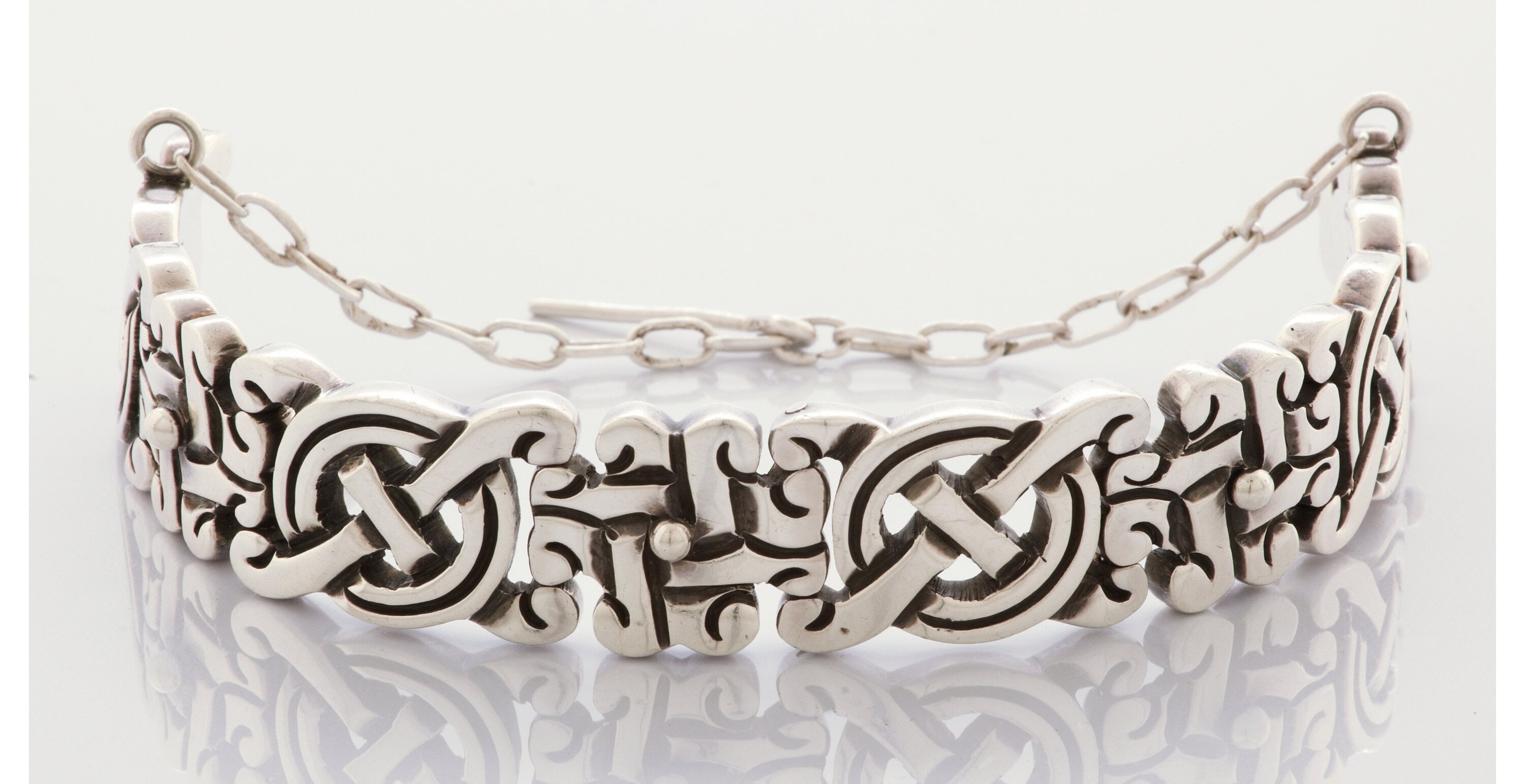
Celtic Cross Bracelet
First Design Period: 1931 - 1946
Silver