Saves instantly, no account needed. Already a member? Sign in.
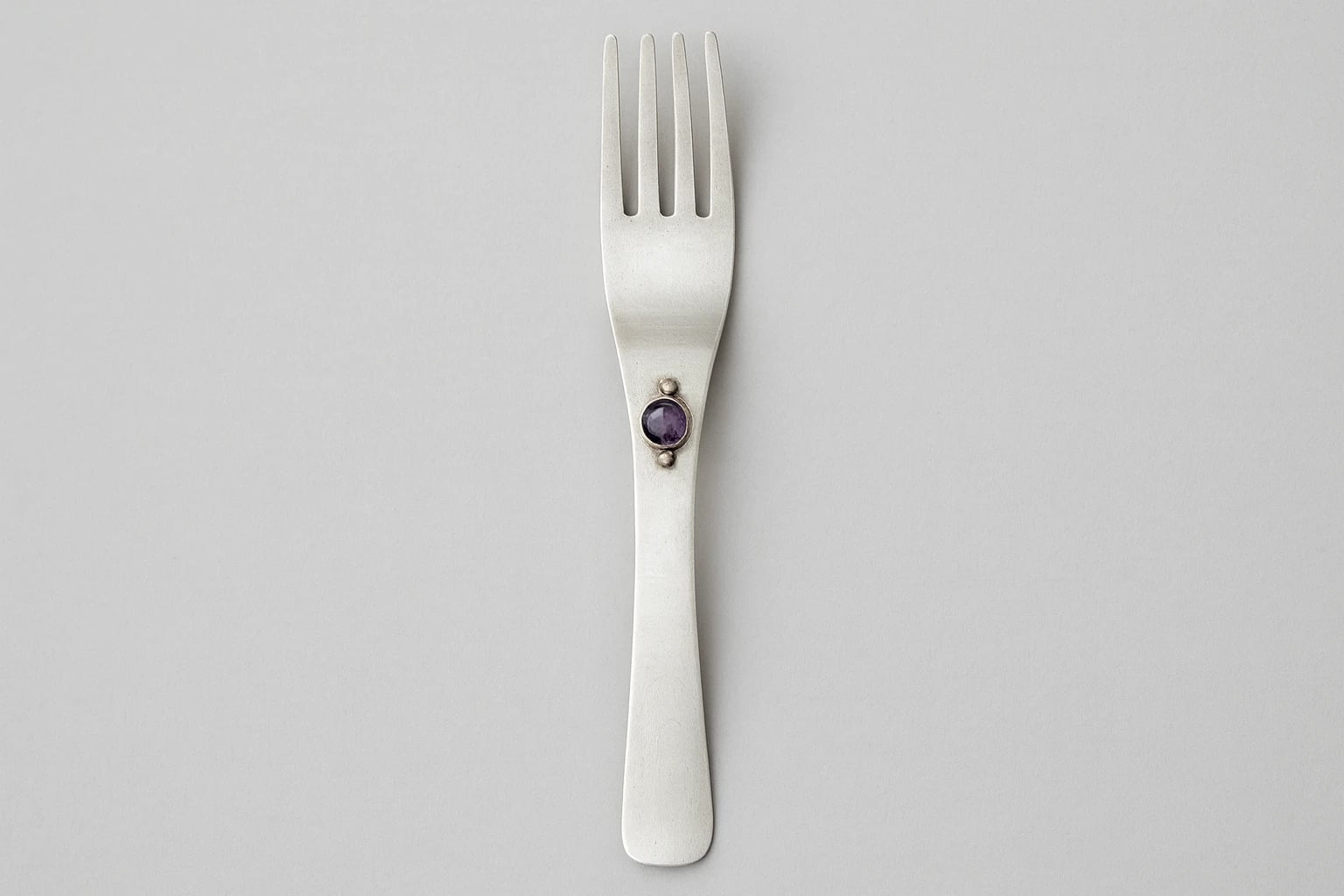
A dinner fork that carries a single amethyst reframes what flatware was expected to do. Utility silver of the early twentieth century usually earned its ornament through pattern alone, engraved borders or die-struck motifs pressed into the handle. Here the handle instead receives a purple stone as a deliberate incident, a point of color set into an object meant to be handled, turned, and used at the table. The result is that a functional fork asserts the same design ambition Spratling brought to his jewelry: that Mexican silver, even at its most domestic, should be conceived by a designer rather than merely reproduced from a catalog.
The amethyst does specific work. Silver at the table is defined by reflection, by the way a fork catches candlelight and the surfaces around it, and against that mobile brightness the amethyst holds a fixed, saturated color that the metal cannot produce on its own. Amethyst is a Mexican stone, quarried within the country, and its inclusion ties this flatware to local material rather than to imported gems or applied enamel. The stone is inset into each piece of the pattern, so that a full four-piece place setting, the form in which this design was produced, repeats the same purple accent across knife, fork, and companions. Repetition at the place setting becomes a compositional idea, the color returning at intervals down the length of a laid table.
Spratling designed this during his first period, the years between founding the Taller de Las Delicias in 1931 and 1946, when he was building both a design language and the workshop system that could execute it. Penny Morrill's study of his work records this pattern among the objects of that era. The flatware belongs to a broader ambition visible across the Taxco renaissance, the conviction among designers such as Spratling, Héctor Aguilar, and Antonio Pineda that silver hollowware and tableware deserved the same authorship as sculpture or jewelry. A stone-set place setting depended on the taller structure that made Taxco distinctive, a designer directing the concept while master smiths handled the fabrication and stone setting that domestic flatware of this kind required.
For a collection tracing the silver renaissance, a stone-inset fork documents the movement's reach into the everyday. Spratling's jewelry and decorative objects are the works most often exhibited, yet flatware is where design met daily use most directly, and where the decision to inset an amethyst rather than engrave a border reveals a designer thinking about color, material origin, and the rhythm of a set table. The piece extends the record of what the Taxco School attempted, showing that its modernism was carried by a dinner fork as surely as by a bracelet.
Museum of Mexican Silver. “Amethyst Fork.” Catalog no. MoMS-000375. https://museumofmexicansilver.com/pieces/spratling-724
See something wrong with this record? Suggest a correction and the piece details fill in automatically.
Ebony