Saves instantly, no account needed. Already a member? Sign in.
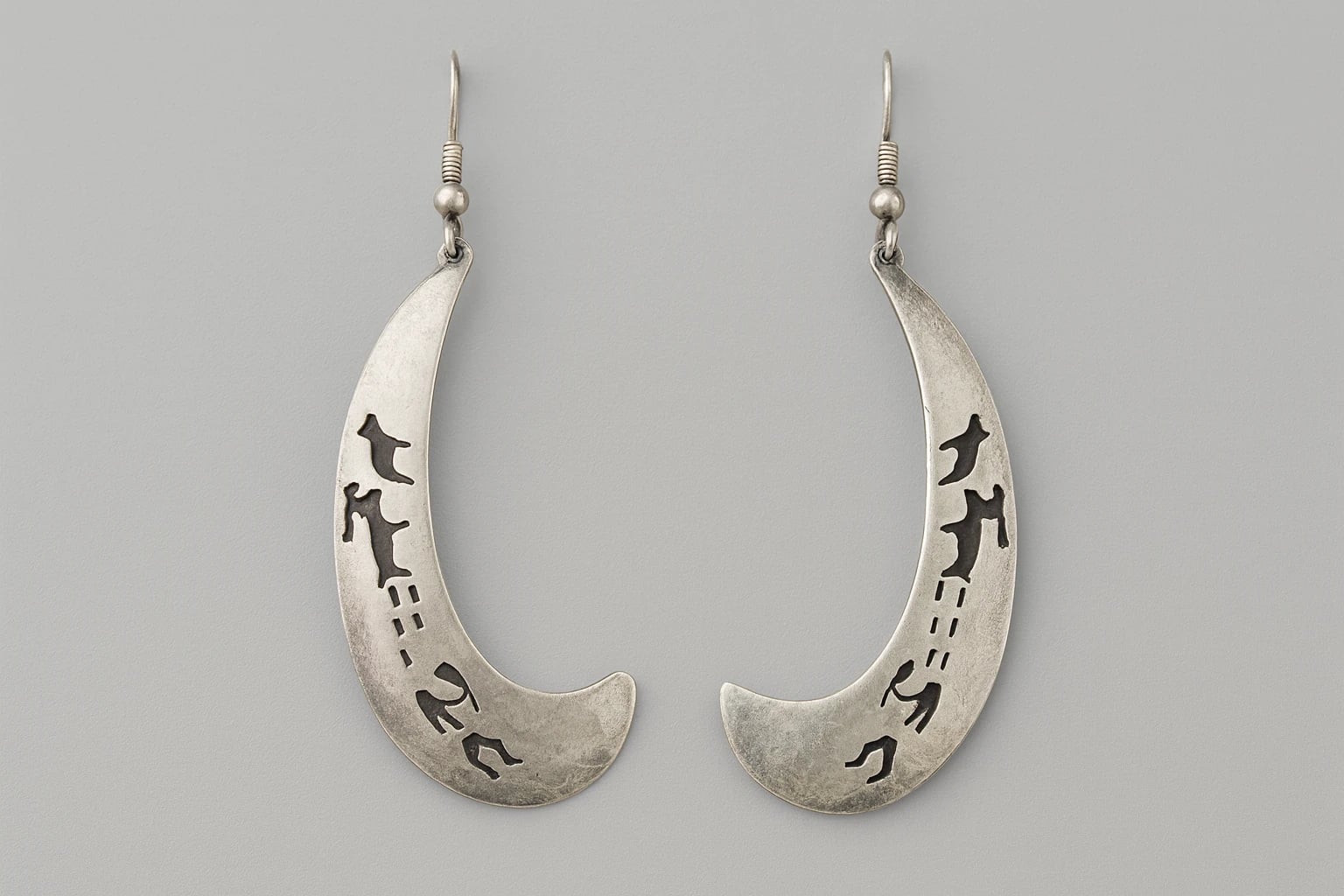
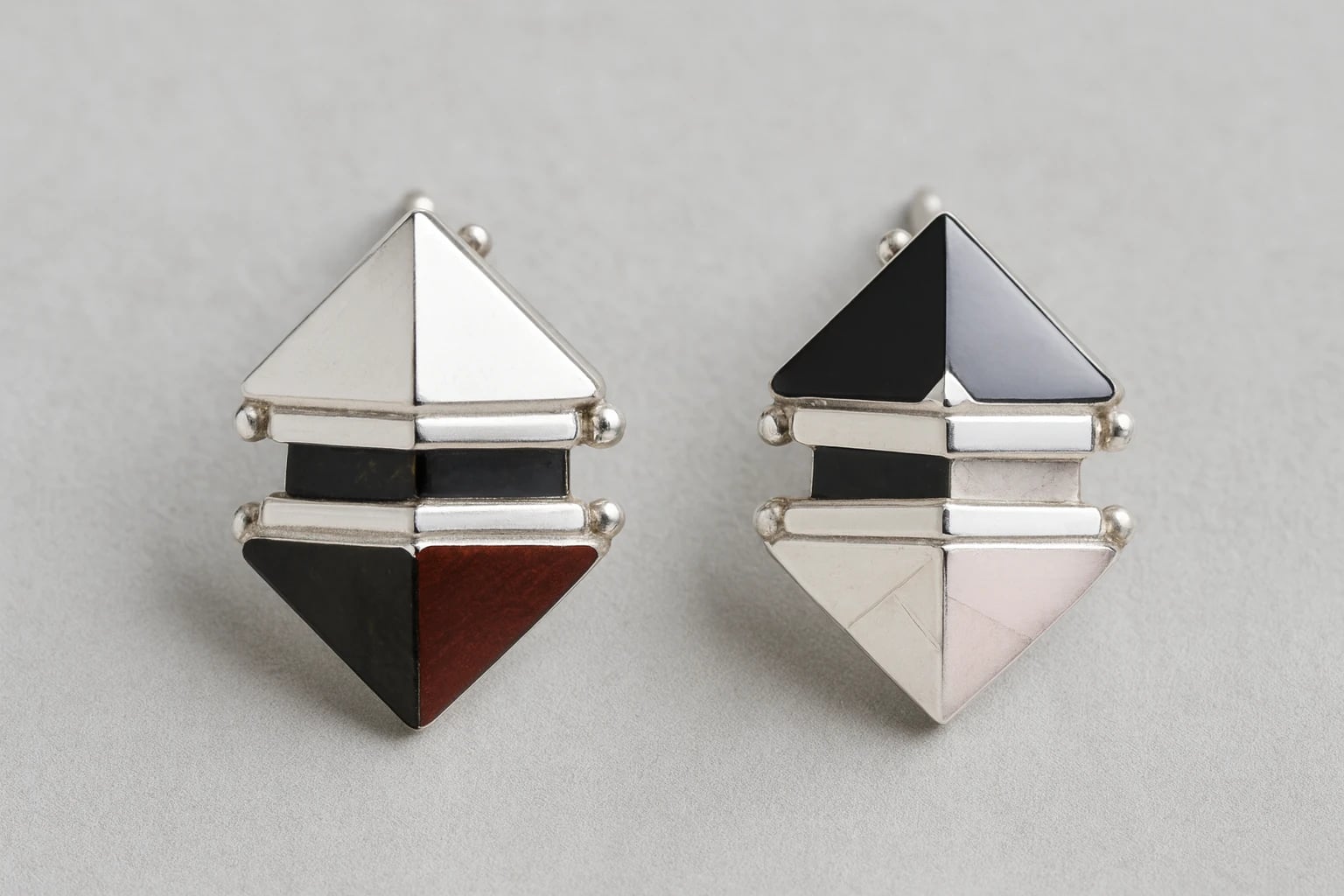
An arrow rendered twice and set in motion: each earring pairs a slim silver shaft with a blade of black obsidian, and the doubling of the motif turns a single directional sign into a small kinetic composition that reads clearly against the neck. The design belongs to the family of arrow and arrowhead forms that Spratling worked repeatedly, and its discipline is characteristic of him. Nothing is added for decoration. The meaning of the object lies in the contrast between the reflective metal and the light-swallowing stone, and in the way two identical elements are arranged to imply movement rather than describe it.
Obsidian carries particular weight in Spratling's material vocabulary. A volcanic glass long worked in central Mexico for blades and mirrors, it holds a dense, near-absolute black that silver cannot approach, and here the two materials divide the labor of the design. The silver reflects and defines edge and line. The obsidian absorbs, giving each arrowhead a depth that flattens into pure shape. That opposition is the whole event of the earring. Because the motif is paired, the eye reads the two arrows as a sequence, and the composition acquires a directional pulse that a single arrow would lack. Spratling extended the same idea across object types, producing cufflinks in this same double arrow design, which tells us he treated the motif as a resolved unit adaptable to different formats rather than a one-time solution.
Spratling described his early Taxco work as departing from Aztec and colonial motifs, sawing pre-Columbian seal designs out of heavy silver sheet as a starting point. By the 1940s, as Morrill records, his approach had shifted toward simpler form and an emphasis on surface and line, and he absorbed the arrowhead and mask forms he encountered through Alaskan art, applying them with deliberate reduction. The double arrow sits within that later, pared vocabulary, where a legible sign is stated without ornament and allowed to carry the design on its own. The pairing of silver with a hard, opaque native stone follows the same logic that governed his combinations of silver with tortoiseshell, wood, and other materials chosen for the strength of their contrast. Spratling's workshop was a taller in which designs were translated into production by skilled smiths under his direction, and the clarity of the arrow form, easy to cut, polish, and set, reflects a design conceived for that system.
For a collection tracing the Mexican silver renaissance, the earrings document how Spratling built a modern ornamental language from reduction rather than elaboration. They show a Mexican material with deep local history, obsidian, integrated into a spare geometric idea, and they preserve a motif that migrated across his production from jewelry to cufflinks. The object records a designer choosing restraint as a positive value, letting one form and one sharp material contrast do all the work, at the scale of something worn at the ear.
Museum of Mexican Silver. “Double Arrow Earrings.” Catalog no. MoMS-000766. https://museumofmexicansilver.com/pieces/spratling-768
See something wrong with this record? Suggest a correction and the piece details fill in automatically.
Silver