Saves instantly, no account needed. Already a member? Sign in.
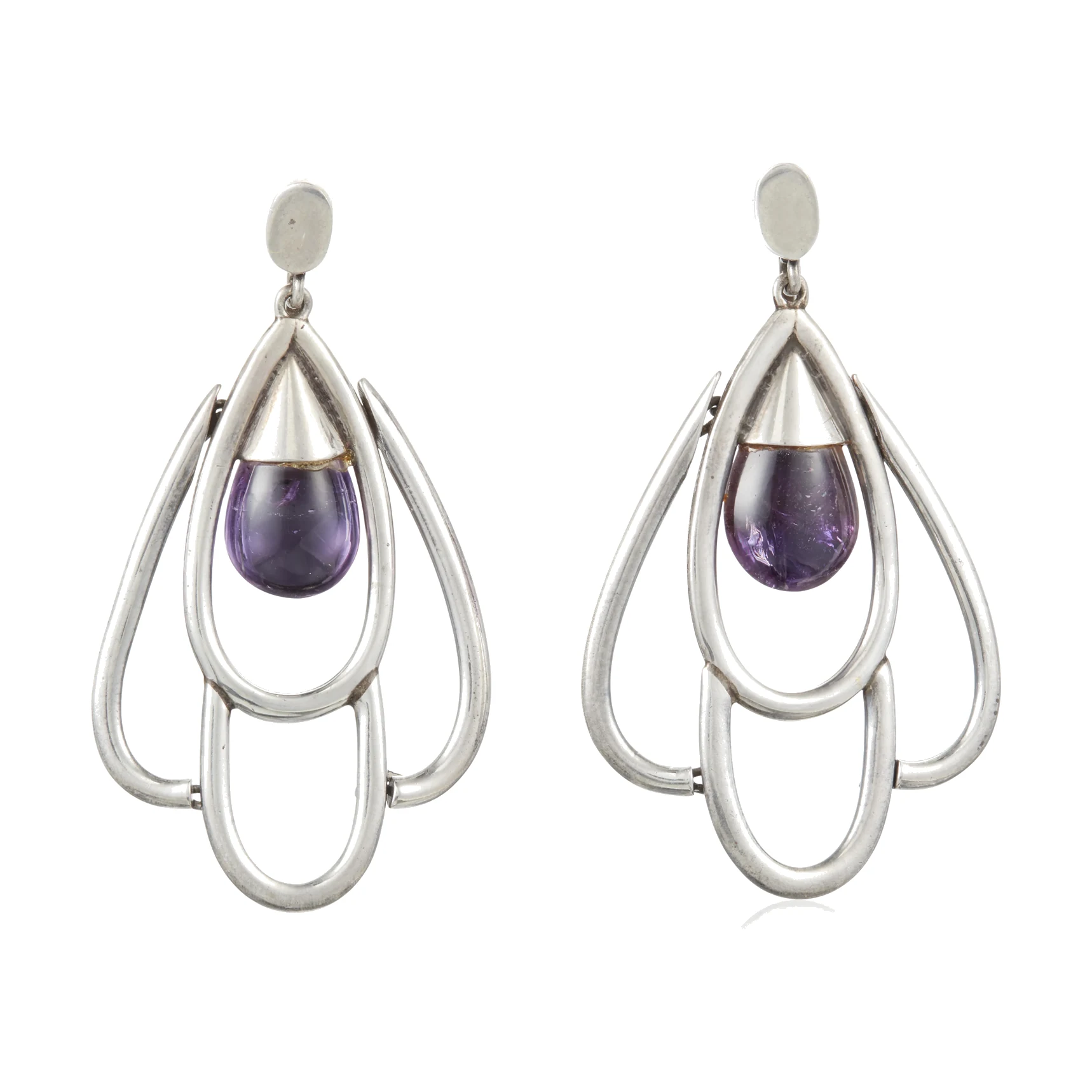
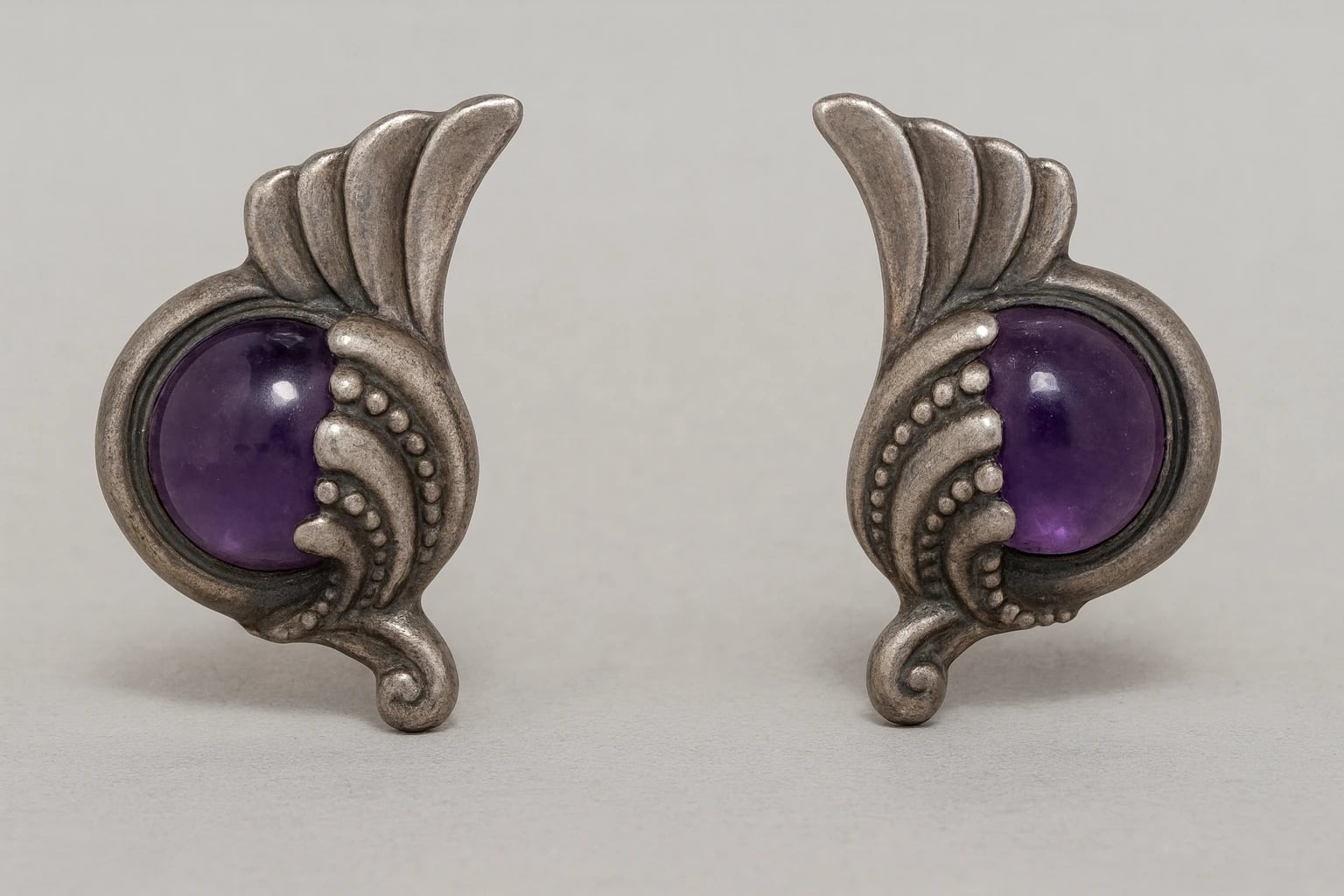
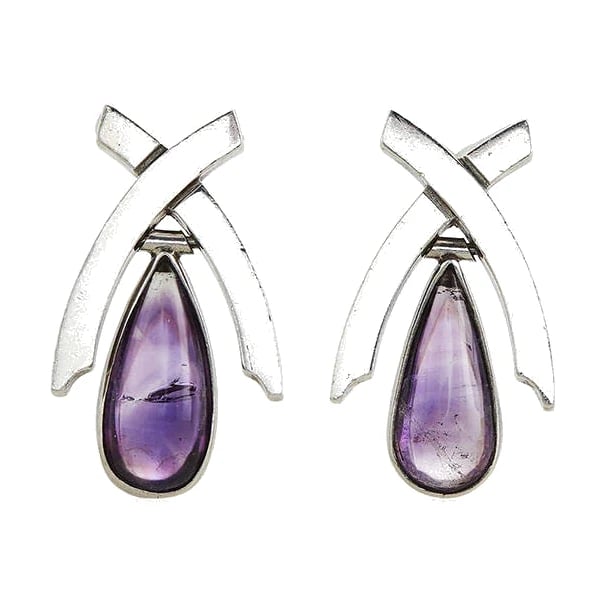
Two slender silver bars cross in an X above each ear, then splay open into a wishbone whose arms curve down and outward to frame a single amethyst teardrop. The stone hangs free below the crossing, so it swings and catches light as it moves. It is the crossing-arch motif rendered at its smallest scale, and a compact example of the sculptural restraint Antonio Pineda pursued further than most of his Taxco contemporaries.
The whole earring is built from a pair of lines and a falling drop. The bars meet, divide, and taper to fine points, and the violet cabochon swings in the open space they leave beneath. The effect is all line and interval — geometry handled like drawing in metal, with no applied ornament to soften it.
Each earring is worked in 970 silver, the high-purity alloy Pineda favored through his Taxco years and the standard recorded for his work by Morrill and Stromberg. The amethyst is cut as a smooth teardrop cabochon and held in a plain bezel, the cool stone set against bright metal. The same wishbone geometry runs through the matching necklace and bracelet, so the three carry one design idea across changing scale.
Shrunk to the dimensions of an earring, the design loses none of its clarity: the cross, the splay, and the drop are stated once and left alone — Pineda treating a small ornament as sculpture, line and stone and nothing it doesn't need.
Museum of Mexican Silver. “Crossing-Arch Amethyst and Silver Earrings.” Catalog no. MoMS-002128. https://museumofmexicansilver.com/pieces/antonio-pineda-crossing-arch-amethyst-and-silver-earrings
See something wrong with this record? Suggest a correction and the piece details fill in automatically.
Antonio Pineda
Caged Amethyst Teardrop Earrings
Silver