Saves instantly, no account needed. Already a member? Sign in.
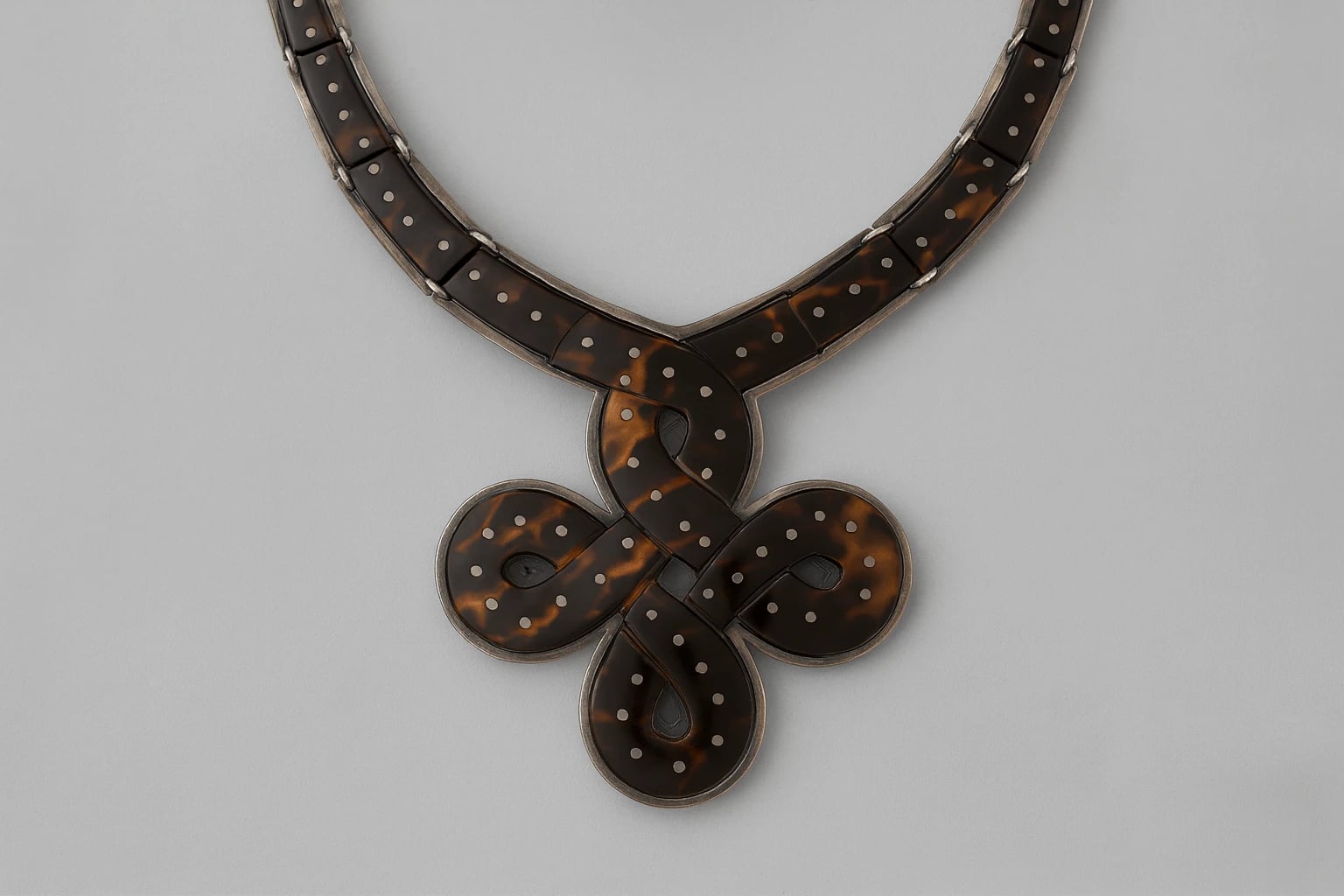
This necklace is a strong example of one of William Spratling's most recognizable Second Design Period ideas, a pendant form so distinctive that it is often called the "pretzel" or "gordian knot." That looping, knotted silhouette, executed in tortoise shell and silver, is the piece's signature and the reason it stands out among his necklaces.
Tortoise shell is fixed to a silver backing with silver rivets, and those rivets are not merely structural: they are placed to emphasize the overall design of the necklace, reading as deliberate accents across the knotted form. The contrast of the warm, mottled shell against silver, with the rivets punctuating the surface, gives the piece its character.
Spratling, the American who set the Taxco silver revival in motion in the 1930s, returned to production in this Second Design Period of 1949 to 1951, and the tortoise-shell-and-silver design was one he developed across multiple forms: the source records that he used a very similar treatment in a bracelet, cuff links, and earrings, marking it as a coordinated design idea rather than a one-off.
The design is recorded in the principal references, including "Mexican Jewelry" by Mary L. Davis and Greta Pack, "William Spratling and the Mexican Silver Renaissance: Maestros de Plata" by Penny C. Morrill, and "Spratling Silver: A Field Guide" by Phyllis M. Goddard. It is a documented "pretzel" necklace from the Second Period, tied to a recognizable suite of related pieces.
Museum of Mexican Silver. ““Pretzel” Tortoise Shell Necklace.” Catalog no. MoMS-000533. https://museumofmexicansilver.com/pieces/spratling-829
See something wrong with this record? Suggest a correction and the piece details fill in automatically.
William Spratling
Turkey Necklace
First Design Period: 1931 - 1946
Silver Plate