Saves instantly, no account needed. Already a member? Sign in.
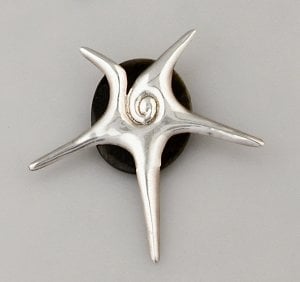
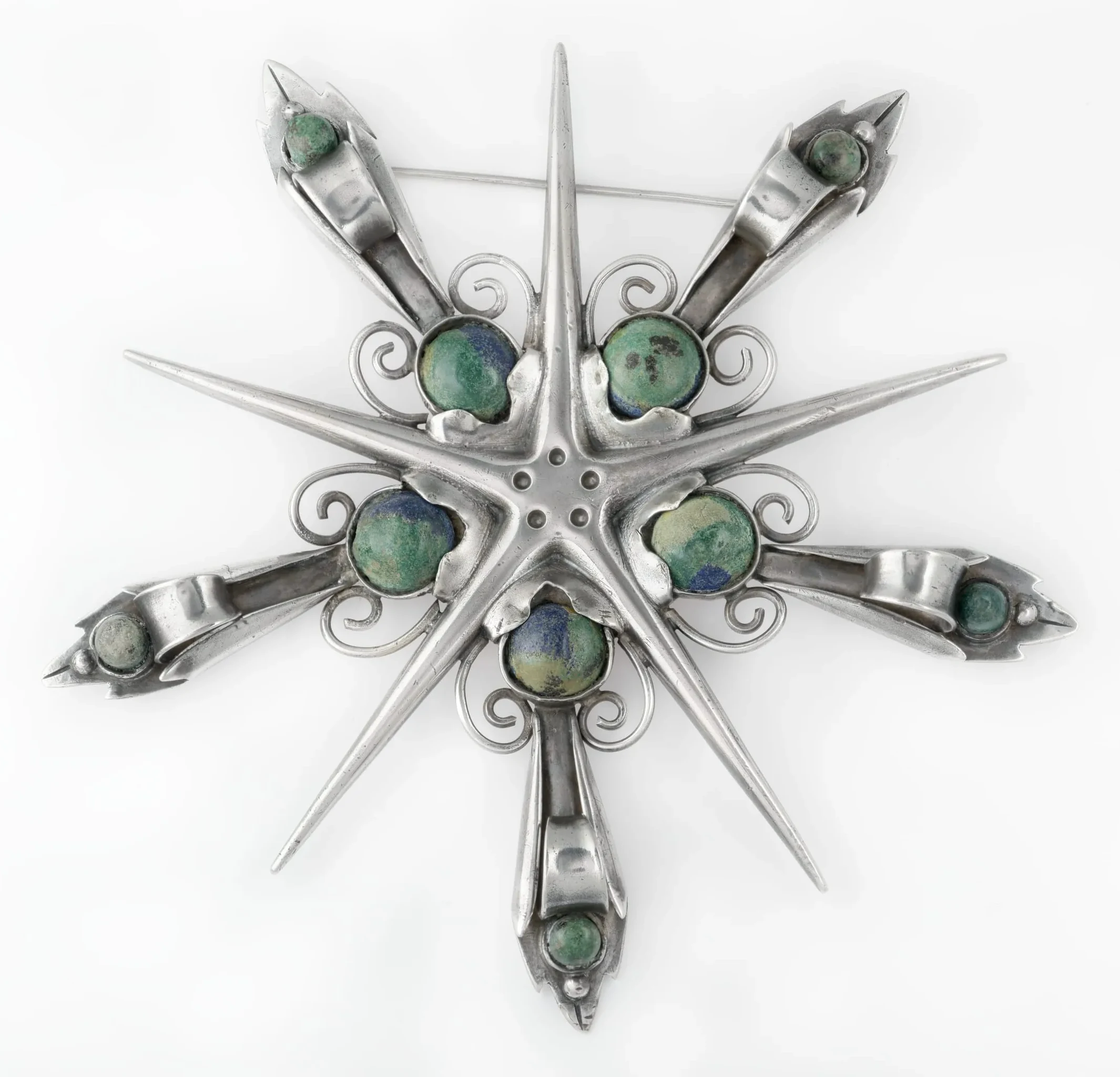
The Star Brooch organizes radiance as construction. At just over four inches square, it uses a clear radial plan, but the surface is not flat or diagrammatic. Long, narrow silver points project beyond broader, folded rays, while raised bezels hold mottled blue and green stones close to the center and at the terminals. The result is a compact object with considerable projection: a brooch that would sit on the body as a small relief sculpture rather than as a flat emblem.
The stones give the brooch much of its visual tempo. Azurite and malachite appear here not as uniform color accents, but as mineral surfaces in which green, blue, gray, and darker passages remain active. Spratling’s setting respects that irregularity. The cabochons are framed by silver rather than disguised by it, so that the metal’s cool reflection and the stones’ matte, variegated color continually shift against one another. Around the central star, wire scrolls soften the severe outward thrust of the rays. They also mark the brooch as a piece of jewelry meant to be seen at close range, where small bends, overlaps, and changes in height interrupt the symmetry without weakening it.
Made in 1944-1946, the brooch belongs to one of the most consequential periods of William Spratling’s Taxco production. The reverse mark, a round SPRATLING MADE IN MEXICO stamp with the central Spratling device and a separate STERLING stamp, corresponds to the mid-1940s marking practice recorded for his workshop. During these same years Spratling published Fine Mexican Silver, reorganized the business as Spratling y Artesanos, and moved production into La Florida, as wartime demand brought Taxco silver to a wider North American public. This history matters here because the brooch is not a private experiment detached from workshop practice. It is a designed object from a large, skilled taller system, where models, materials, and hand execution had to sustain both artistic identity and expanded production.
The star form also clarifies Spratling’s place within Mexican modernism. It does not simply borrow an ancient source or imitate an international modern style. Its sharp rays, mineral color, scrollwork, and raised silver planes bring several Taxco concerns into one object: the transformation of silver into modern form, the renewed visibility of Mexico’s mineral resources, and the portability of modernist design through jewelry. LACMA’s record notes that Spratling first used the blue and green minerals in 1944 and that they became characteristic of many subsequent designs. In this brooch that material choice is already fully integrated. Color is not applied to the silver after the fact. It is part of the brooch’s structure, scale, and rhythm.
Museum of Mexican Silver. “Star Brooch with Azurite and Malachite.” Catalog no. MoMS-002271. https://museumofmexicansilver.com/pieces/spratling-star-brooch-azurite-malachite-lacma-m2015-249-2
See something wrong with this record? Suggest a correction and the piece details fill in automatically.
Within a museum collection, the brooch is especially useful because it makes the ambition of mid-1940s Taxco visible in a single, concentrated form. It is neither a small accessory in the conventional sense nor an isolated luxury object. It shows how the Mexican silver renaissance carried modern design through objects worn on the body, objects whose formal intelligence depended on touch, relief, reflection, and movement. The brooch’s disciplined symmetry and lively mineral surfaces preserve a moment when Spratling’s workshop translated the starburst into something unmistakably of Taxco: radiant, material, and carefully made.
Silson Double Urn Brooch
Silver Plate