Dispatch · April 27, 2026
How Rare Is William Spratling, Anyways?
Spratling is the most famous name in twentieth-century Mexican silver. Las Delicias was, in its peak years, the largest silver workshop in Mexico. None of that means his pieces are easy to find today. Across the 2,094 named-Spratling lots that have crossed a published auction since 2007, the median clears at $750, the top decile at $2,600, and only fourteen have ever cleared $10,000. Production was numerous. Survival is not.
4 min read
Spratling's name is the first one any collector learns. He came to Taxco in 1929, opened Las Delicias in 1931, and by the 1940s was running what Morrill and Berk catalog as a four-hundred-silversmith workshop, the largest in Mexico. He was reviewed in Time. His work moved through New York and Los Angeles. He earned the informal title "the father of Mexican silver."
So a fair-seeming question is: with that scale, with that fame, with a forty-year career producing under several distinct hallmarks, how rare can a Spratling piece really be?
This dispatch is an attempt to answer that with the data we actually have.
Did William Spratling mass-produce his silver?
The first thing to disentangle is the size of the workshop from the size of any individual production run. They are not the same number, and conflating them is what makes Spratling feel commoner than he is.
Las Delicias at its peak employed roughly four hundred silversmiths, with comparable numbers at Los Castillo and Taller Borda during the war years (Morrill and Berk, Mexican Silver). That sounds industrial. But the workshop produced hundreds of distinct designs, in dozens of categories — bracelets, brooches, necklaces, hollowware, flatware, tableware, ceremonial objects, ashtrays, candlesticks, dinner bells — and the typical run for an individual design in the first design period was on the order of one hundred pieces over a decade. For named pieces, sculptural pieces, ceremonial commissions, and pieces requiring special materials or construction, the runs were much smaller. Some were closer to a dozen.
So when a collector hears "the largest silver workshop in Mexico," the right mental picture is not a factory pressing out identical bracelets. It is closer to a serious atelier producing a wide and constantly evolving catalog of objects, most of them in small batches, by hand, by silversmiths trained for years in specific techniques.
That is the production side. The attrition side is heavier still.
How many Spratling pieces survive today?
Most surviving Spratling pieces are, by now, between sixty and ninety-five years old. They have moved through estates, divorces, foreign moves, robberies, melt-downs during silver-price spikes (silver crossed $50/oz in 1980 and again in 2011, and quiet melt is a real fate for unsigned or unrecognized pieces), restorations that obscure marks, and the slow ordinary attrition of any wearable or functional object. Pieces with mixed materials lose their wood, lose their leather, lose their stones, and end up cannibalized for the silver. Pieces with hand-carved tropical hardwood handles — common in Spratling's hollowware — lose those handles to dry climates and careless cleaning.
An honest survival estimate for a 1930s production run of one hundred pieces is, conservatively, on the order of forty to sixty surviving today, with maybe ten to twenty in conditions a serious collector would call complete. For a 1940s run of one hundred, the survival number rises somewhat, but not by as much as time-since-creation would suggest, because the wartime pieces were heavily exported and dispersed.
For the named pieces and ceremonial objects with original runs in the dozens, the surviving examples are countable on two hands.
What does a William Spratling piece sell for at auction?
The Museum of Mexican Silver auction-records dataset currently holds 2,094 lots attributed to Spratling, drawn from Bonhams, Heritage Auctions, John Moran, Sotheby's, Wright, Christie's, Rago, Hindman, and roughly two dozen smaller houses. The 1,000 lots with a recorded hammer price distribute as follows:
| Statistic | Spratling hammer |
|---|---|
| Median | $750 |
| Mean | $1,378 |
| 75th percentile | $1,375 |
| 90th percentile | $2,600 |
| 95th percentile | $4,688 |
| Max | $28,125 |
| Lots ≥ $10,000 | 14 |
| Lots ≥ $5,000 | 47 |
| Lots < $500 | 288 (29% of all named-Spratling lots) |
Two facts deserve emphasis.
First, the long left tail. Of the thousand priced Spratling lots in our dataset, 288 (29%) cleared below $500. These are not unsigned, attribution-uncertain, late-period workshop pieces alone. They include the day-to-day flow of small bracelets, brooches, money clips, and tableware where the auction venue, the catalog framing, or the moment did not surface the piece to the right buyer. The "Spratling clears at melt or below" phenomenon discussed in The Value of Collecting the Taxco Golden Age is not anomalous, it is the bottom third of the distribution.
Second, the thin right tail. Only fourteen Spratling lots have ever cleared $10,000 in our record, across nineteen years of auctions and 2,094 attributed sales. The pieces that built the reputation — the named designs, the early hollowware, the ceremonial commissions, the strong examples in original condition — surface roughly once or twice per year between major houses, and clear at prices that, given the underlying scarcity, look modest.
Which Spratling designs are the rarest and most valuable?
A useful way to make the rarity legible is to walk through specific designs.
The Jaguar tea and coffee service. Spratling's most-imitated hollowware design, with the silver pots, sugar, and creamer modeled with stylized jaguar finials, often paired with hand-carved rosewood handles. Original-era full services (those produced under Spratling's own hallmark, before the workshop's post-1967 successor period) appear in the auction record only a few times per decade. A two-piece set, just the tea and coffee pot from a Jaguar service, c.1964-1967, cleared $2,250 at Heritage in November 2025. A complete eight-piece Jaguar service cleared $4,550 at Long Lake in 2025. A full seven-piece coffee-and-tea service cleared $7,500 at Wright in December 2025. Original production was, by Jeremy Johnson's working estimate after several years of catalog tracking, on the order of thirty complete services ever made, with perhaps a third still extant as full sets and the rest broken up into individual pots, creamers, and sugars circulating separately.
The Caviar necklace. A Spratling design from the 1940s, an elongated link necklace usually shown coiled. Heavy, hand-fabricated, distinctly his. Sold at Bonhams for $14,640. The Caviar appears in the auction record perhaps a dozen times across the last fifteen years.
Hummingbird necklaces. A pair of silver-and-obsidian hummingbird necklaces, c.1964-67, cleared $8,287 at Bonhams. Pairs are unusual; singles surface a handful of times per decade.
The Tulip necklace. Silver and malachite, c.1940-46, cleared $9,562 at Bonhams. A first-design-period sculptural necklace surfacing once in the recorded auction window covered by our dataset.
Sterling silver dinner bells. A recurring Spratling form, hand-fabricated, often paired with a wooden stand or handle. We track seven dinner-bell sales in our dataset, ranging from $1,500 (Moran 2020) and $1,625 (Moran 2023) on the workshop-period examples to $3,570 (Bonhams, 1956-64 example) on a documented mid-period bell. Seven sales across nineteen years of auction tracking.
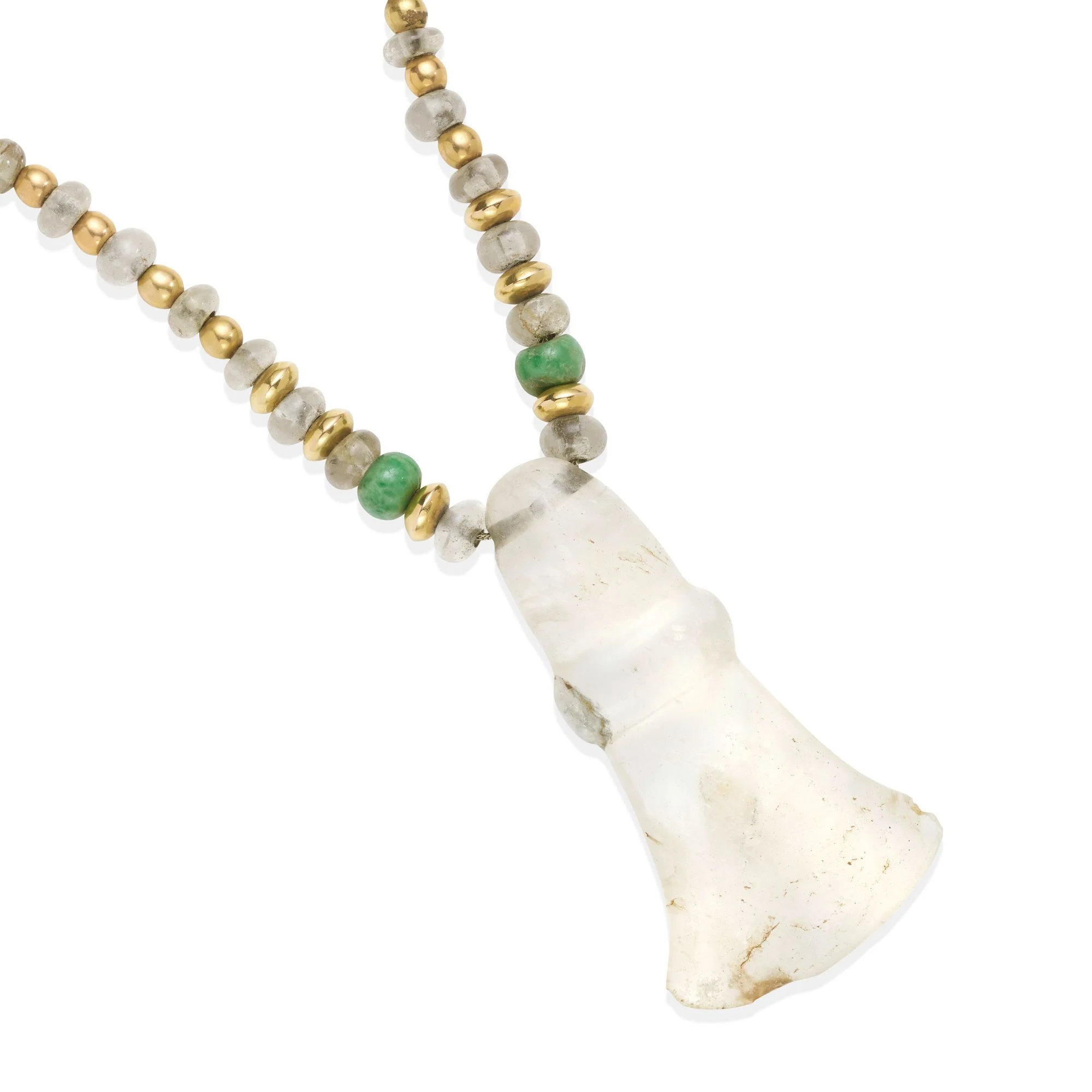
Pre-Columbian crystal, turquoise, and gold necklace. Pictured above, this is the kind of late-career commission piece that almost never surfaces. Cleared $11,475 at Bonhams, the first time we have a record of it appearing on a public block.
Spurs. Two spur-pair sales in our record, both Heritage, both clearing $13,000 to $16,250. The form is so unusual that it does not appear in the workshop catalog as a standard product. Its periodic appearance at auction is, itself, the data point.
The thread connecting these is not that they are uniformly expensive. It is that for each design, the surviving population is small, the auction surface area is narrow, and the auction price is therefore an unreliable proxy for what the piece would cost in a context where the buyer recognized it.
Which museums have William Spratling silver?
A rarity argument is incomplete without an accounting of where the surviving examples actually are. For Spratling, the major institutional holdings are concentrated in five places, with smaller holdings in another dozen.
The Smithsonian, both the main collection and the National Museum of the American Indian, holds extensive Spratling material, including a substantial portion of the work he produced for the U.S. government during World War II under the Office of Inter-American Affairs commission and his subsequent ceremonial commissions. The Met and the Museum of Modern Art each hold examples of his iconic designs as part of their twentieth-century design collections. LACMA holds, by working understanding among Taxco-era specialists, the largest Spratling collection in any American museum, anchored by the William Randolph Hearst gift and subsequent donations from California-based collectors who lived through Spratling's New York and Los Angeles distribution years. In Mexico, the Museo Franz Mayer in Mexico City holds significant examples, as do museums in Taxco itself.
The institutional accounting matters because every piece in a museum collection is a piece not available to the private market. If forty examples of a particular Spratling design were ever made, and twenty are in museum collections, the surviving private-market pool is twenty pieces, total, in a market of thousands of active collectors.
So how rare is William Spratling silver?
Spratling's reputation was built on a body of named designs whose surviving populations are, for the most strongly-identified pieces, on the order of dozens. The auction record over the last nineteen years confirms this: of two thousand attributed Spratling sales, fewer than fifty cleared $5,000, and only fourteen cleared $10,000.
Two readings of that data are possible.
The conventional reading is that the prices reflect the value. If Spratling were as rare as the production-survival math suggests, the market would have already bid the pieces up. Therefore the survival count is overstated, or the market is right.
The reading we find more plausible is that auction venues for Taxco silver are still narrow; documentation is still incomplete; few buyers can yet distinguish a workshop bracelet from a named-design piece; and the secondary market is still in the early stages of pricing the artistic and historical importance of the work. The Spratling who appears in Time, the Spratling whose pieces are in the Smithsonian and LACMA, and the Spratling who clears $750 at the median auction are all the same artist. The gap between the first two facts and the third one is what this museum exists to close.
Concretely: if you own a named Spratling piece in good condition — a Caviar necklace, a Jaguar service, a Tulip necklace, a hummingbird, an early piece with a documented hallmark and original construction — you are likely one of dozens of people in the world who do. That is not a marketing line. It is an arithmetic claim, made from production-run estimates of one hundred or fewer per design in his most prolific decade, attrition rates compounded over eight decades, museum-collection withdrawals, and an auction record that surfaces the named pieces at a rate of one or two per year across all major houses combined.
How rare is William Spratling, anyways?
Rarer than the catalog count suggests. Rarer than the auction prices suggest. About as rare as the museum acquisition committees, who have been competing for these pieces for forty years, have been quietly suggesting all along.
Sources
- Museum of Mexican Silver auction-records dataset, retrieved April 27 2026. 2,094 lots attributed to William Spratling spanning 2007 through April 2026 from Bonhams, Heritage Auctions, John Moran, Sotheby's, Wright, Christie's, Rago, Hindman, and ~25 smaller houses. 1,000 lots with recorded hammer prices used for the distribution statistics. Per-piece source URLs are linked inline.
- Penny Chittim Morrill and Carole A. Berk, Mexican Silver: 20th Century Handwrought Jewelry & Metalwork (Schiffer, revised). Workshop scale: Las Delicias employed roughly 400 silversmiths during the war years, with comparable numbers at Los Castillo and Taller Borda. Used here for the production-scale framing.
- Heritage Auctions, November 12 2025 — A William Spratling Jaguar Pattern Silver Tea Pot and Coffee Pot, Taxco, Mexico, 1964-1967. Hammer $2,250.
- Long Lake Art & Antiques, 2025 — William Spratling Sterling Silver 8-piece Jaguar Tea Set. Hammer $4,550.
- Bonhams (United States), sale 18261 lot 2357 — A William Spratling sterling silver Caviar long necklace, 1940s. Hammer $14,640.
- Bonhams (United States), sale 27287 lot 140 — A silver and malachite Tulip necklace, William Spratling, Taxco, Mexico, circa 1940-46. Hammer $9,562.
- Bonhams (United States), sale 27287 lot 166 — Two silver and obsidian Hummingbird necklaces, William Spratling, Taxco, Mexico, circa 1964-67. Hammer $8,287.
- Bonhams (United States), sale 27287 lot 148 — A pre-Columbian carved raw crystal, turquoise and gold necklace, William Spratling, Taxco, Mexico, circa 1960-65. Hammer $11,475. Hero image of this dispatch.
- John Moran Auctioneers, 2020 — A William Spratling silver dinner bell. Hammer $1,500.
- John Moran Auctioneers, April 4 2023 — A William Spratling sterling silver dinner bell. Hammer $1,625.
- Bonhams (United States), sale 27545 lot 45 — A Mexican sterling silver dinner bell, William Spratling, 1956-1964 Taxco. Hammer $3,570.
- Museum holdings (Smithsonian, NMAI, Met, MoMA, LACMA, Museo Franz Mayer): per the working understanding of Taxco-era specialists. Specific institutional accession lists were not directly verified for this dispatch; collectors needing accession-level provenance should check each museum's published online catalog.
- Production-run estimates (~100 per first-design-period design, ~30 per Jaguar service, named-piece runs in the dozens) and survival math: working estimates from Jeremy Johnson, accumulated over several years of cataloging Taxco-era inventory and auction comps. Treated here as the best available framework, not as published peer-reviewed data. Refinement welcome from collectors and scholars who have direct access to workshop production records.
More in Dispatches
Why Mexican Modernism Is Modern Art
Alexander Calder's jewelry was received as art the moment he made it, because he was already known as a sculptor. The Taxco school had no such advocate, and a half-century of mid-century Mexican silver has been miscategorized as vintage jewelry rather than what it is: modern sculpture.
The Value of Collecting the Taxco Golden Age
Taxco silver has beauty, history, scarcity, and market inefficiency in the same place. The auction record across 1,156 weighable Golden Age lots, with each lot's melt value computed at the silver spot in effect on the day it sold, shows the spread: a typical Spratling or Pineda piece clears at roughly ten times its silver weight, the best examples clear sixty to a hundred times, and the same makers' hollowware regularly sells below melt at the wrong auction. The drift between the metal floor and the recognition ceiling is the entire opportunity.
The Jill and Byron Crawford Collection at Bonhams
One couple's Taxco Golden Age jewelry, 119 lots across every major workshop of the era, cleared through two Bonhams sales in 2022 and 2023. The results are a cleaner benchmark for the middle of the market than collectors remember.