
Dispatch · April 27, 2026
The Value of Collecting the Taxco Golden Age
Taxco silver has beauty, history, scarcity, and market inefficiency in the same place. The auction record across 1,156 weighable Golden Age lots, with each lot's melt value computed at the silver spot in effect on the day it sold, shows the spread: a typical Spratling or Pineda piece clears at roughly ten times its silver weight, the best examples clear sixty to a hundred times, and the same makers' hollowware regularly sells below melt at the wrong auction. The drift between the metal floor and the recognition ceiling is the entire opportunity.
14 min read
Most collecting categories become exciting when beauty, history, scarcity, and market inefficiency overlap. Taxco silver has all four.
Between the 1930s and 1970s, Taxco became one of the most important silver design centers in the world. What began as a local revival of handwrought silver grew into an internationally recognized design movement: William Spratling, Antonio Pineda, Héctor Aguilar, Los Castillo, Sigi Pineda, Margot de Taxco, Salvador Terán, Matilde Poulat, Ana Núñez Brilanti, and others helped create a distinctive modernist language rooted in Mexico's pre-Columbian, colonial, and popular-art traditions. The Fowler Museum's Silver Seduction describes Taxco as emerging not only as a major mineral resource, but as a center of silver design, production, and distribution from the early 1930s to the 1970s. It also emphasizes that Pineda and his contemporaries "together built a Taxco School."
But the economics of collecting Taxco silver are especially interesting for a different reason: the market is still inefficient.
In many mature collecting categories — blue-chip watches, major postwar art, top-tier French design, important American studio jewelry — the price discovery mechanism is fairly advanced. Auction houses, dealers, collectors, archives, online databases, museum exhibitions, and social media have all helped compress knowledge gaps. A great Rolex, Cartier, Calder, Lalanne, or Nakashima piece is much less likely to be overlooked today than it was twenty years ago.
Taxco silver is different. Despite its importance, the market remains fragmented, under-documented, and unevenly understood. The same caliber of object can sell for dramatically different prices depending on whether it appears in a specialist auction, a design gallery, a general estate sale, a regional auction, an eBay listing, a Mexican market, or a dealer's case where the seller may understand the silver weight but not the maker, period, design lineage, or rarity.
That gap between intrinsic quality and market recognition is one of the reasons this museum exists.
Is Taxco Silver Worth More Than Its Melt Value?
Silver has a built-in floor: melt value. A heavy bracelet, necklace, bowl, tray, or set of flatware always has some value simply because it contains precious metal. That makes silver feel deceptively simple. Weigh it, multiply by silver content, apply spot price, and there is your baseline.
But Taxco Golden Age silver is not bullion. At its best, it is sculpture, design history, cultural history, and handcraft condensed into wearable or functional form.
A great Spratling, Pineda, Aguilar, or Los Castillo piece should not trade like scrap silver. In our view, strong pieces by the named masters often deserve to trade at 7–10 times melt value, and the rarest, most sculptural, best-documented, or most iconic examples can justify more. That premium reflects authorship, design, craftsmanship, rarity, condition, provenance, and historical importance.
The problem is that the market does not always recognize those factors. The auction record is full of pieces that fell straight through the floor (each ratio below uses the day-of-sale silver spot, not today's):
- A Héctor Aguilar sterling silver tray, 1,737 grams, sold at Direct Auction Galleries in Chicago in September 2025 for $1,650 against approximately $2,248 of metal at the day's $42.82/oz spot — a hammer-to-melt ratio of 0.73x. Taller Borda hollowware, where Aguilar ran the largest silver workshop in Mexico, cleared at three-quarters of its silver content. (Auction lot.)
- A William Spratling sterling silver service, 1,364 grams, sold at Jackson's International in April 2025 for $850 against approximately $1,307 of metal — 0.65x. A multi-piece Spratling service, treated as scrap by weight. (Auction lot.)
- An Antonio Pineda group of Lascaux-motif silver belt buckles, 367 grams, sold at John Moran in May 2025 for $254 against $375 of metal — 0.68x. Pineda used inventory codes including "82" specifically for buckles, and the Lascaux-motif series is a documented design in his taller. The lot still cleared below melt because it was framed as a generic group rather than as a named design. (Auction lot.)
- A William Spratling sterling silver teapot, 639 grams of sterling, sold at Abell Auction in September 2023 for $450 against approximately $445 of metal at the day's $23.40/oz spot — a hammer-to-melt ratio of 1.01x. Hand-wrought Spratling hollowware, with its maker's mark, cleared the block at exactly the price of the silver inside it. (Auction lot.)
These are not outliers buried in obscure provincial auctions. They are public, photographed, catalogued lots from named houses. Sometimes a 150-gram bracelet by a major maker is priced as "vintage sterling." Sometimes a museum-quality hollowware object is sold as "Mexican silver bowl." Sometimes a rare hallmark is missed. Sometimes a design that belongs in the history of modernism is treated like a decorative accessory.
For collectors, that is the opportunity.
Why Do Similar Taxco Pieces Sell for Such Different Prices?
Taxco silver is a market where knowledge compounds. A buyer who can identify hallmarks, distinguish workshop periods, recognize signature forms, assess construction quality, and understand which designs are rare has a real advantage.
A generalist seller may see:
"Sterling silver Mexican bracelet, 105 grams."
A specialist collector may see:
"Early Taxco modernist cuff, heavy-gauge hand construction, likely 1940s–1950s, strong design lineage, possibly by a named workshop, worth several multiples of melt if authenticated."
Those are very different objects economically, even if they are physically the same object.
This happens because the category requires interdisciplinary knowledge. One has to understand silver marks, Mexican cultural history, modernist design, workshop production, tourist-market production, hand fabrication, stone setting, repoussé, married metals, and the changing role of the great talleres. Silver Seduction notes that the large Taxco workshops were not standard factories: they were labor-intensive, hand-process systems where finished works passed through skilled manual stages, with production focused on design innovation rather than standardization.
That matters because the economic value of a Taxco object is not only in the material. It is in the accumulated knowledge and labor embedded in the object.
How Big Were the Great Taxco Workshops?
The Taxco Golden Age was not a loose cluster of hobbyists. It was a serious design ecosystem.
The great talleres trained silversmiths, developed technical specializations, created new design vocabularies, and served national and international markets. Antonio Pineda's workshop, for example, employed more than fifty smiths by the early 1950s, and Pineda's work was internationally recognized and exhibited in major venues. His jewelry sold through Gump's of San Francisco, and by the 1940s his taller distributed through Mexico, San Francisco, Los Angeles, New York, Chicago, and Argentina.
Spratling's workshop also shows the scale of the phenomenon. During the war years, demand from American companies helped expand Taxco production dramatically; Morrill and Berk note that more than four hundred silversmiths worked at Las Delicias, with three hundred at both Los Castillo and Taller Borda.
This was not small-scale souvenir production. At the top, it was a major export design industry. And yet much of that work now circulates in a secondary market that remains surprisingly opaque.
Where Is the Opportunity in Collecting Taxco Silver?
The most exciting collecting markets are not necessarily the ones where prices are lowest. They are the ones where price and quality are most inconsistently connected.
Taxco silver has this inconsistency in abundance.
A signed Spratling piece in a top design gallery may be priced with full recognition of its importance. A comparable or better piece in a local estate auction may be priced near melt. An Antonio Pineda bracelet with a desirable hallmark may be understood by one seller as museum-quality modernist jewelry and by another as "old Mexican sterling." A Margot de Taxco enamel parure may bring a premium in the right venue, while a less visible listing may miss the significance of the design, condition, or completeness of the set.
That spread creates several different kinds of opportunity:
First, there is identification arbitrage. The buyer recognizes what the seller does not.
Second, there is venue arbitrage. The same object may sell differently depending on whether it is offered in a specialist design auction, a regional estate sale, a Mexican antiques market, a general online marketplace, or a high-end gallery.
Third, there is education arbitrage. As more collectors learn the hierarchy of makers, marks, forms, and periods, the best objects should become harder to find cheaply.
Fourth, there is aesthetic arbitrage. Many Taxco pieces still look radically contemporary. A 1940s or 1950s bracelet by Spratling, Pineda, Aguilar, Los Castillo, or Sigi Pineda can sit comfortably beside Scandinavian modernism, French Art Deco, American studio jewelry, or contemporary sculptural jewelry. The objects are often underpriced relative to comparable design movements.
How Many Times Melt Value Does Taxco Silver Actually Sell For?
A 7–10x melt framework may sound aggressive to someone encountering the category for the first time. But viewed properly against the auction record, it is often conservative.
We pulled every record in our auction-records dataset where the catalog description includes a parseable gross weight and the lot is attributed to one of the eight named Golden Age makers we track. After excluding mixed-metal and gold lots, the sample is 1,156 lots spanning 2007 through April 2026. Each lot's melt value is computed at the silver spot in effect during the month it sold, using monthly silver fixings from the World Bank Pink Sheet. Per-maker silver standards are taken from the documented purity of each workshop (Aguilar 0.940, Pineda 0.970, the others 0.925). The lookup matters: silver ran from roughly $14/oz in 2019 to over $90/oz in early 2026, and using a single recent spot for every old sale would systematically misstate the historical ratios.
The hammer-to-melt distribution by maker, with each lot's melt computed at the day's silver spot:
| Maker | Lots | Median | p75 | p90 | Max |
|---|---|---|---|---|---|
| MATL (Matilde Poulat) | 165 | 19.2x | 28.7x | 43.8x | 97.6x |
| Antonio Pineda | 163 | 10.2x | 16.5x | 28.3x | 78.2x |
| William Spratling | 219 | 9.6x | 16.7x | 25.9x | 104.0x |
| Salvador Terán | 21 | 9.2x | 13.7x | 23.4x | 42.3x |
| Margot de Taxco | 187 | 6.5x | 9.8x | 15.9x | 45.7x |
| Héctor Aguilar | 207 | 5.7x | 9.7x | 15.2x | 67.3x |
| Los Castillo | 186 | 3.5x | 5.4x | 9.3x | 30.0x |
| Sigi Pineda | 8 | 2.1x | 2.8x | 6.5x | 6.5x |
A typical Spratling or Pineda piece in this sample clears the block at roughly ten times its silver weight in dollars on the day it sold. The top quartile clears at sixteen to seventeen. The top decile clears at twenty-five to twenty-eight, and MATL's top decile is over forty. And specific identified pieces — the work the masters are actually known for — clear higher still:
- An Antonio Pineda silver and amethyst brooch, 60.5 grams, sold at John Moran in September 2024 for $4,445 against approximately $57 of metal at the day's $30.13/oz spot — a hammer-to-melt ratio of 78.2x. (Auction lot.)
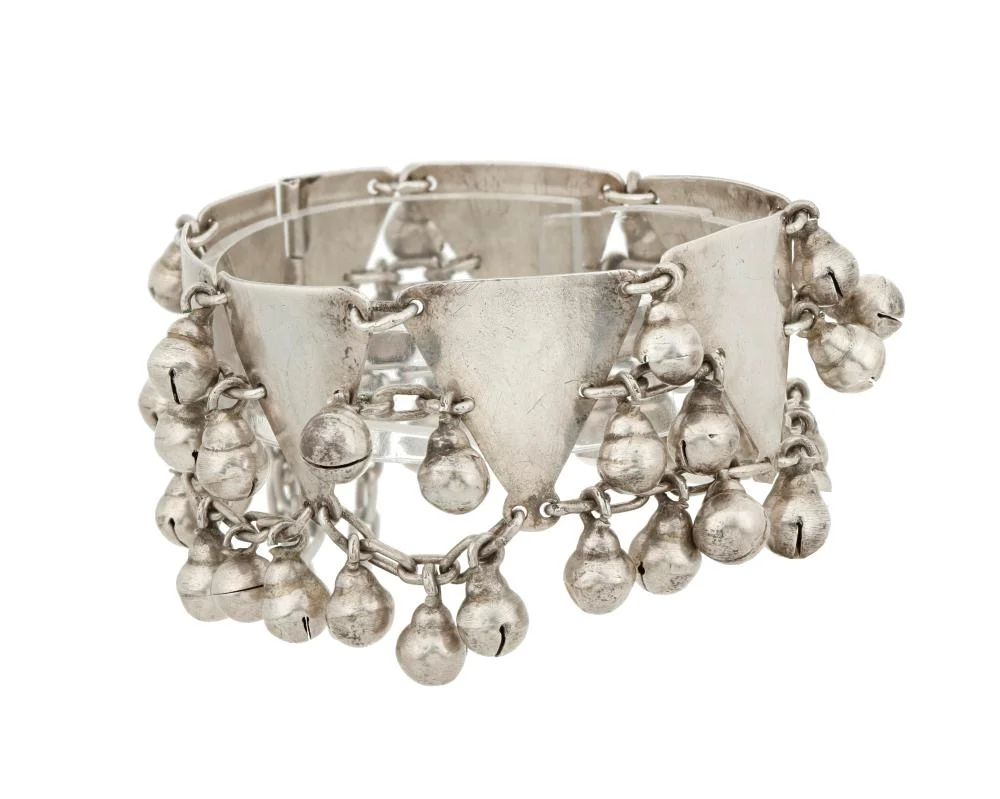
- A Héctor Aguilar sterling silver bell bracelet, 40.9 grams of 940 silver, sold at John Moran in April 2023 for $2,080 against approximately $31 of metal at the day's $25.01/oz spot — 67.3x. (Auction lot.)
- A Margot de Taxco "Zodiac" necklace, the full twelve-charm set, 88.8 grams, sold at Ripley Auctions in January 2026 for $7,500 against approximately $244 of metal at the day's $92.06/oz spot — 30.8x. The same hammer in 2023, against that period's silver spot, would read as roughly 120x melt; the signal is the dollar premium over metal, not the ratio in isolation. (Auction lot.)
None of these is unique. Comparable pieces by the same makers with documented hallmarks and recognizable design vocabulary regularly clear in the same multiples band when they reach a specialist audience.
Consider what a collector is buying in a great Taxco piece. They are buying precious metal, often in high silver content such as .925, .940, .970, .980, or .990 depending on maker and period. They are buying hand labor from a workshop system that required years of apprenticeship. They are buying design by one of the major figures of twentieth-century Mexican modernism. They are buying a finite historical object from a period that cannot be recreated. They are buying a piece connected to Mexico's post-revolutionary search for identity, to pre-Columbian revival, to Hollywood-era tourism, to cross-border cultural exchange, and to the rise of modern design in the Americas.
And in many cases, they are buying something wearable, displayable, and usable.
That is a lot more than silver.
The data also shows where the named-master premium frays. Sigi Pineda — who apprenticed in Antonio's taller before opening his own workshop — sells at a median of 2.1x melt across our sample. Same city, same era, same medium, much smaller premium. The market does not extend the Pineda surname to a related but distinct authorship. That gap is itself an early signal: today's 2x makers are sometimes tomorrow's 10x makers, and the people who saw it first paid the lowest price.
Why Is Taxco Silver Still Undervalued?
The market remains inefficient partly because Taxco silver sits between categories. It is not only jewelry. It is not only decorative arts. It is not only Mexican art. It is not only modernist design. It is not only silver.
That in-between quality is part of its magic, but it also slows market recognition. Auction houses may place pieces in "silver," "jewelry," "Latin American art," "design," or "decorative arts," each attracting a different buyer base. Sellers may describe the same object using radically different language. Some collectors search by maker; others by "Taxco"; others by "Mexican sterling"; others by "modernist silver." Many important pieces never meet the right audience.
Documentation is another issue. The field has important books, museum exhibitions, and dealer knowledge, but it lacks the centralized, searchable, image-rich reference infrastructure that more mature categories enjoy. Hallmarks are dispersed across books, collector websites, auction archives, and private knowledge. Provenance is often incomplete. Design numbers may be misunderstood. Later workshop production can be confused with earlier production. Reissues, unsigned pieces, married-metal experiments, posthumous Spratling workshop pieces, and rare one-off forms all require careful interpretation.
This is exactly the gap the Museum of Mexican Silver is meant to close.
Can You Still Find Great Taxco Pieces in the Wild?
For many collectors, the thrill of Taxco is not only owning beautiful objects. It is the process of discovery.
A great piece can still appear in the wild. A seller can still miss a hallmark. A major design can still be mislabeled. A rare object can still be grouped with ordinary sterling. A historically important piece can still be sitting in a case, waiting for someone who knows enough to recognize it.
That possibility gives the field an energy that many mature categories have lost. In Taxco silver, expertise still matters. Patience still matters. Looking closely still matters. The collector who studies, compares, handles, photographs, weighs, researches, and learns can still be rewarded.
This is not speculation in the shallow sense. It is not about chasing prices. It is about recognizing that the market has not yet fully absorbed the artistic and historical importance of the best Taxco work.
The best pieces from the Taxco Golden Age are beautiful, scarce, culturally significant, and materially substantial. They were made by named artists and workshops whose importance is increasingly understood. They belong in museums, serious collections, and design history. Yet many still trade at prices that do not fully reflect that reality.
That is what makes the category so compelling economically.
Not because every piece of Mexican silver is underpriced. It is not.
Not because every Taxco mark is important. It is not.
Not because melt value is irrelevant. It is the floor.
But because the difference between the floor and the true collector value can be enormous.
And for those willing to learn, that gap is where the treasure is.
Sources
- Museum of Mexican Silver auction-records dataset, retrieved April 27 2026. 1,156 lots passing the filter: named-maker attribution to one of Aguilar / Antonio Pineda / Spratling / Los Castillo / Margot / MATL / Salvador Terán / Sigi Pineda; parseable gross weight (5–5,000 g range); positive hammer; no gold/vermeil flag in title or description. Per-maker silver standards: Aguilar 0.940, Pineda 0.970, others 0.925. Each lot's melt value is computed at the silver spot in effect during the month of sale; for lots with year-only sale dates we use that year's monthly average. Analysis script and lot-level CSV:
tools/melt-vs-hammer.pyandtools/melt-vs-hammer.csvin the project repository. - World Bank Commodity Price Data ("Pink Sheet"), monthly silver fix in USD per troy ounce, 1960 to present. The series in
tools/silver-monthly.csvis extracted from the published Excel workbook and runs January 1960 through March 2026. - John Moran Auctioneers, September 11 2024, lot 2142 — Antonio Pineda silver and amethyst brooch, 60.5 g. Hammer $4,445 against silver spot of $30.13/oz. 78.2x melt.
- John Moran Auctioneers, April 4 2023, lot 2170 — Héctor Aguilar sterling silver bell bracelet, 40.9 g. Hammer $2,080 against silver spot of $25.01/oz. 67.3x melt.
- Ripley Auctions, January 19 2026, lot 61 — Margot de Taxco "Extremely Rare" Zodiac necklace with 12 charms, 88.8 g. Hammer $7,500 against silver spot of $92.06/oz. 30.8x melt.
- Direct Auction Galleries, September 13 2025, lot 21 — Héctor Aguilar Taxco Mexico sterling silver tray, 1,737 g. Hammer $1,650 against silver spot of $42.82/oz. 0.73x melt.
- Jackson's International, April 30 2025, lot 654 — William Spratling sterling silver service, 1,364 g. Hammer $850 against silver spot of $32.23/oz. 0.65x melt.
- John Moran Auctioneers, May 20 2025, lot 1107 — Antonio Pineda group of Lascaux-motif silver belt buckles, 367 g. Hammer $254 against silver spot of $32.76/oz. 0.68x melt.
- Abell Auction, September 14 2023, lot 243 — William Spratling silver tea pot, 639 g. Hammer $450 against silver spot of $23.40/oz. 1.01x melt.
- Penny Chittim Morrill and Carole A. Berk, Mexican Silver: 20th Century Handwrought Jewelry & Metalwork (Schiffer, revised). Workshop scale: Las Delicias c. 400 silversmiths, Los Castillo c. 300, Taller Borda c. 300 during the war years.
- Gobi Stromberg, Silver Seduction: The Art of Mexican Modernist Antonio Pineda (Fowler Museum at UCLA, 2008). Pineda taller employed 50+ smiths by the early 1950s; distributed through Gump's of San Francisco and outlets in Los Angeles, New York, Chicago, and Argentina. The "Taxco School" framing.
More in Dispatches
Why Mexican Modernism Is Modern Art
Alexander Calder's jewelry was received as art the moment he made it, because he was already known as a sculptor. The Taxco school had no such advocate, and a half-century of mid-century Mexican silver has been miscategorized as vintage jewelry rather than what it is: modern sculpture.
How Rare Is William Spratling, Anyways?
Spratling is the most famous name in twentieth-century Mexican silver. Las Delicias was, in its peak years, the largest silver workshop in Mexico. None of that means his pieces are easy to find today. Across the 2,094 named-Spratling lots that have crossed a published auction since 2007, the median clears at $750, the top decile at $2,600, and only fourteen have ever cleared $10,000. Production was numerous. Survival is not.
The Jill and Byron Crawford Collection at Bonhams
One couple's Taxco Golden Age jewelry, 119 lots across every major workshop of the era, cleared through two Bonhams sales in 2022 and 2023. The results are a cleaner benchmark for the middle of the market than collectors remember.