Dispatch · May 4, 2026
Why Mexican Modernism Is Modern Art
Alexander Calder's jewelry was received as art the moment he made it, because he was already known as a sculptor. The Taxco school had no such advocate, and a half-century of mid-century Mexican silver has been miscategorized as vintage jewelry rather than what it is: modern sculpture.
10 min read
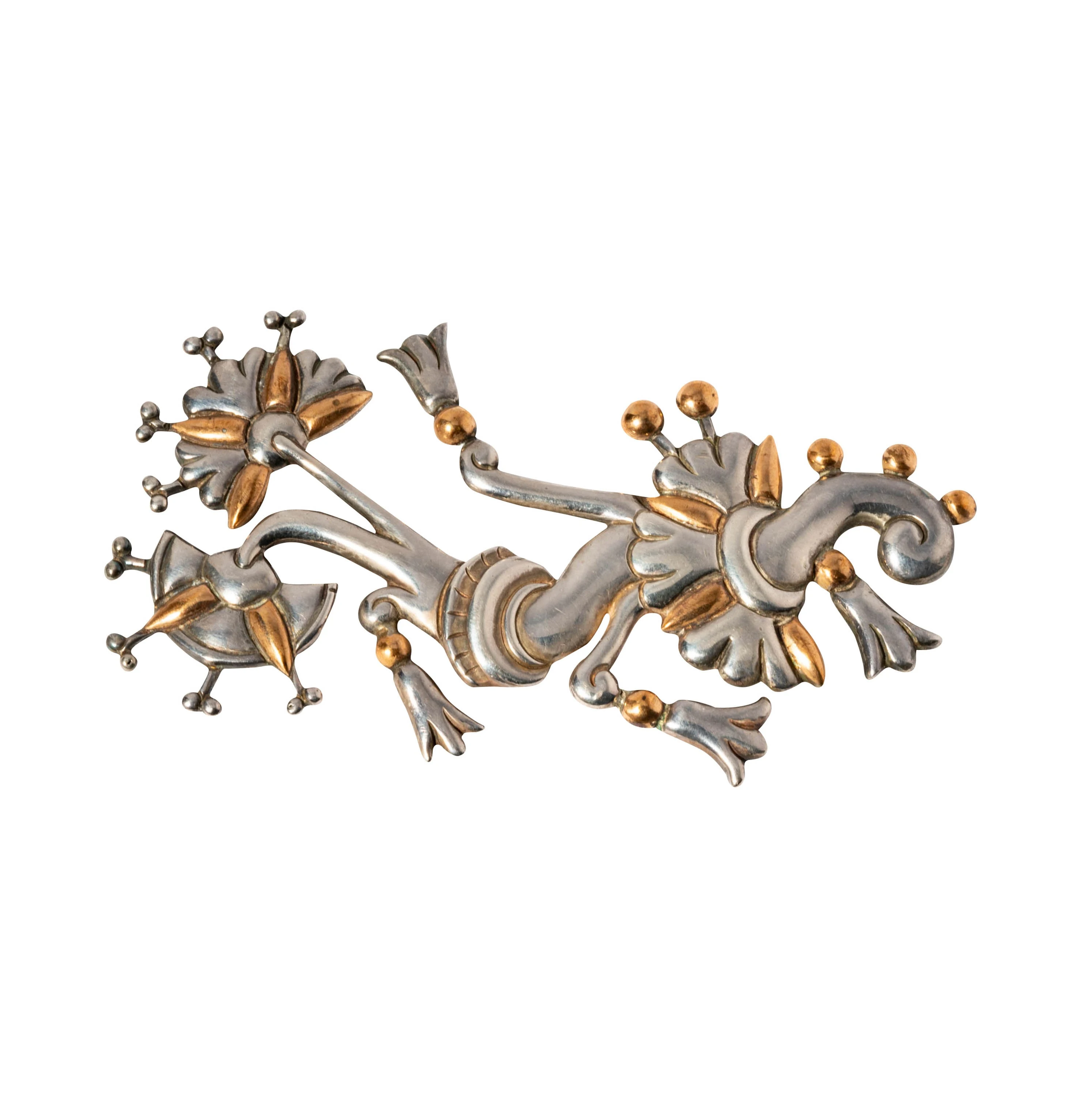
The brooch is small enough to hold in the palm. It is silver, hand-cut, oxidized in the recesses to throw the surface forward. The composition is symmetrical and not quite. A central trunk rises and divides, branches splay out and curl back, leaves resolve as flat geometric repeats. The piece reads as a tree. It also reads as a diagram of one. The maker's mark in the back is a circular cartouche with the initials WS at the center, ringed by SPRATLING TAXCO MEXICO, paired with an oval stamp reading SPRATLING SILVER. That second stamp is the period brand for 980 silver, a higher grade than sterling. The brooch was made by William Spratling's workshop in Taxco, Mexico, in the early 1940s.
That object is the subject of this essay. The argument is that it belongs in the same conversation as a Calder mobile or a Brâncuși fish. The field has spent fifty years filing it under vintage jewelry instead. That has been a mistake of category, and the cost has been measurable.
Why is Taxco silver filed as vintage jewelry instead of modern art?
A piece of mid-century Taxco silver enters the market through one of three doors. It comes through a Bonhams or Wright Artist Jewelry sale. It comes through a regional estate auction as "Mexican sterling, c. 1945." Or it comes through a dealer who weighs it for the metal and lets the design follow as a courtesy. None of those doors are the museum entrance, and the museum entrance is where this work was made to be received.
The reasons are partly historical. The first wave of American interest in Spratling's work ran through Sanborn's in Mexico City and then through department-store buyers, Saks, Marshall Field, Montgomery Ward. The Montgomery Ward Christmas catalog of 1943 carried Spratling Silver as a featured line, with copy explaining that Spratling Silver was "980/1000 pure silver while sterling, according to U.S. government standards, is only 925/1000 pure silver." That was good marketing copy for 1943. It was also the first beat of a framing problem that has not fully corrected. Mid-century Taxco silver was sold as luxury merchandise in its own decade, and the trade publications that covered it later, the jewelry-and-design press, the auction-house specialty sales, inherited that framing. The work has been described in inventory terms, not in art-historical ones. It has been catalogued by maker and date and silver weight, not by design family and sculptural intention.
The cost of that framing is visible in the auction record. A signed Héctor Aguilar bracelet from Taller Borda's strongest decade, 1939 to 1949, comes to a Crawford-collection sale and clears at a four-figure hammer. A signed Calder bracelet from the same decade clears six or seven figures at a Phillips Design sale. Both are hand-fabricated by their named maker, both are signed authored objects, both are formal compositions that draw on indigenous and pre-Columbian sources translated into modernist abstraction. One is in the Whitney's collection as sculpture. The other is in LACMA's costume and textiles department as decorative art. The price spread does not reflect a difference in the objects. It reflects a difference in the institutions that have claimed them, and the disciplines that have written about them.
How does Taxco silver compare to Calder's jewelry?
Calder began making jewelry around 1929, the same year Spratling moved to Taxco. He made it by hand, in his studio, from heavy-gauge silver and brass wire bent into the same vocabulary that ran through his mobiles and standing pieces. He gave most of it to friends. The pieces that did sell sold to a gallery audience that already knew his sculpture. When the Whitney mounted the major Calder Jewelry exhibition in 2008, the curatorial framing was straightforward: this is sculpture made small, by a sculptor, in the same idiom as the rest of his work. The work was received as art because the maker was already known as an artist.
The Taxco school had no such precedent. Spratling came to Mexico as an architect and a writer, not a sculptor. Héctor Aguilar was Spratling's manager before opening Taller Borda in 1939, not a salon-trained metalsmith. Antonio Pineda opened his own taller in 1941 after working under Spratling, and Margot Carr, who became Margot de Taxco, took over her own workshop in 1948 after a marriage and a partnership with Antonio Castillo dissolved. None of them arrived in Taxco with an art-world reputation that could carry over to the work. They arrived as designers, as managers, as draftsmen, and they built ateliers. The work had to argue for its own status from the inside out.
The case for taking that work seriously as modern art has been made before, but unevenly. Penny Chittim Morrill's Mexican Silver: 20th-Century Handwrought Jewelry and Metalwork (Schiffer, revised) is the foundational reference text. Morrill walks the workshop chronologies, the marks, the design vocabularies, with the precision of a museum catalog. Her revised edition is the source most auction houses cite when they catalog these pieces today. Silver Masters of Mexico (Schiffer, 1996) extended the argument across the field. Gobi Stromberg's Silver Seduction: The Art of Mexican Modernist Antonio Pineda (Fowler Museum at UCLA, 2008), produced for the major Pineda retrospective at the Fowler, treats Pineda's work as a sculptural body of work and frames the Taxco school explicitly as a modernist movement. Stromberg's introduction makes the argument plainly: Pineda and his contemporaries "together built a Taxco School," and that school was a center of design innovation comparable to other mid-century international design movements.
The scholarship is in place. The institutional reception has lagged it.
Who founded the Taxco school of silver?
Spratling arrived in Taxco in 1929. He opened Taller de las Delicias in 1931. By the late 1930s he was the largest single employer in the town and the workshop he had built was producing silver objects that ran from architectural-scale flatware services to small repoussé brooches. He was also training, deliberately, a next generation of Mexican silversmiths who would open their own talleres. That training pipeline is the structural fact that distinguishes the Taxco school from a single artist's workshop.
Aguilar opened Taller Borda in 1939, on the Calle Borda in Taxco, with capital and a workforce that had largely passed through the Spratling shop. Los Castillo opened the same year, founded by Antonio, Justo, Miguel and Jorge Castillo, brothers who had worked under Spratling. Pineda opened in 1941. Matilde Poulat, working as MATL out of Mexico City rather than Taxco, was independently producing what would become one of the most identifiable design vocabularies of the period, religious and folk-derived motifs in heavy silver with carved stones. Fred Davis ran an antiquities-and-design business in Mexico City beginning in the 1920s that effectively functioned as a precursor and parallel taller. Margot de Taxco took over her own workshop in 1948. Ana Núñez Brilanti opened Victoria de Taxco in the 1940s, one of the earliest woman-run silver ateliers in Mexico.
The point of this list is not biography. The point is that the workshop model itself is part of what makes this work modernist. The Taxco talleres were not factories in the industrial sense. They were design-driven studios where master silversmiths, apprentices, and outside designers collaborated by hand. A Taller Borda bracelet from 1944 is the product of Aguilar's design, his foreman's metalwork, and a team of artisans whose names did not enter the catalog but whose hands shaped the object. A Pineda necklace from 1955 is the product of Pineda's drawing, his workshop's stone-setting expertise, and the standards of the Eagle 17 registration that the Mexican government granted his shop in 1948. The collaborative workshop is what produced the volume, the consistency, and the disciplined design vocabulary that distinguishes Taxco silver from one-off studio jewelry. It is also the reason a serious account of this work has to treat the workshop, not just the named maker, as a unit of analysis.
That makes the Taxco school different from Calder's studio in scale, but not in kind. Calder fabricated his own jewelry by hand. Spratling, Aguilar, and Pineda designed work that was fabricated by hand under their direction. Both models produced authored objects with a coherent design vocabulary. The Taxco model produced more of them, and it produced them in the context of a post-revolutionary cultural project that was actively trying to forge a modern Mexican design language out of pre-Columbian, colonial, and contemporary international sources. The work was modernist by intention, not by accident. It was also, importantly, made for export. It was made to enter the international design conversation, and it did, before the framing closed back around it.
Which museums hold Taxco silver, and how do they classify it?
The institutional record is uneven but improving. The Smithsonian holds every Spratling Alaska-period design and additional Spratling pieces across multiple decades. The Smithsonian's National Museum of the American Indian holds further Spratling work. The Metropolitan Museum of Art and the Museum of Modern Art each hold Spratling examples. The Los Angeles County Museum of Art holds the largest American collection of Spratling and Taxco Golden Age silver, and is the institution where most of the canon-defining objects of this period can be studied in person. In Mexico, the Museo Franz Mayer in Mexico City holds substantial Taxco Golden Age material. The Fowler Museum at UCLA mounted the 2008 Pineda retrospective and produced the Stromberg catalog. The major scholarly references, Morrill 1994, Morrill 1996, Stromberg 2008, are now twenty to thirty years old and have not been substantially superseded.
What the institutional record has not yet done is ratify the modern-art framing. The Calder Jewelry exhibition at the Whitney in 2008 was in the Whitney. The major Pineda retrospective in the same year was in the Fowler, an ethnographic and decorative-arts museum at UCLA. The framing follows the institution. A Spratling brooch in the Met sits in the American Wing under decorative arts, not in the modern collection under sculpture. That is not a complaint about cataloging departments. It is a description of where the field's institutional momentum has placed this work, and a note that the placement has not caught up with the scholarship.
The collector culture lags both. A buyer who has read Morrill cover to cover and looked carefully at the Pineda monograph will still encounter pieces in trade contexts where the dealer treats them as decorative silver. Warrior Monkey Brooch Héctor Aguilar Héctor Aguilar, Monkey Head brooch, ca. 1940. Taller Borda, Taxco. The kind of object the field still routinely files as 'vintage Mexican jewelry.'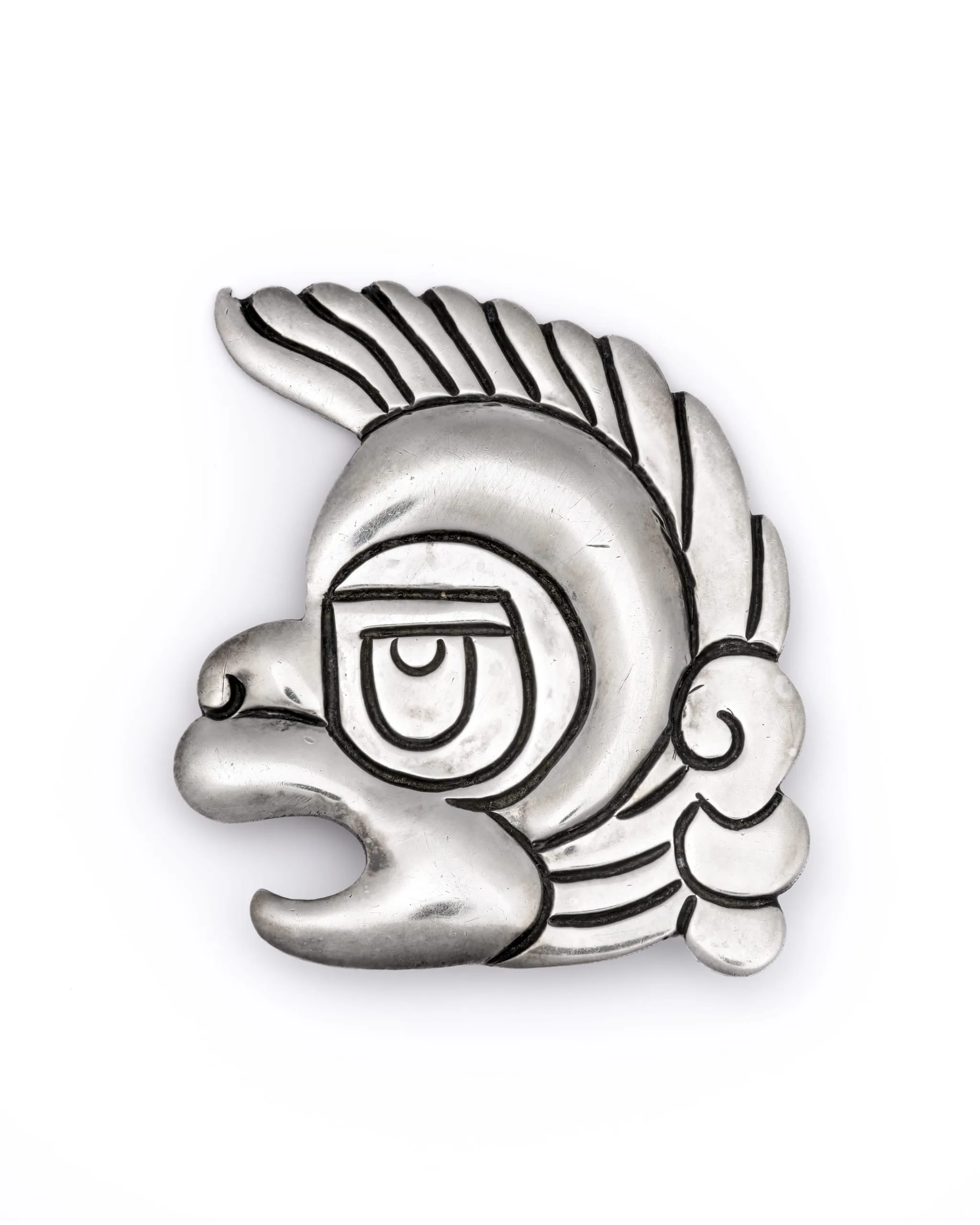
What is the Museum of Mexican Silver?
The Museum of Mexican Silver is a working scholarly catalog. Each record carries an attribution-confidence grade from A to E. A piece signed by its maker with documented provenance receives an A. A piece with maker-mark only and no published comparison receives a C. The grade is visible on the record, and the methodology is documented at /methodology. Citations are required for load-bearing claims. Records can be corrected by anyone, and corrections are tracked. The launch set is fifty pieces, drawn from the workshops above, anchored on the strongest examples that have entered the auction or museum record.
The point is not to publish a comprehensive census. The point is to publish a curated, sourced, correctable starting point that takes this work seriously as modern art. A reader who finishes the Tree of Life brooch entry should arrive at the next Spratling brooch understanding it as a sculptural decision in an extended body of work, not as a vintage object on a shelf. A collector who arrives looking for value should leave with a clearer picture of what is rare, what is published, and what the field has not yet absorbed. The full launch catalog is at /collection.
The argument of this essay is small. The work was modern art when it was made. The framing problem is the field's, not the work's. Reading these objects as sculpture is not a stretch, it is a return to what their makers were doing.
Sources
- Penny Chittim Morrill and Carole A. Berk, Mexican Silver: 20th-Century Handwrought Jewelry and Metalwork (Schiffer, revised edition, 1994). Foundational reference for the Taxco workshops, hallmarks, and design vocabularies. Spratling Silver mark and the 1943 Montgomery Ward catalog quote cited at p. 45. Workshop chronologies for Aguilar, Los Castillo, Pineda, Margot de Taxco, and the Mexico City makers covered across pp. 38-247.
- Penny Chittim Morrill, Silver Masters of Mexico: Héctor Aguilar and the Taller Borda (Schiffer, 1996). The standard reference for Aguilar's workshop and the broader Taxco school's institutional development.
- Gobi Stromberg, Silver Seduction: The Art of Mexican Modernist Antonio Pineda (Fowler Museum at UCLA, 2008). Catalog for the 2008 Pineda retrospective. Kim Richter's chronology of Pineda's hallmarks, including the Eagle 17 registration, at pp. 79-81. The book's framing of the Taxco school as a modernist movement is the most explicit institutional statement to date.
- Jane Adlin and Mark Rosenthal, Calder Jewelry (Yale University Press / Calder Foundation, 2008). Catalog for the Whitney Museum of American Art's 2008 Calder Jewelry exhibition. Reference for the Calder analogy that anchors this essay's argument.
- Museum holdings cited for Spratling and the Taxco school: the Smithsonian Institution (full Alaska-period Spratling holdings); the Smithsonian's National Museum of the American Indian; the Metropolitan Museum of Art; the Museum of Modern Art; the Los Angeles County Museum of Art (largest American holdings of Spratling and Taxco Golden Age silver); the Museo Franz Mayer in Mexico City. Specific accession-level claims are made on individual piece records; this essay cites institutional holdings at the collection level only.
- Bonhams Artist Jewelry sales 27697 (November 2022) and 29172 (June 2023), the Jill and Byron Crawford Collection, 119 lots of Taxco Golden Age silver. Cited as the public, provenanced cross-section of mid-century pricing referenced in the auction-record argument above. Catalog entries public on bonhams.com.
More in Dispatches
How Rare Is William Spratling, Anyways?
Spratling is the most famous name in twentieth-century Mexican silver. Las Delicias was, in its peak years, the largest silver workshop in Mexico. None of that means his pieces are easy to find today. Across the 2,094 named-Spratling lots that have crossed a published auction since 2007, the median clears at $750, the top decile at $2,600, and only fourteen have ever cleared $10,000. Production was numerous. Survival is not.
The Value of Collecting the Taxco Golden Age
Taxco silver has beauty, history, scarcity, and market inefficiency in the same place. The auction record across 1,156 weighable Golden Age lots, with each lot's melt value computed at the silver spot in effect on the day it sold, shows the spread: a typical Spratling or Pineda piece clears at roughly ten times its silver weight, the best examples clear sixty to a hundred times, and the same makers' hollowware regularly sells below melt at the wrong auction. The drift between the metal floor and the recognition ceiling is the entire opportunity.
The Jill and Byron Crawford Collection at Bonhams
One couple's Taxco Golden Age jewelry, 119 lots across every major workshop of the era, cleared through two Bonhams sales in 2022 and 2023. The results are a cleaner benchmark for the middle of the market than collectors remember.