
Dispatch · September 30, 2026
The Silson Period in Spratling Silver
For a few wartime years, some William Spratling designs were produced in silver plate by Victor Silson's company. They are real evidence of Spratling's commercial reach, but they are not the handwrought Taxco silver that should anchor the public collection.
5 min read
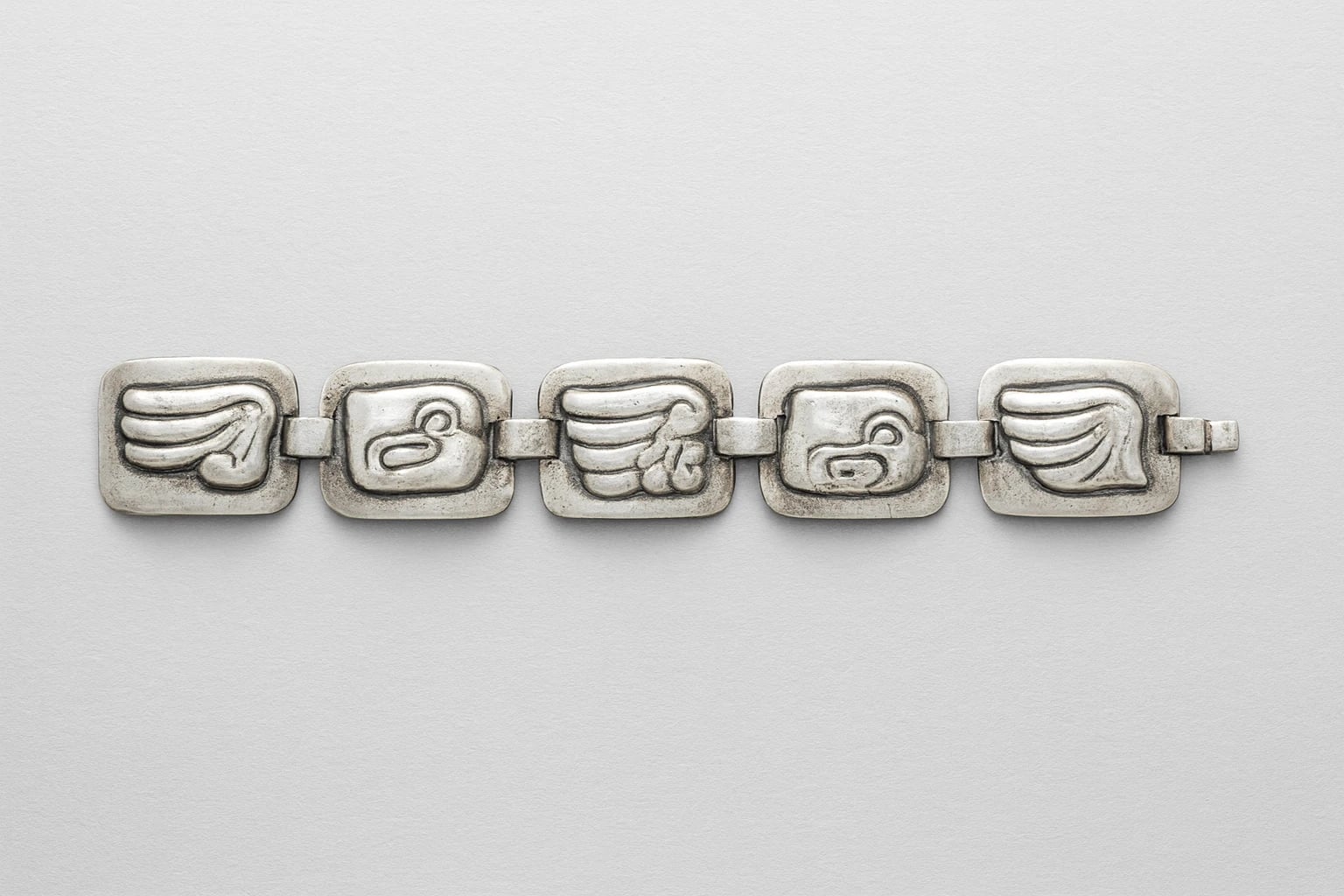
The Silson pieces are not fakes. They are also not the center of William Spratling's achievement.
That distinction matters because the mark can confuse even careful collectors. A piece stamped SPRATLING OF MEXICO SILSON INC. or PAT PEND SPRATLING OF MEXICO SILSON INC. carries the Spratling name, but it belongs to a short wartime production arrangement in which some Spratling designs were made in silver plate by Victor Silson's company. It documents reach, licensing, and American commercial distribution. It does not document the handwrought 980 silver work that made Spratling central to the Taxco school.
That is why the museum has temporarily hidden the Silson silver-plate pieces from the public catalog. They are useful study material, and they will return in the right interpretive context. But a first encounter with Spratling should foreground the work that changed the field: the hand-fabricated silver, the wood and obsidian constructions, the hollowware, the sculptural brooches, the named designs, and the workshop objects that made Taxco matter internationally.
What was the Silson period?
The Silson period was a short wartime episode in Spratling's commercial expansion. Hougart summarizes it directly: between 1940 and 1945, some Spratling designs were produced in silver plate by Victor Silson's company, Silson. Morrill's chronology places the key corporate moment in the same window: Silson patents were registered in the United States in 1940 and 1941, and by 1941 Silson, Inc. in New York was producing Spratling designs.
The pieces usually carry marks that announce the arrangement rather than hiding it. Hougart lists two relevant marks: WS PAT PEND SPRATLING OF MEXICO SILSON INC., dated ca. 1940-42, and WS SPRATLING OF MEXICO SILSON INC., dated 1940-44. Morrill illustrates the Silson patent drawing from 1940. In other words, this was not later misattribution. It was a documented business arrangement around Spratling designs.
The material is the important divider. These are silver-plate pieces, not Spratling workshop silver. They were made for broader commercial production at a moment when Spratling's name was moving through American retail channels. That makes them historically interesting. It also makes them categorically different from a Las Delicias object made in Taxco in 980 silver.
Why did Spratling do it?
Spratling was not only a designer. He was a builder of markets.
By the early 1940s, the Taxco workshop had become a major employer. Hougart notes that by 1944 Spratling employed well over 300 people. Morrill and Berk describe the workshop's wartime scale and the way Spratling Silver entered American retail culture, including Montgomery Ward catalogues from 1943 to 1946. That context is the plain explanation for Silson: the demand for the look of Spratling was wider than the handwrought Taxco workshop could or should satisfy.
Silver plate let a design move through a different channel. It lowered the material cost. It made the object easier to sell in quantity. It separated the commercial idea from the labor and metal standard of the Taxco shop.
That was not unusual in mid-century design. Important designers often had multiple production tracks: studio work, workshop work, licensed manufacture, department-store editions, export lines. The problem comes later, when every track gets flattened into one market label. Spratling then becomes a single category, and the distinction between a handwrought 980 silver brooch and a plated Silson brooch begins to disappear.
The museum's job is to put that distinction back.
How should collectors read a Silson mark?
A Silson mark should be read as a licensed or commercially produced Spratling-design object from the early 1940s, made in silver plate. It should not be read as evidence that the piece is one of Spratling's handwrought Taxco silver objects.
That does not make the object worthless or illegitimate. It makes it a different kind of evidence. A Silson piece can show which motifs Spratling believed would travel commercially. It can show how his designs were simplified or adapted for plated manufacture. It can also help identify solid-silver workshop versions of related designs, because some forms existed in both tracks.
But the collector should not collapse those tracks. A Silson piece belongs in the study of Spratling's reach. A Taxco silver piece belongs in the study of Spratling's art.
That is also why price comparisons can mislead. A plated commercial brooch and a handwrought silver brooch may share a motif, a design family, or even a general silhouette. They do not share the same material fact, labor fact, or collecting meaning. The Silson piece is a document of distribution. The Taxco silver piece is the authored work.
Why hide the Silson pieces from the public catalog now?
Because the museum is still teaching visitors what matters first.
A complete scholarly catalog should eventually show the Silson period. It should show the marks, the patents, the plated pieces, the solid-silver analogues, the Montgomery Ward retail context, and the American distribution story. That is real history.
But the public collection is also an argument. It is saying that Mexican modernist silver is modern art, not merely vintage jewelry or decorative merchandise. If the visible Spratling catalog is cluttered with plated commercial pieces, the first lesson gets weaker. Visitors see quantity before hierarchy. They see the brand before the work.
So the Silson pieces have been moved out of the main public flow for now. We are keeping the records internally. We are keeping the evidence. The next version should be a dedicated study page or guide section where the Silson period can be explained on its own terms, with the necessary warning: these pieces matter, but they matter differently.
That is the larger point. The Spratling name is not enough. The mark, material, production context, and workshop path all matter. The highest art of the Taxco school came from handwrought silver made inside a design culture. Silson helps explain how far that design culture traveled. It should not be mistaken for the thing itself.
Sources
- Bille Hougart, The Little Book of Mexican Silver Trade and Hallmarks (2018), pp. 144 and 151. Hougart identifies Victor Silson's company Silson as the silver-plate producer for some Spratling designs between 1940 and 1945 and lists the two Silson marks,
PAT PENDca. 1940-42 andSPRATLING OF MEXICO SILSON INC.1940-44. - Penny Chittim Morrill and Carole A. Berk, Mexican Silver: 20th-Century Handwrought Jewelry and Metalwork (Schiffer, revised edition, 1994), p. 53 and chronology pp. 257 ff. Morrill illustrates the 1940 Silson patent drawing and records the 1940-41 patent registrations, the 1941 Silson, Inc. New York production of Spratling designs, and Spratling Silver's 1943-46 Montgomery Ward catalogue presence.
- Museum of Mexican Silver catalog operation, September 30, 2026. Thirty-nine visible Spratling silver-plate records whose title, description, or curatorial note identified Silson were hidden from the public collection; the non-Silson visible Spratling silver-plate pitcher remained public.
More in Dispatches
Why Mexican Modernism Is Modern Art
Alexander Calder's jewelry was received as art the moment he made it, because he was already known as a sculptor. The Taxco school had no such advocate, and a half-century of mid-century Mexican silver has been miscategorized as vintage jewelry rather than what it is: modern sculpture.
How Rare Is William Spratling, Anyways?
Spratling is the most famous name in twentieth-century Mexican silver. Las Delicias was, in its peak years, the largest silver workshop in Mexico. None of that means his pieces are easy to find today. Across the 2,094 named-Spratling lots that have crossed a published auction since 2007, the median clears at $750, the top decile at $2,600, and only fourteen have ever cleared $10,000. Production was numerous. Survival is not.
The Value of Collecting the Taxco Golden Age
Taxco silver has beauty, history, scarcity, and market inefficiency in the same place. The auction record across 1,156 weighable Golden Age lots, with each lot's melt value computed at the silver spot in effect on the day it sold, shows the spread: a typical Spratling or Pineda piece clears at roughly ten times its silver weight, the best examples clear sixty to a hundred times, and the same makers' hollowware regularly sells below melt at the wrong auction. The drift between the metal floor and the recognition ceiling is the entire opportunity.