Saves instantly, no account needed. Already a member? Sign in.
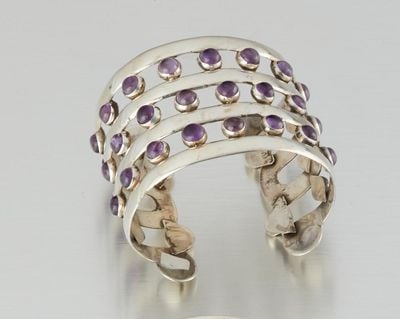
Five parallel silver bands run the width of this cuff, and each carries a row of round amethyst cabochons set at regular intervals. The design gains its character from repetition managed at two scales: the bands repeat across the wrist, and within each band the purple stones repeat along its length. The result is a grid of color held in silver, ordered rather than lush, closer to the logic of a woven structure than to the clustered stone settings that appear elsewhere in Héctor Aguilar's amethyst work.
The band construction is the governing decision. Rather than a single broad sheet of silver, the cuff is built from separate parallel runs, and the back is worked in pierced openwork. That piercing reduces mass and lets the metal breathe against the wrist, so a wide cuff carrying multiple rows of stones need not become a solid weight of silver. The amethyst cabochons, cut round and domed, sit as evenly spaced points of translucent color; where the settings meet the light, the purple reads against the warmer tone of the silver. The spacing is consistent enough that the eye follows the horizontal bands first and then registers the vertical alignment of stone to stone across them, a quiet secondary rhythm within the primary one.
Aguilar's amethyst bracelets, made under his Taller Borda mark in Taxco, take several forms in the documented record. Morrill's survey of his work catalogs square amethyst bracelets, rounded amethyst bracelets, hinged and curved examples, and versions with braided or diamond-shaped tubular hinges, several of these set in flanged squares that turn each stone into a distinct faceted unit. This wide banded cuff belongs to that family of amethyst work but resolves it differently. Where the hinged bracelets rely on articulated links and beaded borders to build movement and surface variety, this design holds the stones in continuous parallel bands and finds its interest in the steady repetition of round cabochons rather than in the play of hinges. It is a more even, more architectural handling of the same material vocabulary.
Amethyst quartz was a favored stone in Aguilar's Taxco production, valued for a color that carries well against silver without the expense of imported gemstones, and its use here is characteristic of the workshop's material intelligence. This cuff records a specific way of organizing that material: color distributed as an ordered field across the wrist, with the weight of a wide cuff relieved by openwork behind. It documents a resolved and legible variant within Aguilar's amethyst work and the disciplined, structural sensibility that distinguishes Taller Borda from the more ornamental strands of Taxco design.
Museum of Mexican Silver. “Amethyst Wide Four Bands Bracelet.” Catalog no. MoMS-002168. https://museumofmexicansilver.com/pieces/aguilar-five-row-amethyst-cuff
See something wrong with this record? Suggest a correction and the piece details fill in automatically.
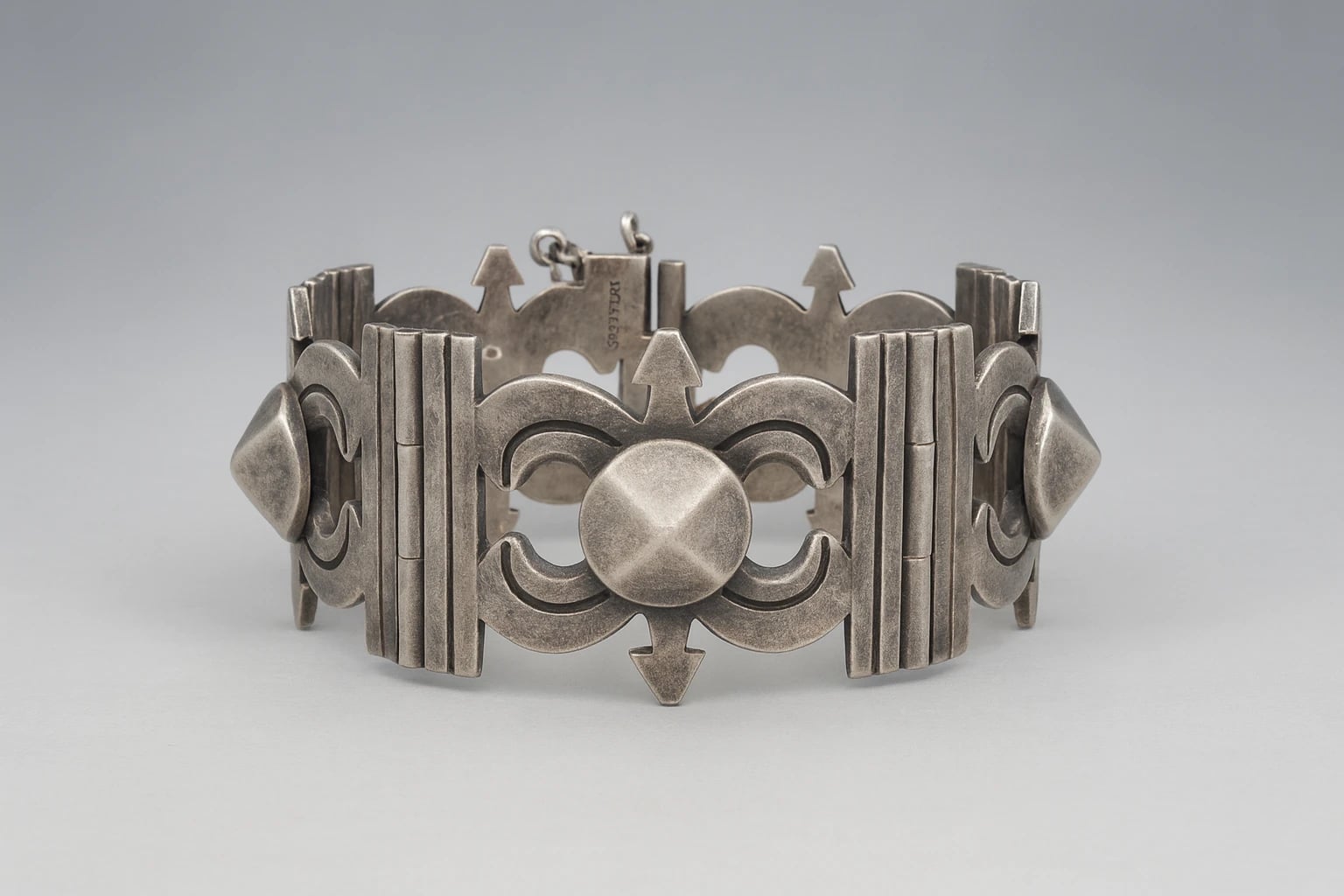
Héctor Aguilar
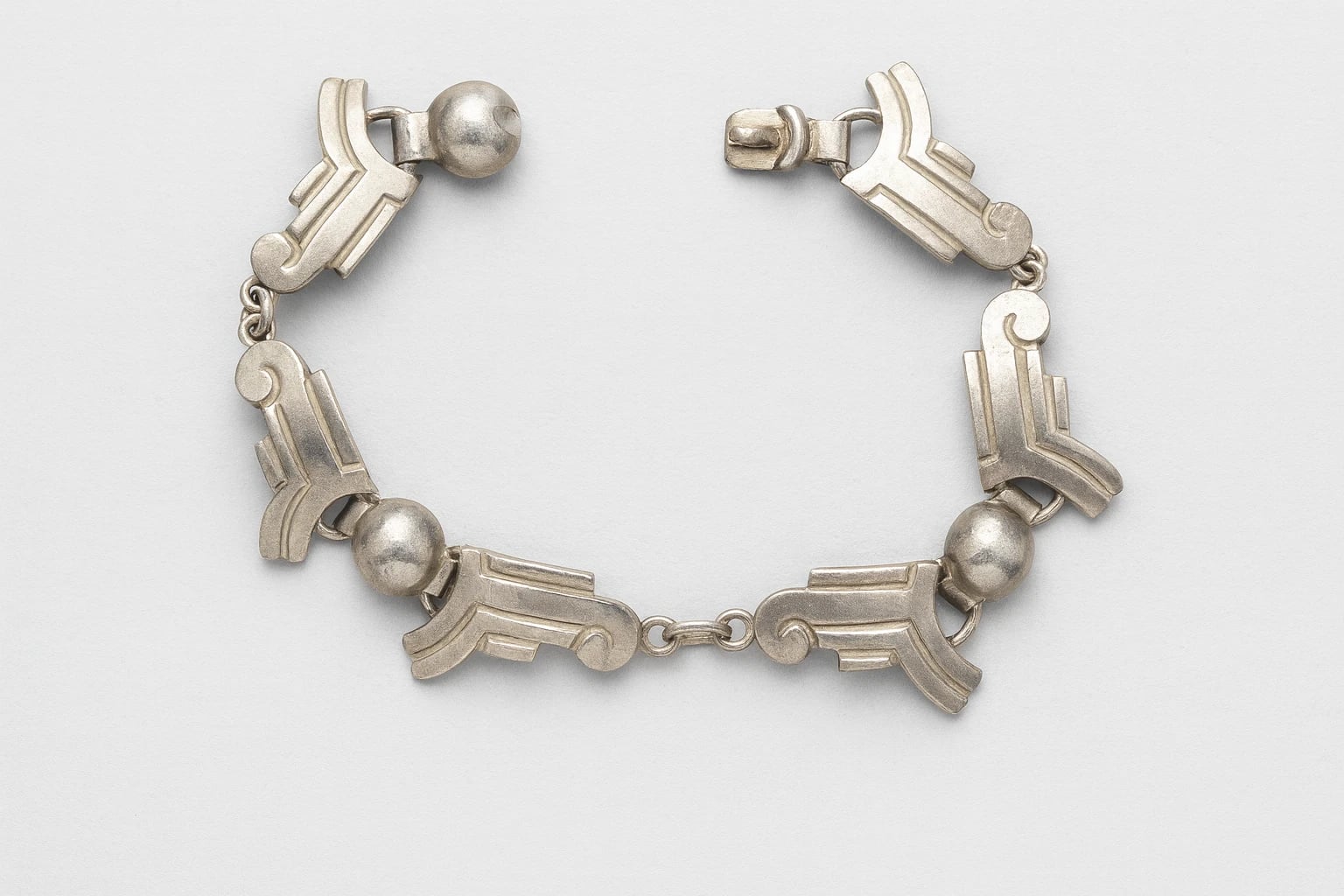
Pyramidal-and-Silver-Ball Link Bracelet
Sterling silver