Saves instantly, no account needed. Already a member? Sign in.
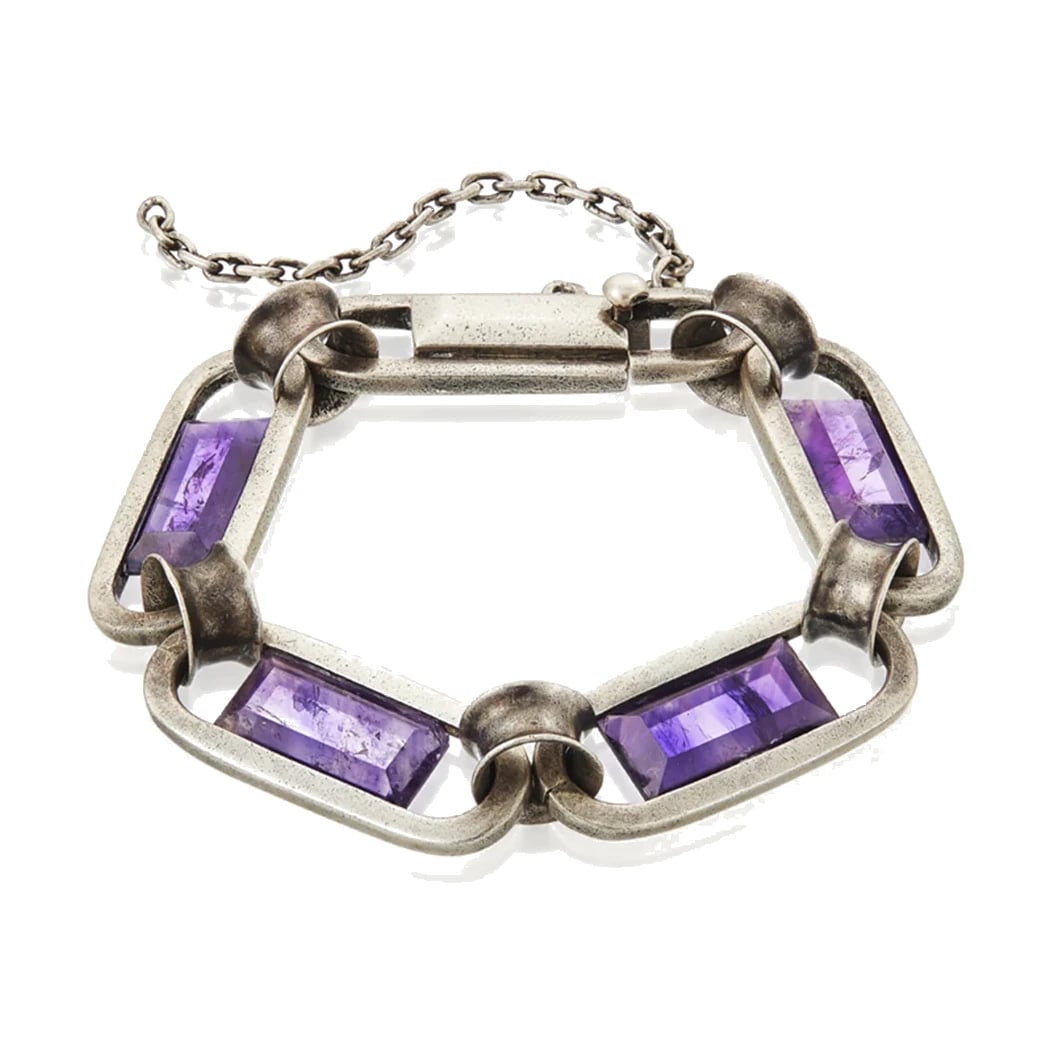
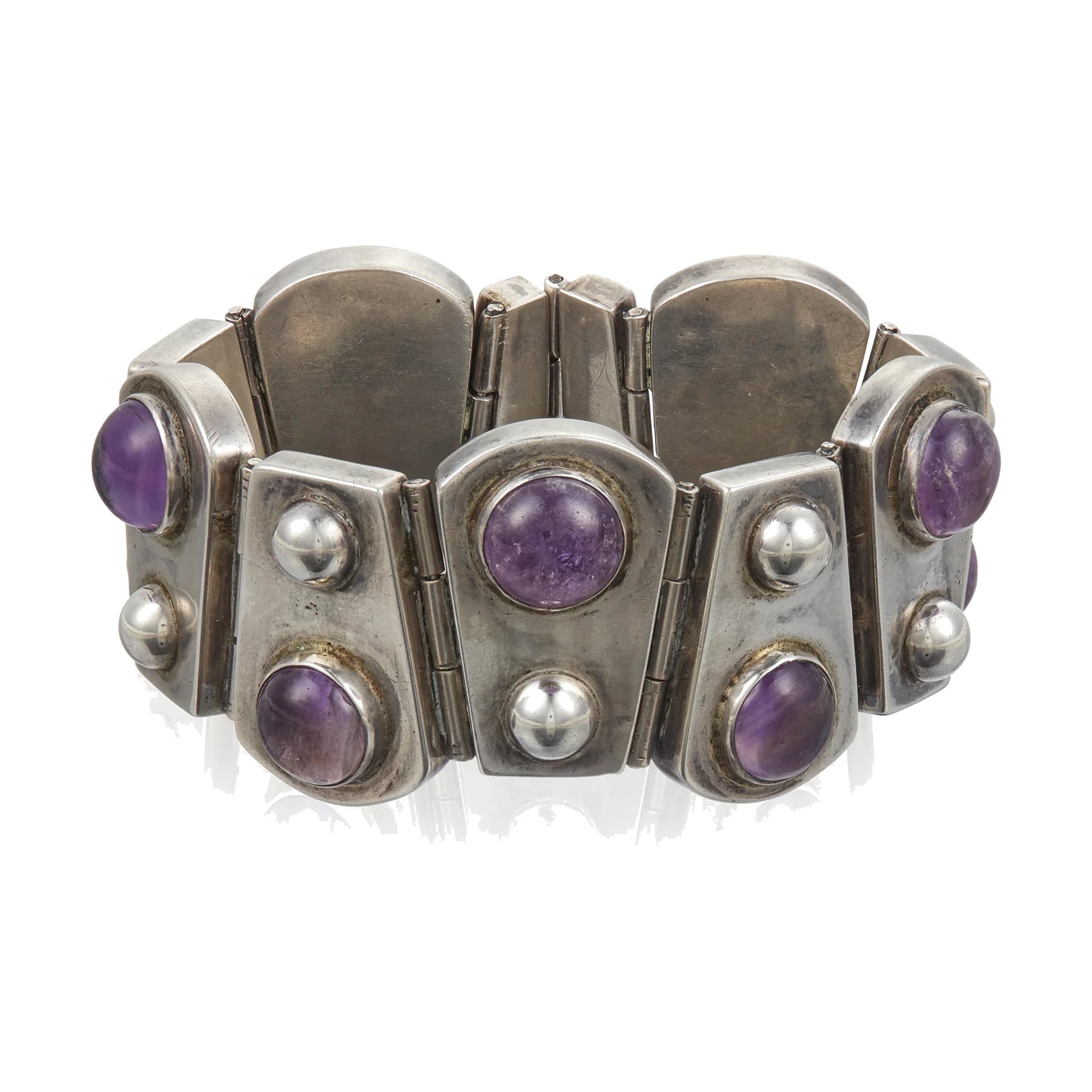
Broad rectangular plaques of silver ride the wrist in a row, each carrying a single domed amethyst cabochon in a deep bezel and flanked by a pair of raised round bosses that swell like beads of the same bright metal. The bracelet runs on alternation: soft violet translucence against hard polished silver, the cool ground against the warm color of the stone. Articulated at every hinged joint, the heavy links flex so the band rides the arm as one sculptural volume rather than a string of set jewels. It is an early, confident piece by Antonio Pineda, who would come to define the ambition of mid-century Taxco.
The vocabulary is architectural rather than floral. Stone and boss are treated as equal sculptural events, set into the plane of each plaque so the piece holds real depth in the hand. The amethysts are cut as smooth cabochons, their domed faces made to glow rather than sparkle against the bright silver.
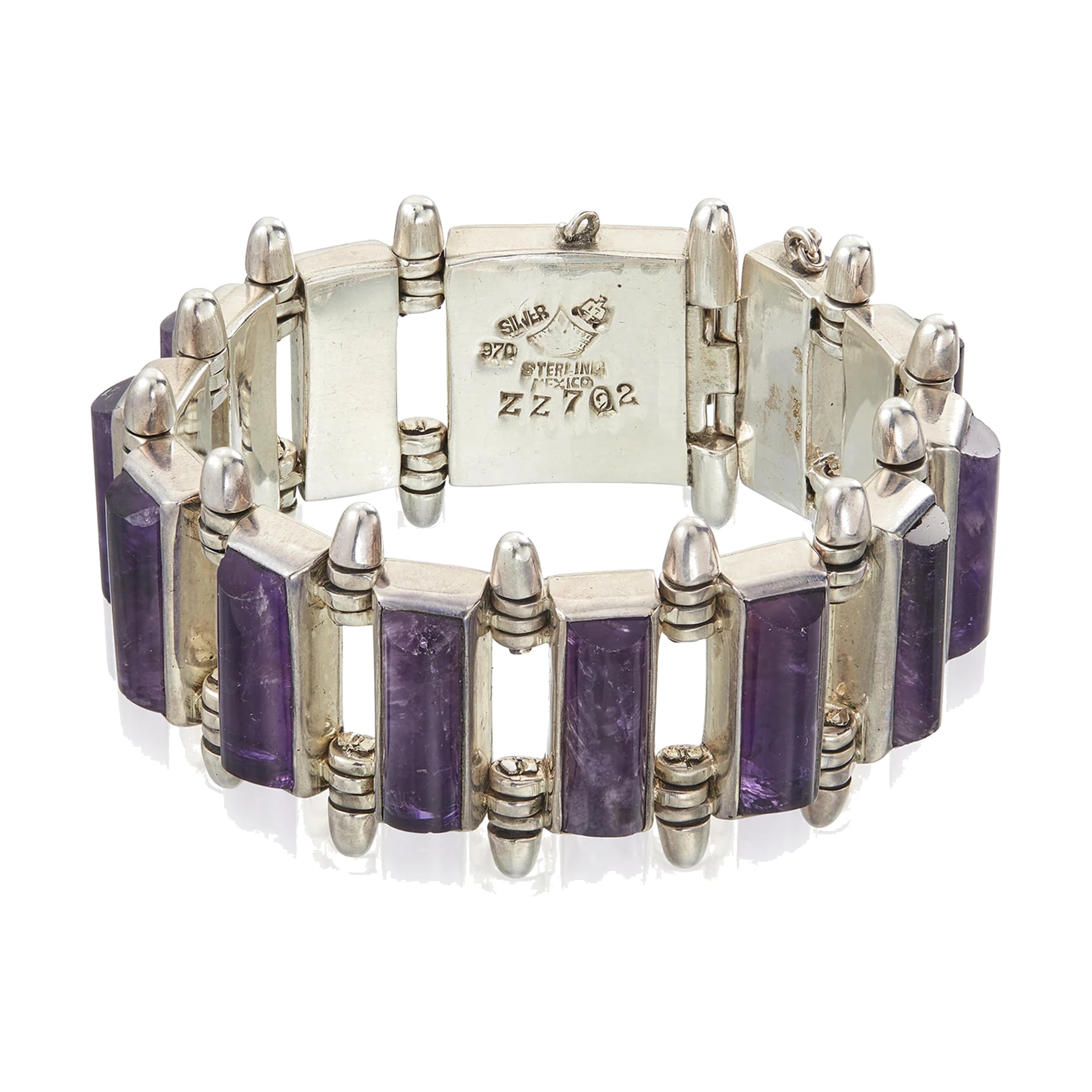
The reverse carries the SILVER BY TOÑO / MEXICO mark. "Toño" is the affectionate diminutive of Antonio, and that signature belongs to a narrow window in his early production, roughly 1948 to 1953, after the simple AP hallmark he used through the 1940s and before the Antonio-crown mark became his standard, as Morrill and Stromberg both record. Pineda had opened his own workshop on the Taxco zócalo in 1941, and this bracelet comes from the years when that independent shop was finding its sculptural idiom.
The same construction was worked a second time in black onyx, the two bracelets reading as one design resolved in two registers of color, violet and dark.
Record data: Materials now read silver and amethyst; the field previously listed silver alone. The date is entered as 1948-1953 on the authority of the SILVER BY TOÑO mark described above, and that mark is now recorded in the Marks field. Note one internal discrepancy for a reader to resolve: this catalog's hallmark guide dates the Silver by Toño stamp c.1945-c.1948, while Morrill and Stromberg, as cited in this note, place it roughly 1948-1953. The wider reading 1945-1953 is the safe outside range until the two chronologies are reconciled.
Museum of Mexican Silver. “Amethyst and Silver Link Bracelet.” Catalog no. MoMS-002107. https://museumofmexicansilver.com/pieces/antonio-pineda-amethyst-and-silver-link-bracelet
See something wrong with this record? Suggest a correction and the piece details fill in automatically.
Antonio Pineda
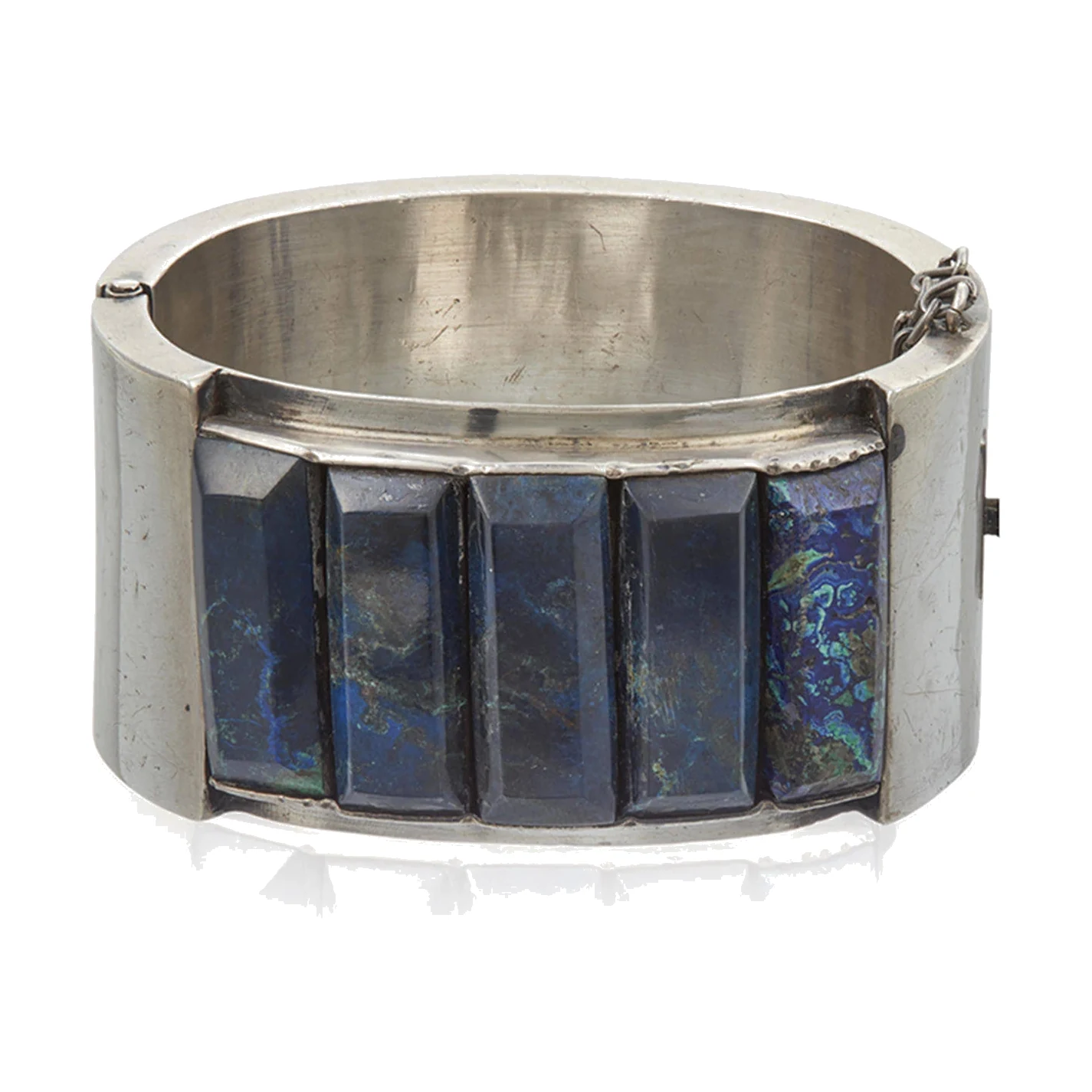
Azurmalachite and Silver Cuff Bracelet
Silver