Saves instantly, no account needed. Already a member? Sign in.
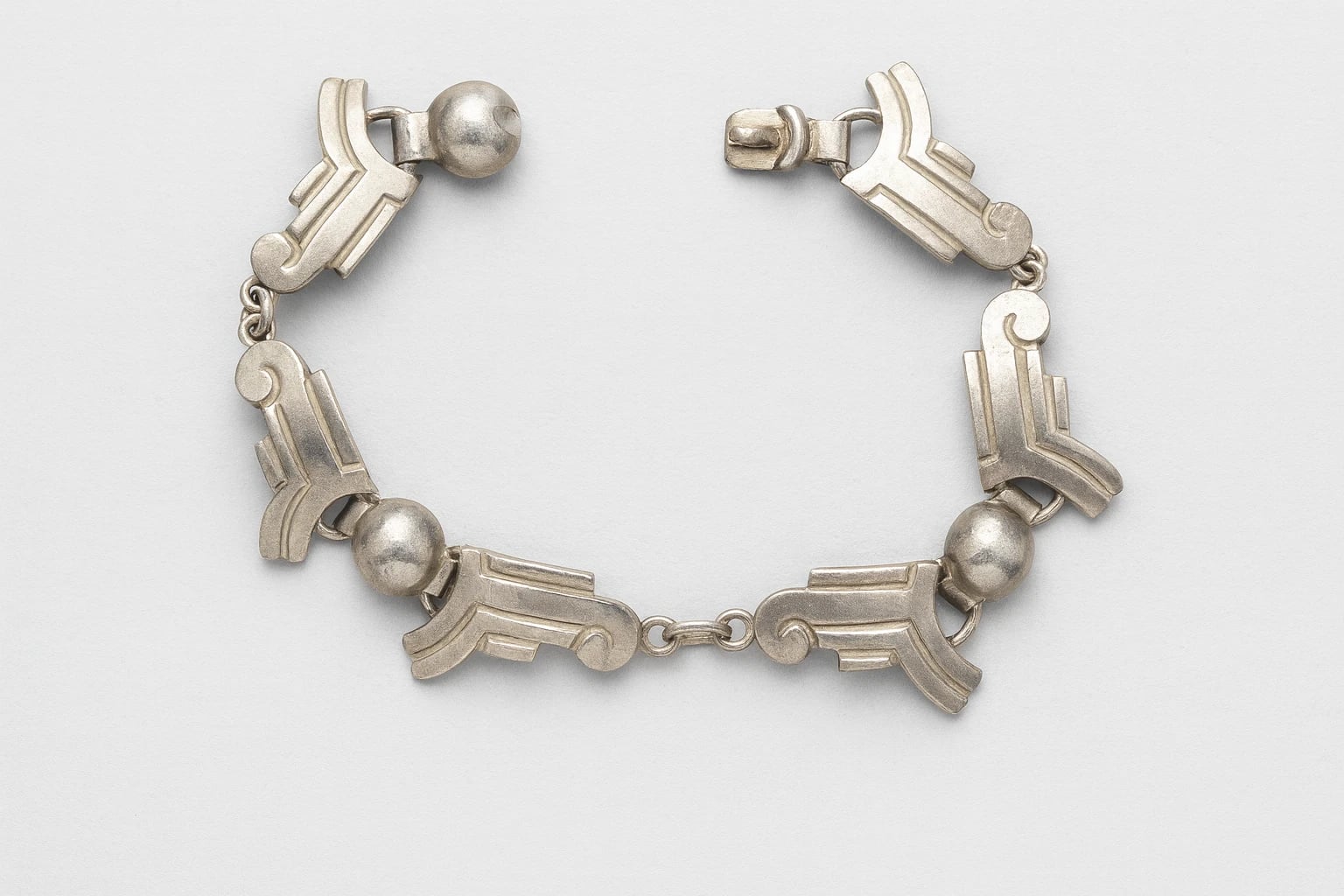
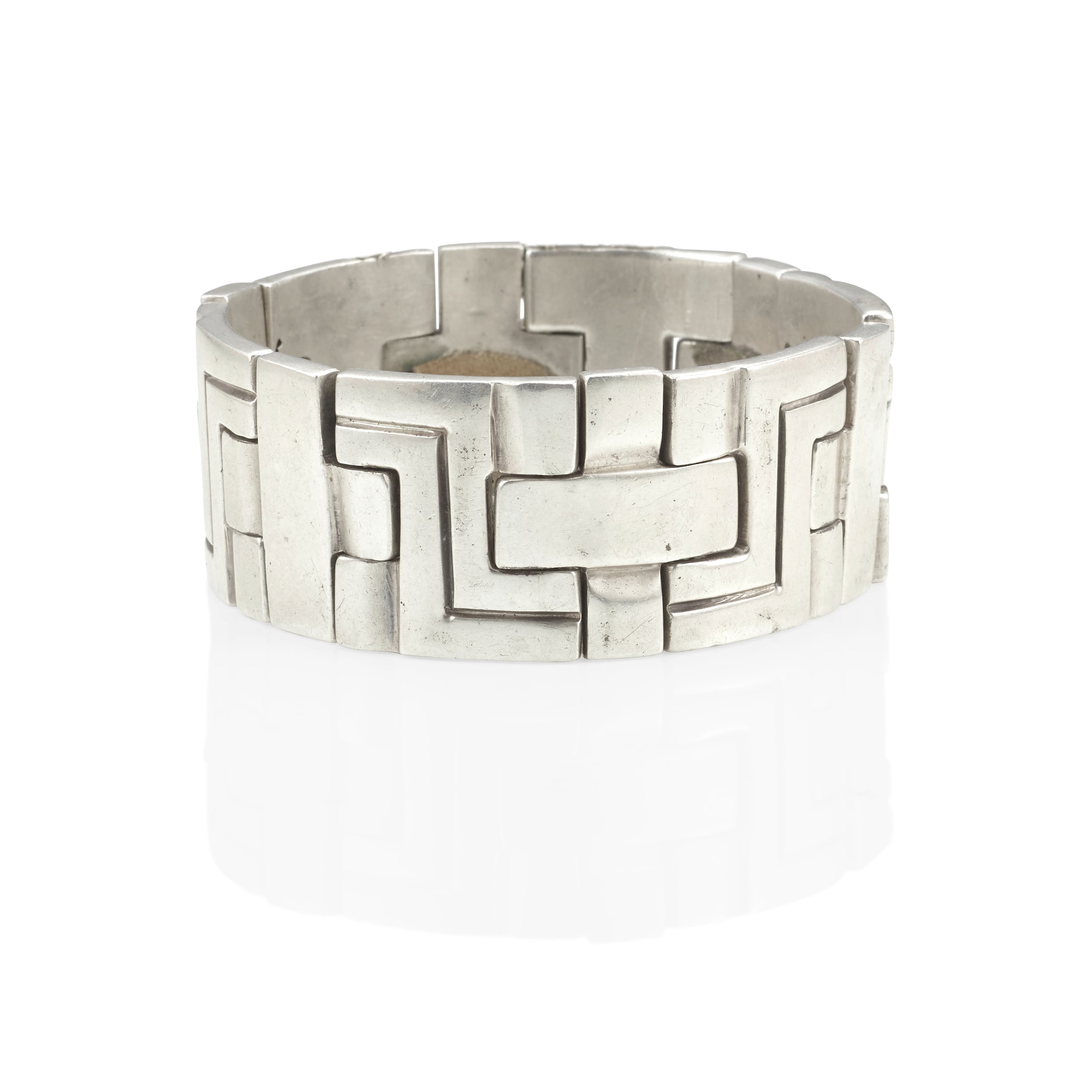
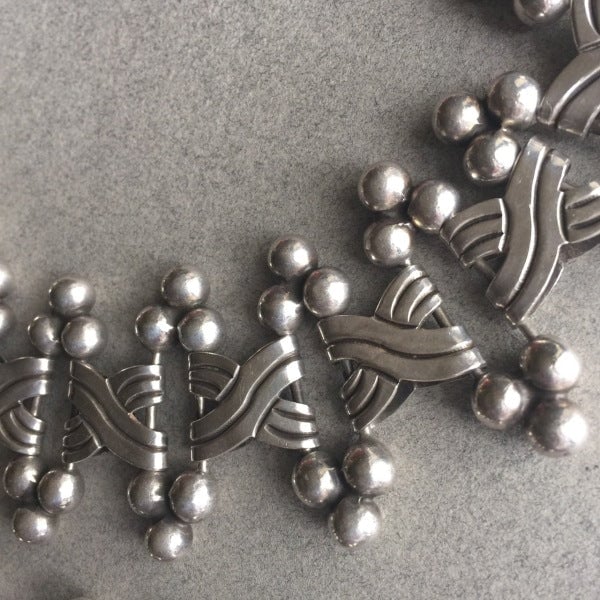
This wide sterling bracelet is Héctor Aguilar working in his most purely geometric register, and it belongs to the mature phase of the Taller Borda when interlocking, rectilinear design had become a confident vehicle for the workshop's discipline. Rather than carrying relief ornament on the surface of each link, the band is built from links that themselves interlock as stepped, key-like shapes: L-forms and T-forms that key into one another to produce a continuous meander, a silver reworking of the Greek fret and, by extension, of the stepped grecas found in Pre-Columbian architecture and textiles. The pattern is the structure, and the structure is the pattern. Assigned to about 1955 and recorded as property from the collection of Jill and Byron Crawford, whose holdings include documented Aguilar jewelry in the standard literature, it sits within the well-collected core of the workshop's output.
The engineering is the quiet achievement here. Each substantial element is cut and finished so that it interlocks with its neighbors along stepped edges, yet the links remain articulated enough to flex and follow the wrist. Seen in aggregate the band presents an almost unbroken field of planes and right-angled channels, so that shadow lines run continuously across the face and shift as the bracelet moves, animating what is otherwise a rigorously flat, matte-to-bright surface. The width and weight give it real presence and a satisfying architectural heft, while the interlocking joinery keeps it wearable rather than stiff. Nothing is applied and nothing is figural; the entire visual interest is generated by how the geometric units meet. This is a designer trusting a single formal system to carry an object, and calibrating scale and finish precisely enough that it does.
The fret and stepped-key vocabulary carried a particular resonance in mid-century Taxco. It let a designer be at once modern and rooted, aligning the piece with the clean geometry of Art Deco and international modernism while quietly invoking the greca of ancient Mesoamerican design, a doubling that was central to Mexican modernism's search for a national idiom built from indigenous form. By the 1950s Aguilar had spent close to two decades refining exactly this kind of clean-edged, fully resolved design, and the wide interlocking-link bracelet is one of the forms in which that refinement is most legible. It is architecture for the wrist, and it reads as such.
A museum collection is well served by this bracelet because it shows the abstract, geometric side of the Taxco renaissance at full maturity and with impeccable resolution. It teaches how a Taxco master could take an ornamental motif with both classical and Pre-Columbian ancestry and rebuild it as pure interlocking structure, and its documented provenance in a known collection of Aguilar material strengthens its value as a reference object. As a clean, confident statement of geometry as ornament in its own right, it earns preservation and display.
Museum of Mexican Silver. “Geometric Link Bracelet.” Catalog no. MoMS-001917. https://museumofmexicansilver.com/pieces/aguilar-geometric-link-bracelet
See something wrong with this record? Suggest a correction and the piece details fill in automatically.
Héctor Aguilar
“Six Spheres” Bracelet
Sterling silver