Saves instantly, no account needed. Already a member? Sign in.
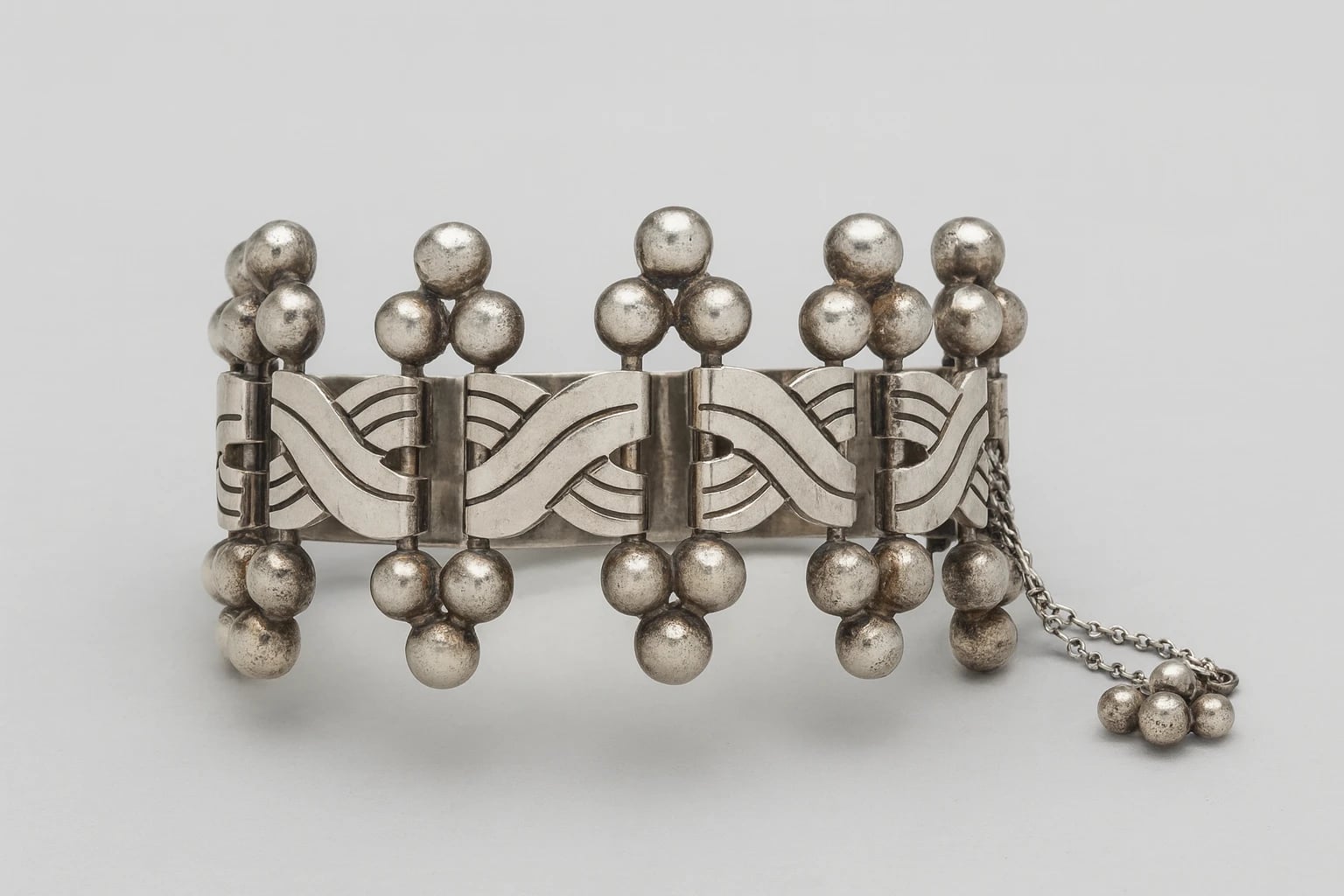
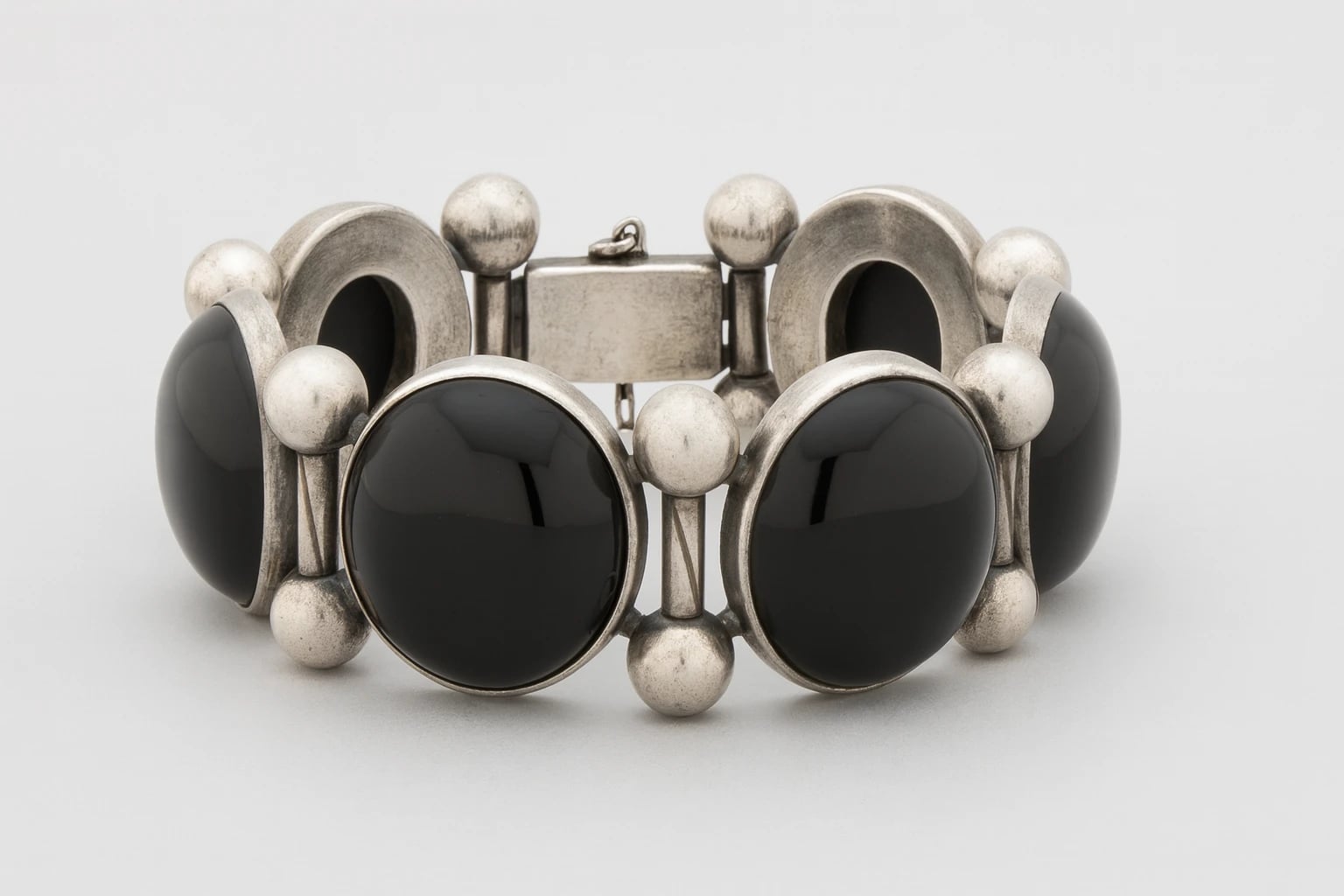
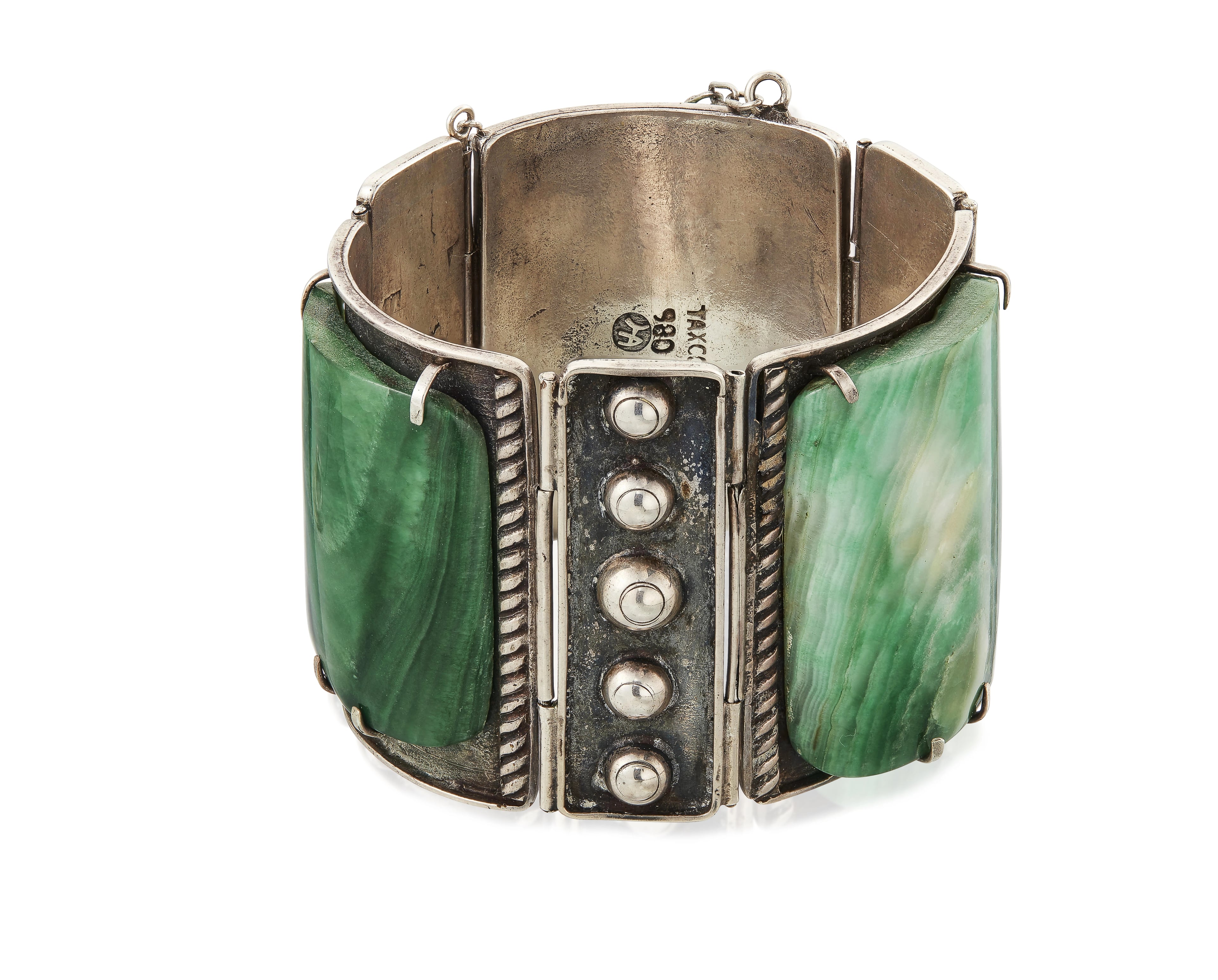
This hinged cuff brings hardstone into Héctor Aguilar's architectural bracelet language, and it does so with an unusual clarity about the relationship between the stone and the silver that carries it. Large domed cabochons of black onyx are set in a row around the wrist, each bezel-mounted and separated from the next by short bar links and by paired clusters of polished silver balls. The onyx is not treated as a jewel to be admired for its own sake but as a structural element, a series of dark voids that alternate with the bright volume of the silver spheres. The effect is emphatically graphic: the eye moves around the cuff in a steady beat of black disc, silver bar, silver ball, and the piece reads almost as a diagram of contrast made wearable. This is Aguilar using gem material to sharpen a form rather than to soften it.
The engineering is that of a proper cuff rather than a light bangle. The band is hinged so that it opens to admit the wrist and closes on a tongue clasp with a safety chain, and the mass of the onyx and the applied spheres gives the bracelet real presence and weight on the arm. The bezels rise from the silver ground so that the cabochons sit proud of the band, catching light on their polished domes while the flat black of the stone absorbs it, a deliberate opposition of surface that the design exploits throughout. Everything is subordinated to the overall rhythm; no single stone is allowed to dominate, and the silver structure remains legible as the governing idea. That subordination of gem to form is the quality that distinguishes the piece from the more conventional stone-set cuffs of the period, in which the metal is often merely a setting for the stone.
Within the Taxco context the bracelet reflects the modernist confidence that ran through Aguilar's best work. The Taller Borda, which he ran from 1939 until its closing in 1962, produced both handwrought silver and a large volume of pressed jewelry, and it was in the handwrought designs that his architectural sensibility came through most strongly. The pairing of black hardstone with polished silver aligns the cuff with the broader graphic vocabulary of Mexican Modernism, where bold contrast and clean geometry were prized over naturalistic ornament. The choice of onyx in particular, rather than the amethyst or malachite favored elsewhere in Taxco, keeps the palette severe and the emphasis on structure.
This is not as historically central as the named designs that anchor Aguilar's reputation, and its value should be described honestly as that of a strong, representative canon piece rather than a landmark. Its usefulness to a museum collection is real nonetheless. It documents the workshop's stone-and-silver work, and more importantly it captures a specific and instructive design decision, the demotion of gem material from ornament to component. A collection that holds this cuff can show, in a single object, how Aguilar thought about the role of a stone within a larger architectural whole, which is exactly the kind of insight that separates a serious survey of Taxco silver from a display of pretty things.
Museum of Mexican Silver. “Sterling Silver and Onyx Cuff Bracelet.” Catalog no. MoMS-001963. https://museumofmexicansilver.com/pieces/aguilar-sterling-silver-and-onyx-cuff-bracelet-18
See something wrong with this record? Suggest a correction and the piece details fill in automatically.
Héctor Aguilar
Jade and Silver Bracelet
Silver