Saves instantly, no account needed. Already a member? Sign in.
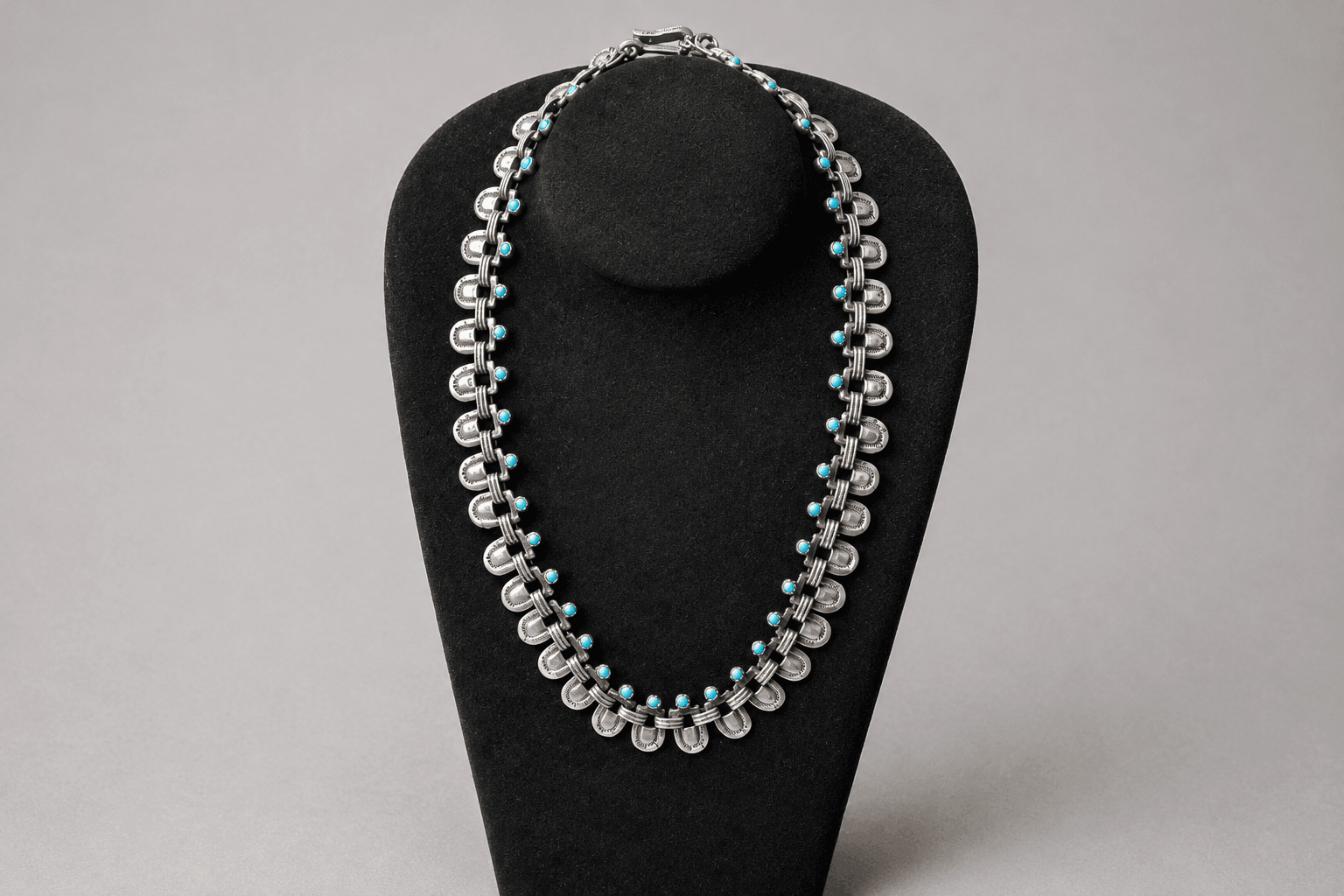
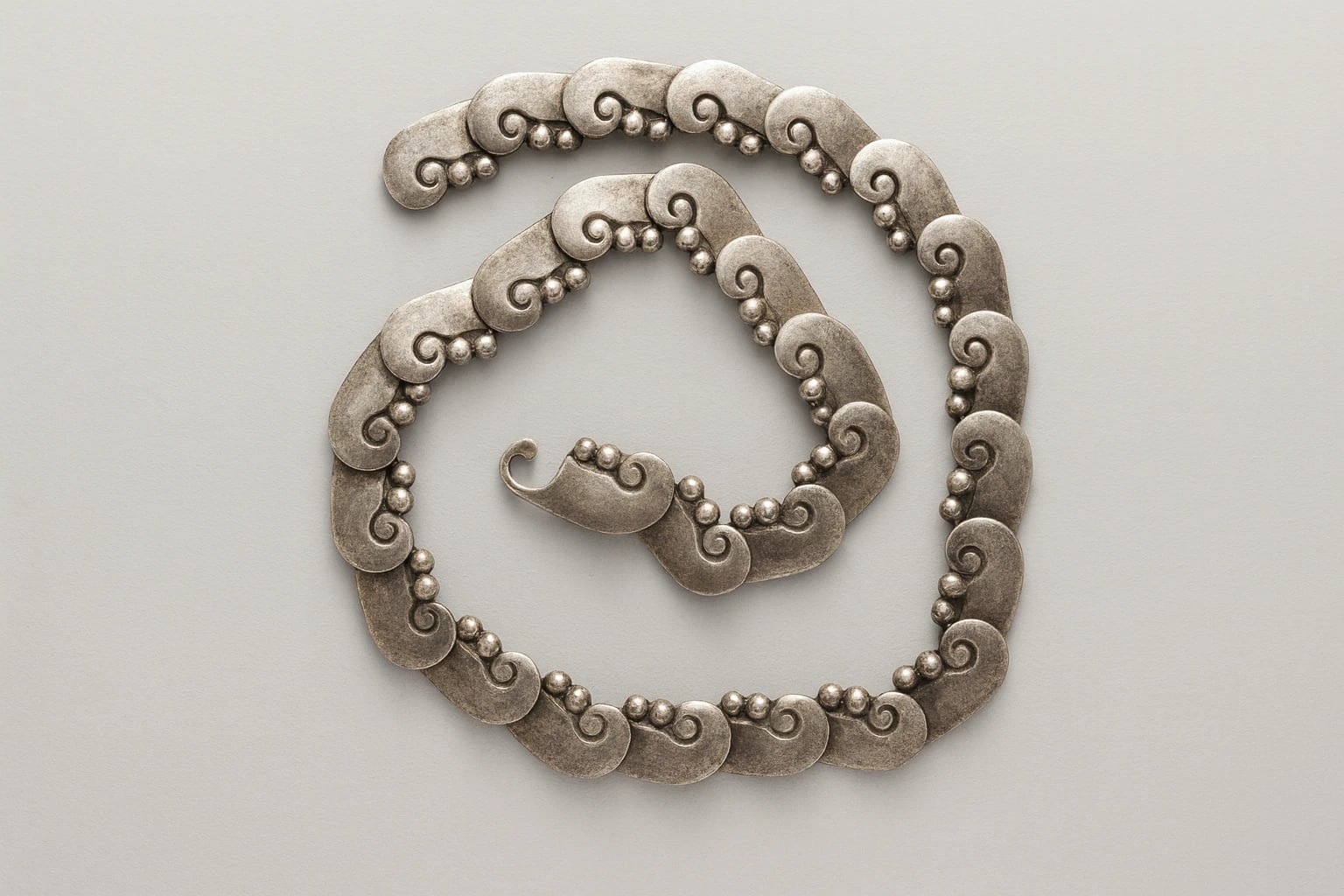
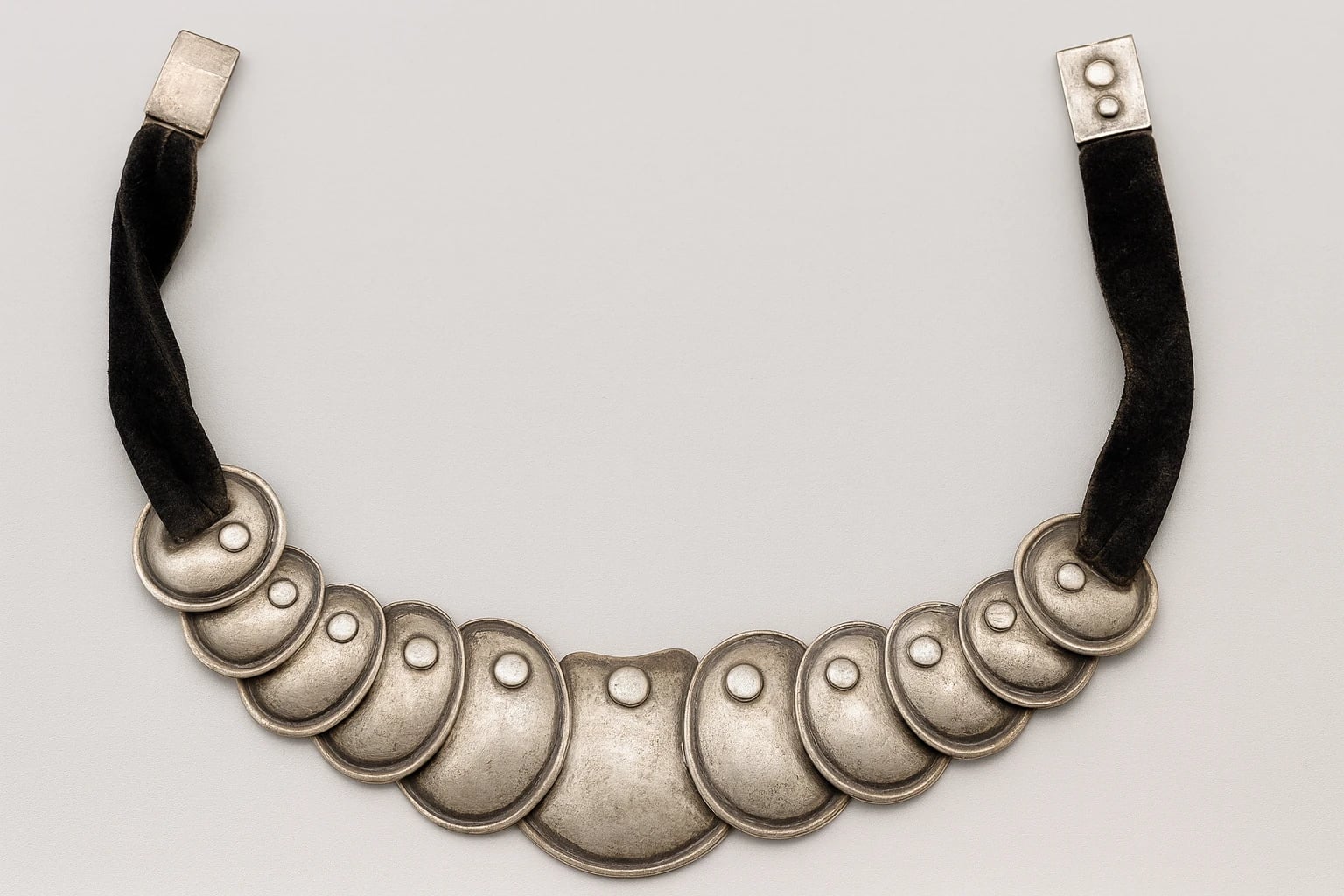
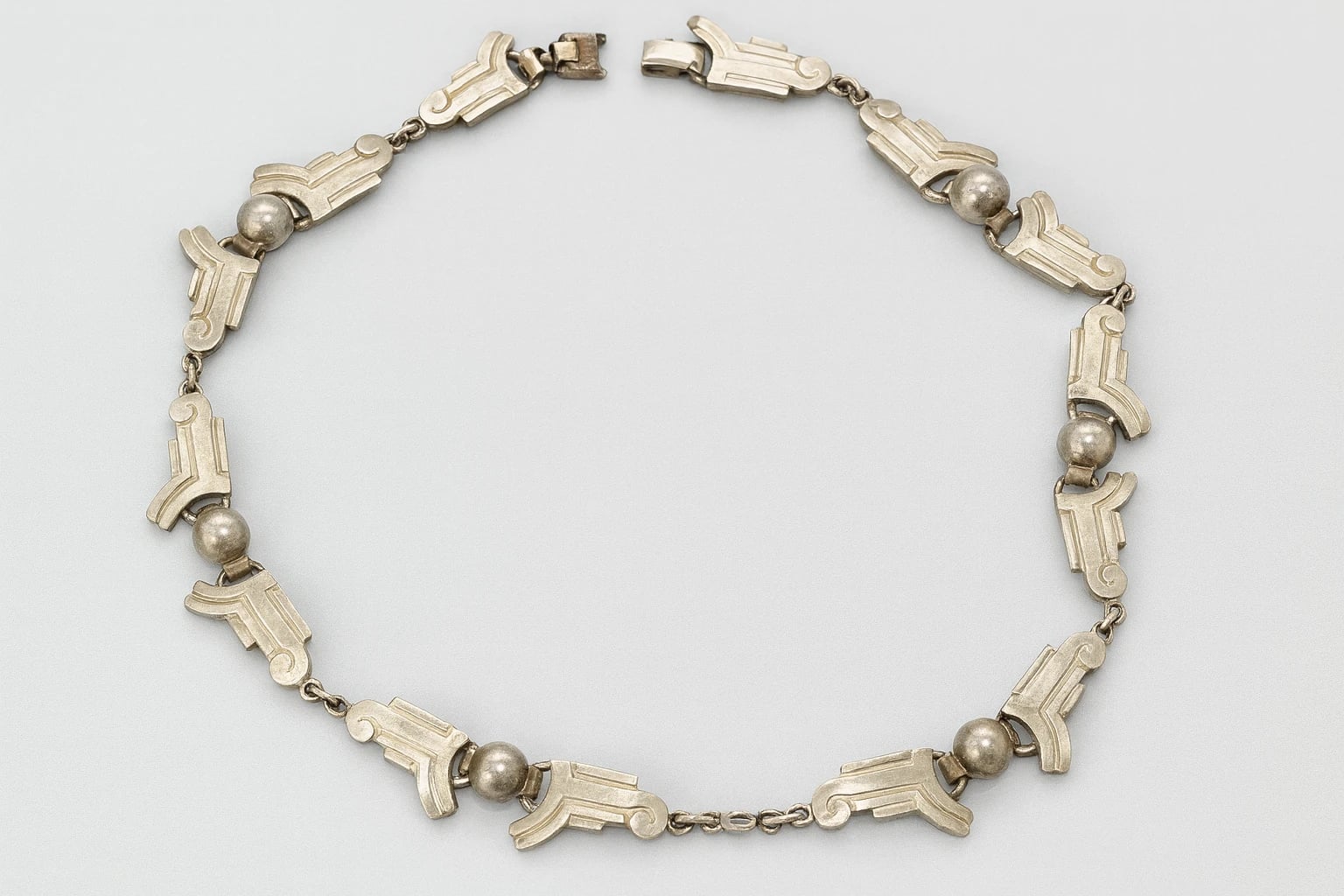
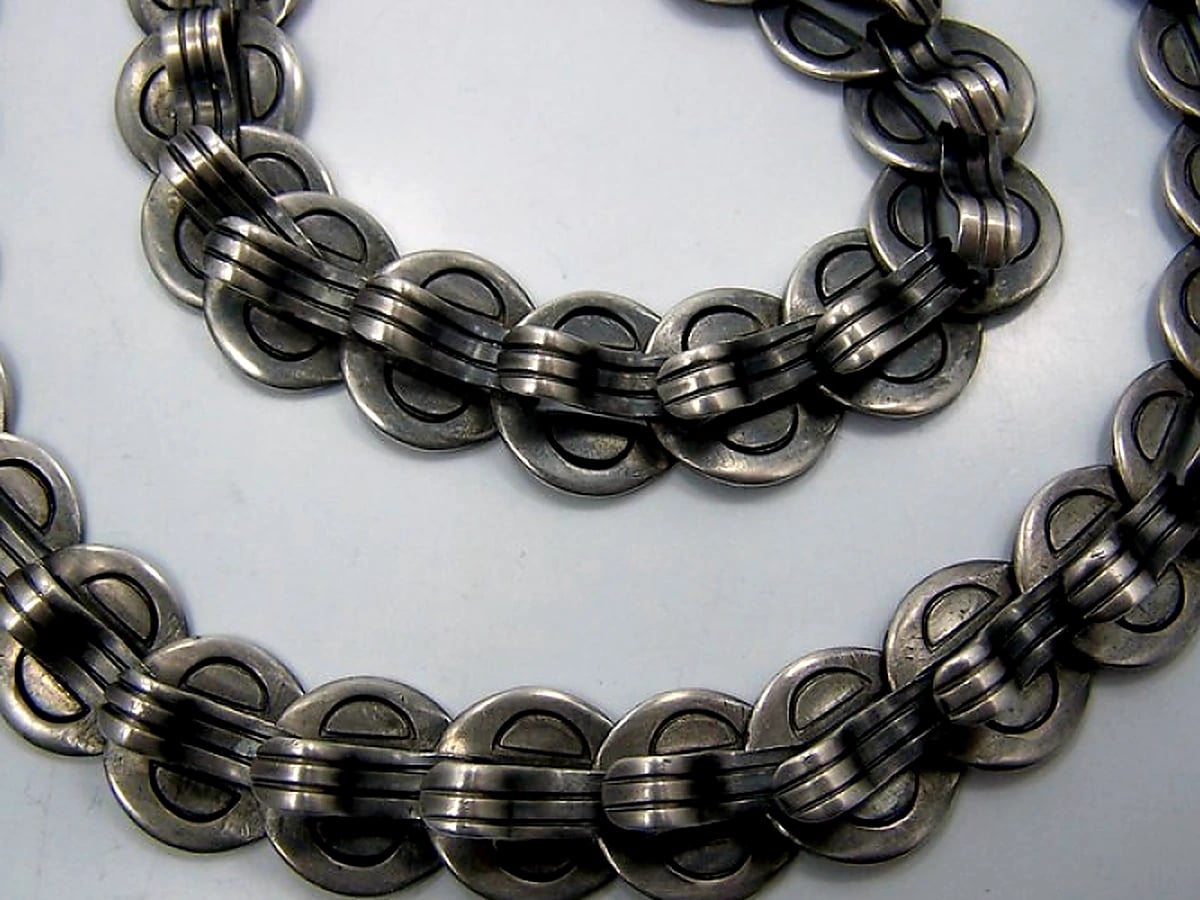
A row of clipped disks, each incised and slightly raised, carries this necklace on a single geometric idea worked with restraint. The links read as flattened coins, their edges cropped rather than left fully round, joined in a continuous band that holds its rhythm around the neck. Héctor Aguilar built the design from one repeated unit, and the incised lines across each disk break up the reflective surface so that the metal shifts as it moves. Color and figure are absent by choice. The necklace depends instead on the interval between links and the shallow tooling that animates each face.
The clipped edge is the design's governing decision. By cropping the circle, Aguilar gives each link a flat register that seats against its neighbors, and the row gains a measured cadence rather than the loose swing of fully round medallions. The raised hook elements that close and connect the band are treated as part of the ornament, not concealed hardware, so that the mechanism belongs to the visual scheme. Incised strokes cut into the silver catch and release light differently across the curved and flat portions of each disk, which is how the piece generates movement without stones, enamel, or applied motif. The effect is grave and deliberate, closer to ceremonial regalia than to decorative jewelry, achieved entirely through geometry and surface.
Aguilar directed the Taller Borda in Taxco, and his silver is known for weight, clean structure, and confidence with plain metal, qualities visible in this necklace's reliance on a single form. Morrill's survey of Aguilar's work records comparable necklaces built from repeated solid units, including a solid silver drops necklace dated to about 1945 and a malachite and silver necklace of roughly 1945 to 1950. Those examples situate the present piece within Aguilar's practice of working from a simple, substantial component and multiplying it into a resolved whole. Hougart's hallmark record notes that at one point the Conquistador firm produced items marked for Héctor Aguilar, a reminder that Taxco production often involved outside manufacturing capacity even for a workshop as established as Taller Borda. This necklace's incised, abstract vocabulary places it comfortably within Aguilar's geometric idiom rather than his figural or stone-set work.
As a reference object, the necklace shows how Aguilar could make an austere geometry feel weighty and formal. It is not among his most widely published designs, but it documents a characteristic method: take a plain unit, clip and incise it, and let repetition do the work that a stone or a figure might otherwise perform. For understanding the abstract, surface-driven strand of the Taxco silver renaissance, and Aguilar's particular command of it, the piece is a clear and useful example.
Museum of Mexican Silver. “Incised Clipped-“Coin” Link Necklace.” Catalog no. MoMS-001970. https://museumofmexicansilver.com/pieces/aguilar-incised-clipped-coin-link-necklace-25
See something wrong with this record? Suggest a correction and the piece details fill in automatically.
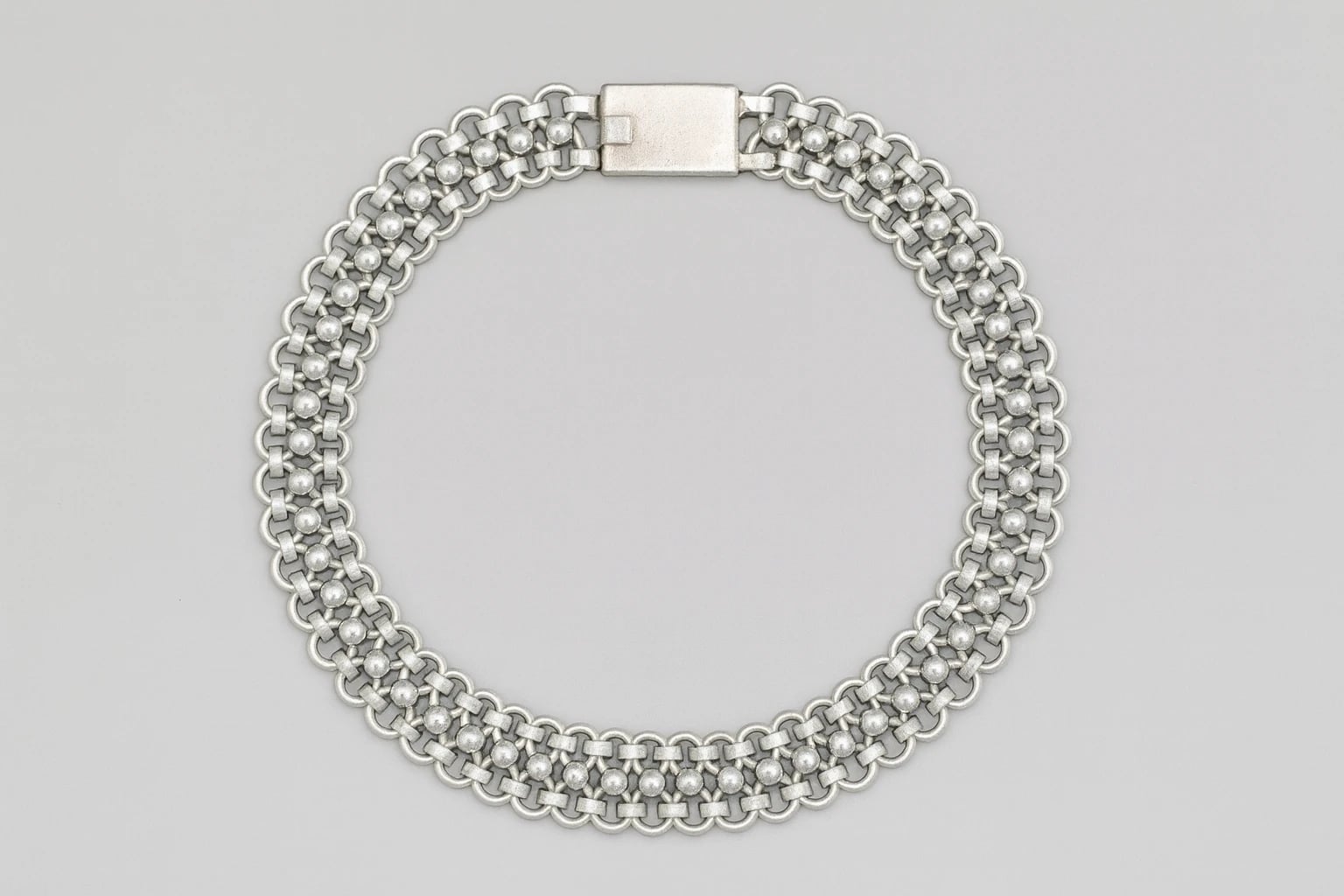
Héctor Aguilar
Chain Link Necklace
c. 1940–50
Sterling silver