Saves instantly, no account needed. Already a member? Sign in.
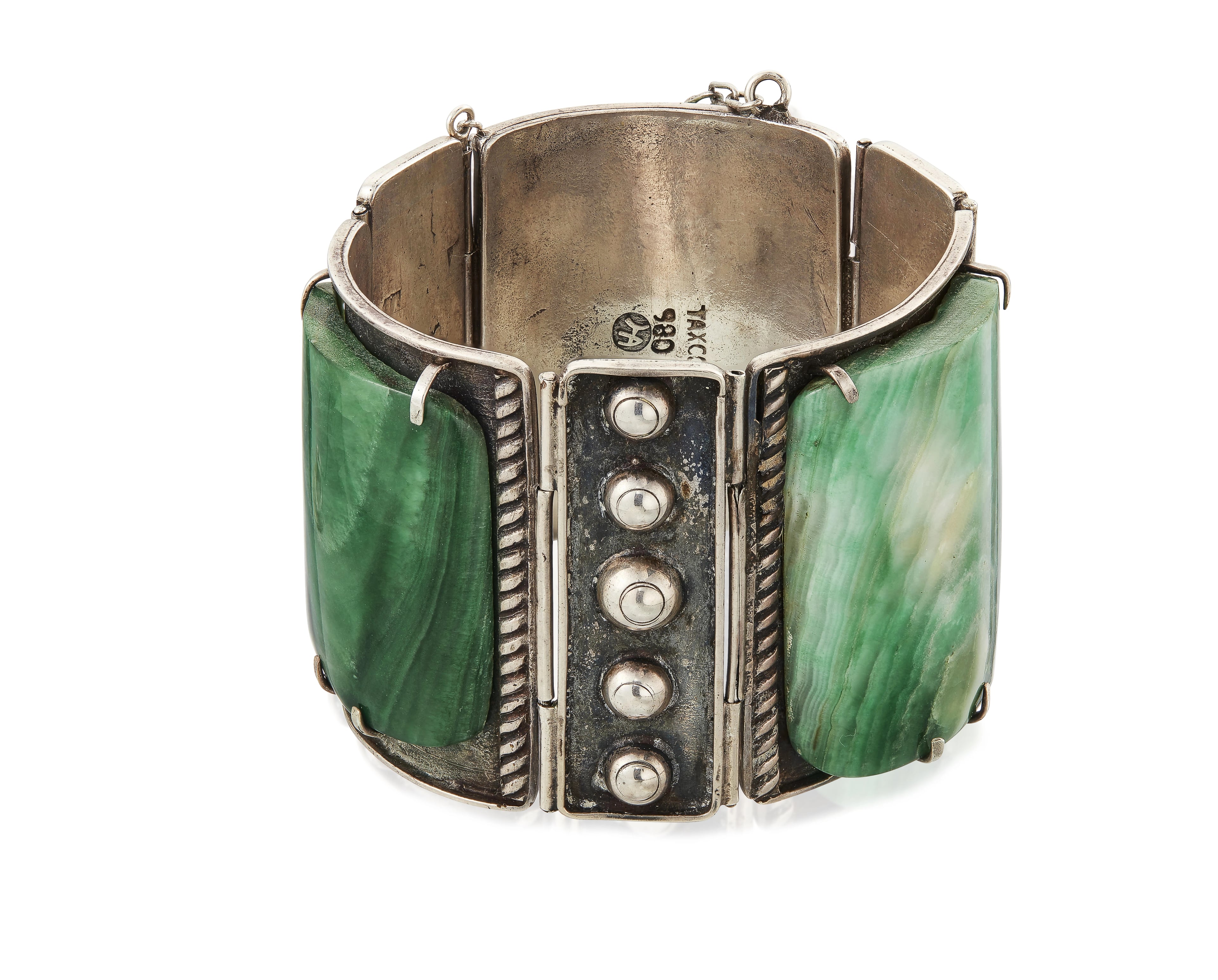
Few objects locate themselves so precisely at the beginning of a career. The HA cipher struck inside this cuff is the mark Héctor Aguilar used only at the very outset of his independent shop, around 1939 to 1940, the years immediately after he left Spratling's Taller de las Delicias to open his own Taller Borda in the Casa Borda on Taxco's main square. A wide, articulated bracelet carrying three large jade plaques and that earliest signature is therefore not simply an Aguilar piece but a document of the moment he became his own maker, when the design vocabulary he would build a workshop around was still being set down by hand. That early dating, the scale of the stones, and the survival of so emphatic a statement bracelet are what give it weight.
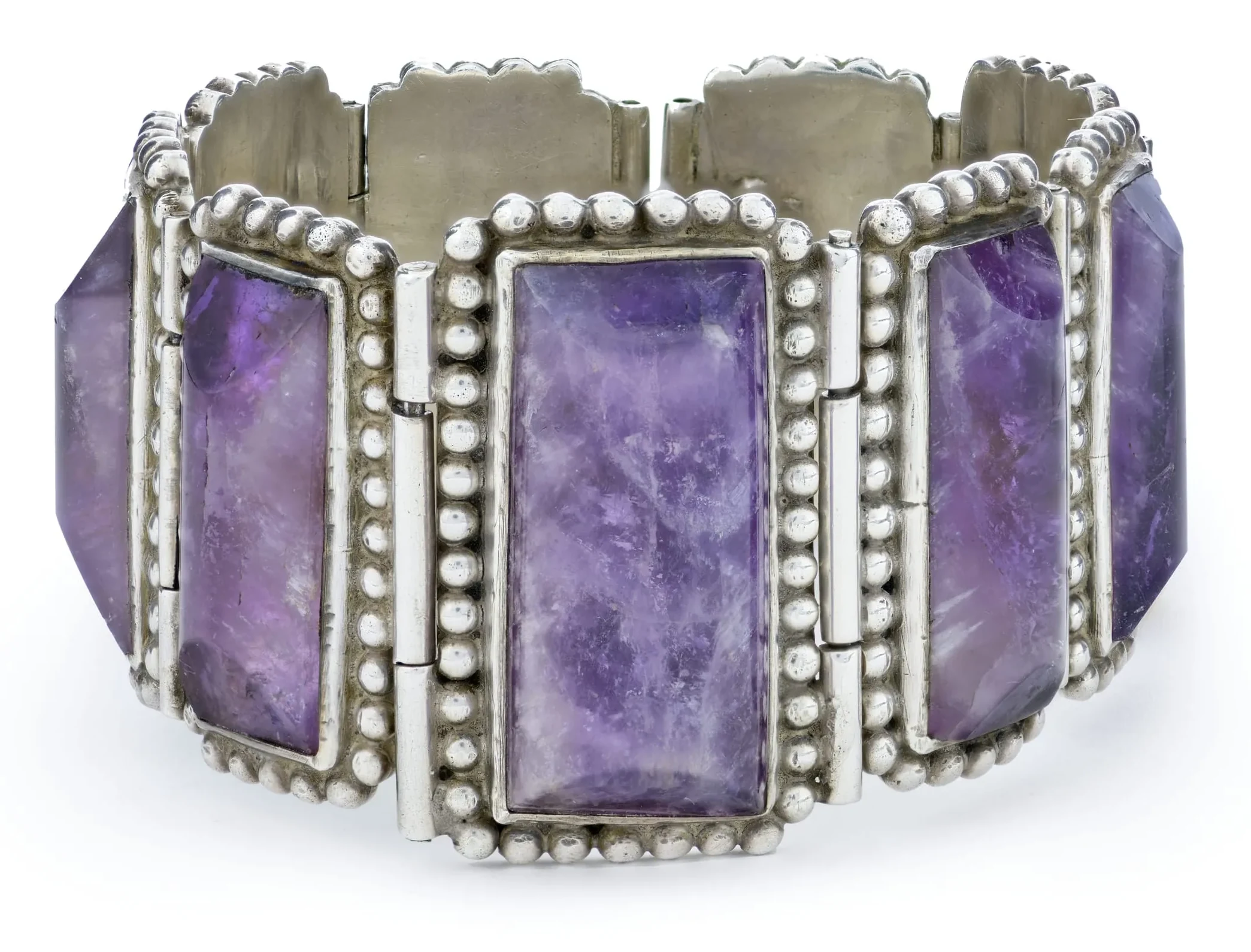
The construction reads as pure Taller Borda. Three broad, richly mottled green jade tablets are set across the wrist, each captured in a frame of twisted, roped silver wire and divided by silver panels; the central panel is built as a hinged spine studded with a graduated column of applied half-round bosses, the rounded silver beadwork that recurs through Aguilar's jewelry of this period. The whole is articulated so the heavy ensemble follows the wrist rather than fighting it, the hinged links doing the work that lets a bracelet of this breadth and substantial weight remain wearable. Aguilar's pieces in these years were fabricated by hand from inked copper master models, the silversmith transferring the design to the plaque and cutting it out with a coping saw, and the slight individuality of the framing and the seating of each stone here is consistent with that bench practice rather than with die-struck repetition (Morrill, 1996, pp. 127, 204).
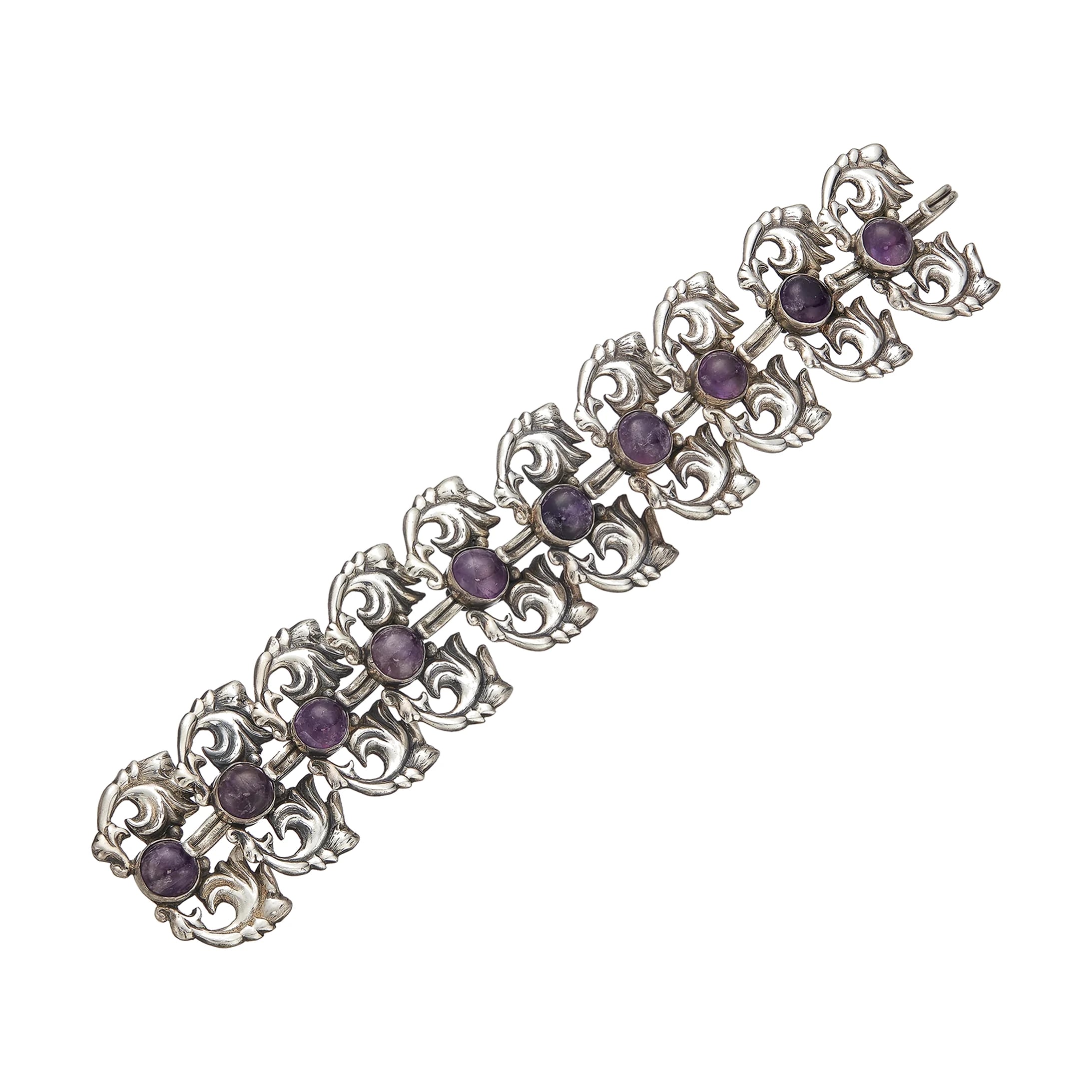
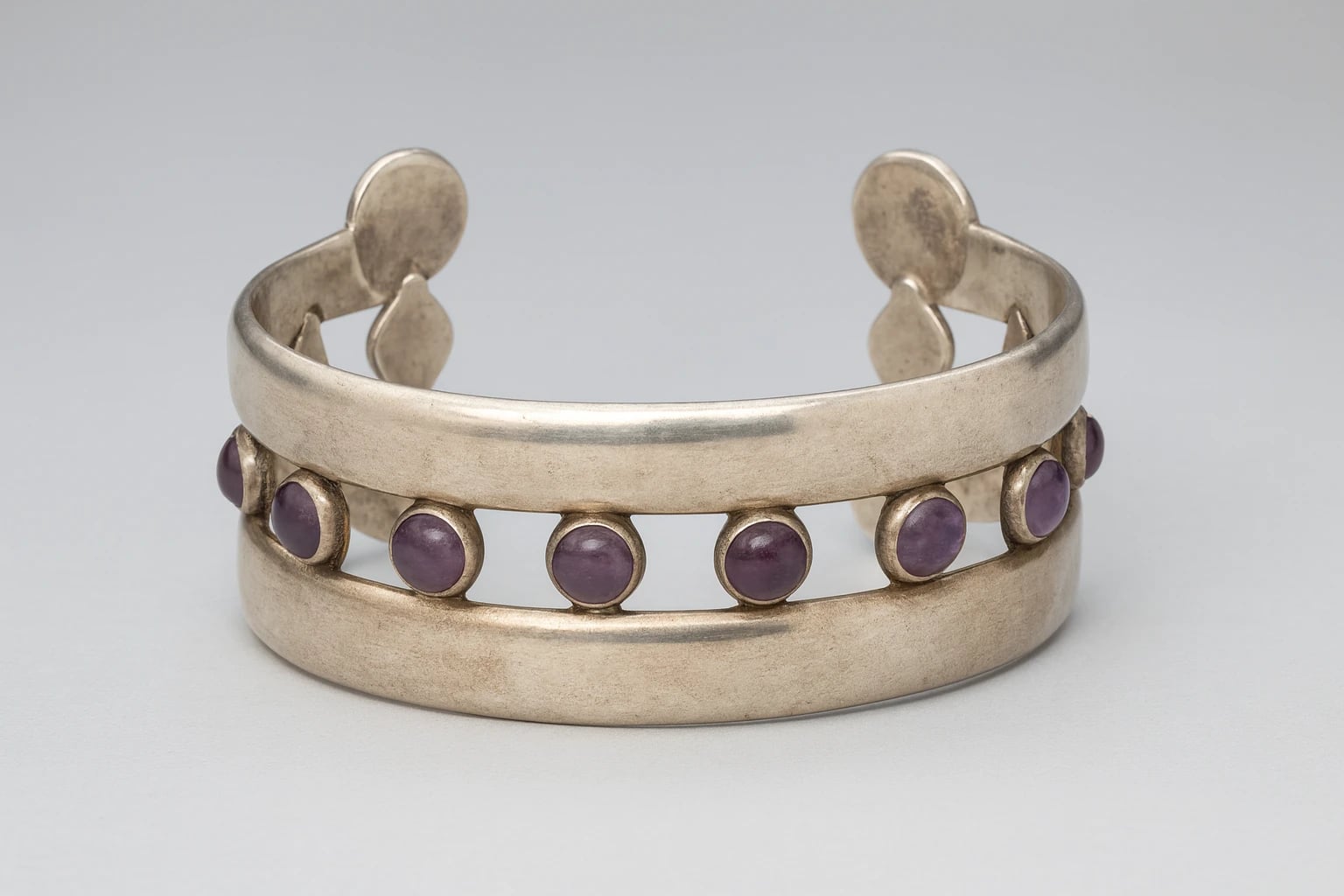
The metal is marked TAXCO 980, the near-fine standard Aguilar favored over ordinary sterling, and which Morrill records on his bracelets of about 1940 (Morrill, 1996, p. 63). The choice is characteristic: a softer, brighter, slightly warmer silver that suited the broad burnished surfaces and the deep green of the stone. Set against the literature, this cuff sits comfortably among Aguilar's early statement bracelets, the large-stone, wide-cuff format he explored at the same moment as his amethyst and copper-and-silver bracelets, but here turned to jade and carried at architectural scale.
A bracelet of this date, standard, and ambition belongs to the foundational chapter of Mexican modernist silver, the short window in which Aguilar, fresh from Spratling's circle, was defining the Taller Borda house style that would make him one of Taxco's most important twentieth-century silversmiths.
Museum of Mexican Silver. “Jade and Silver Bracelet.” Catalog no. MoMS-002057. https://museumofmexicansilver.com/pieces/hector-aguilar-jade-and-silver-bracelet
See something wrong with this record? Suggest a correction and the piece details fill in automatically.
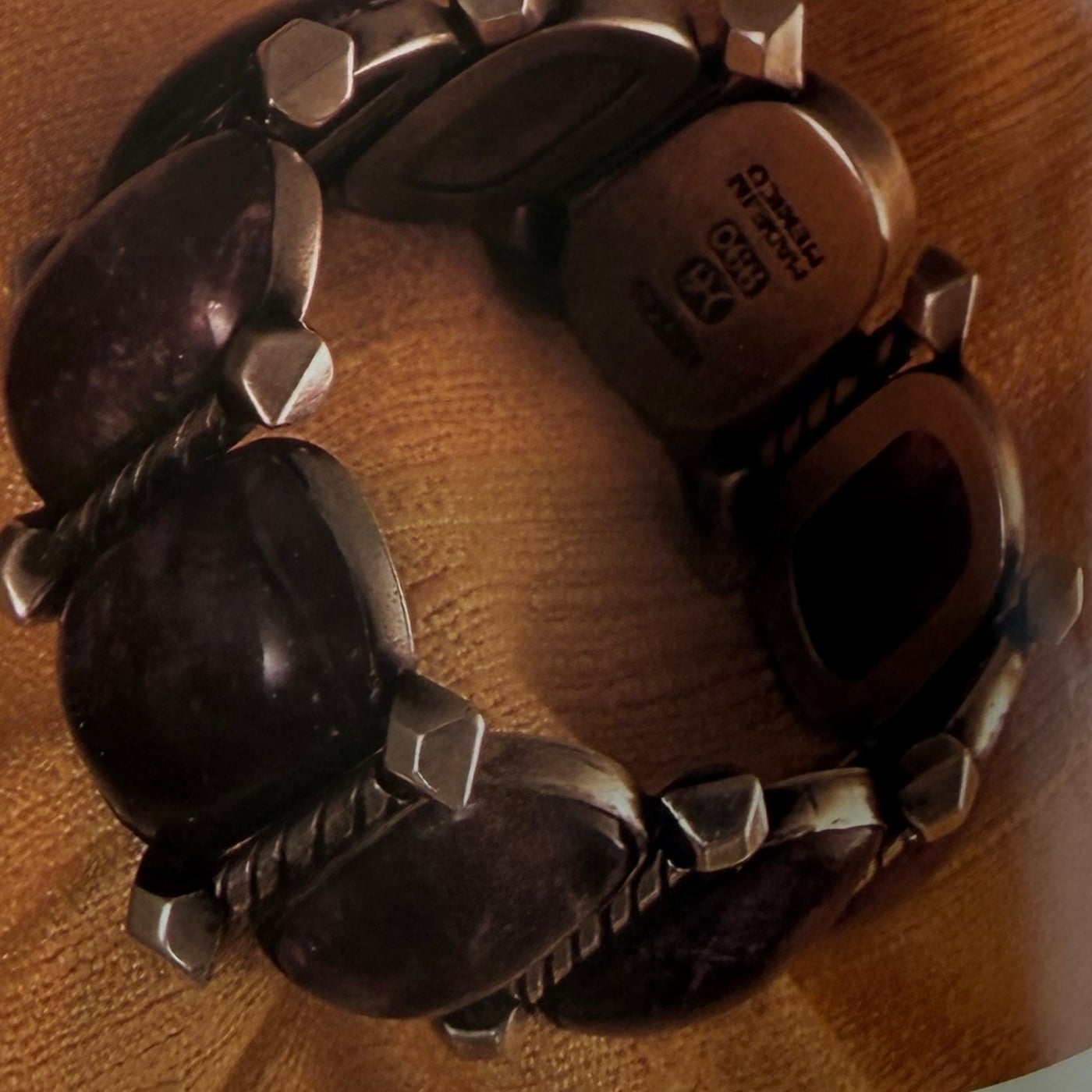
Héctor Aguilar
Amethyst Bracelet with Braid and Diamond-Shaped Hinges
c. 1940
990 silver