Saves instantly, no account needed. Already a member? Sign in.
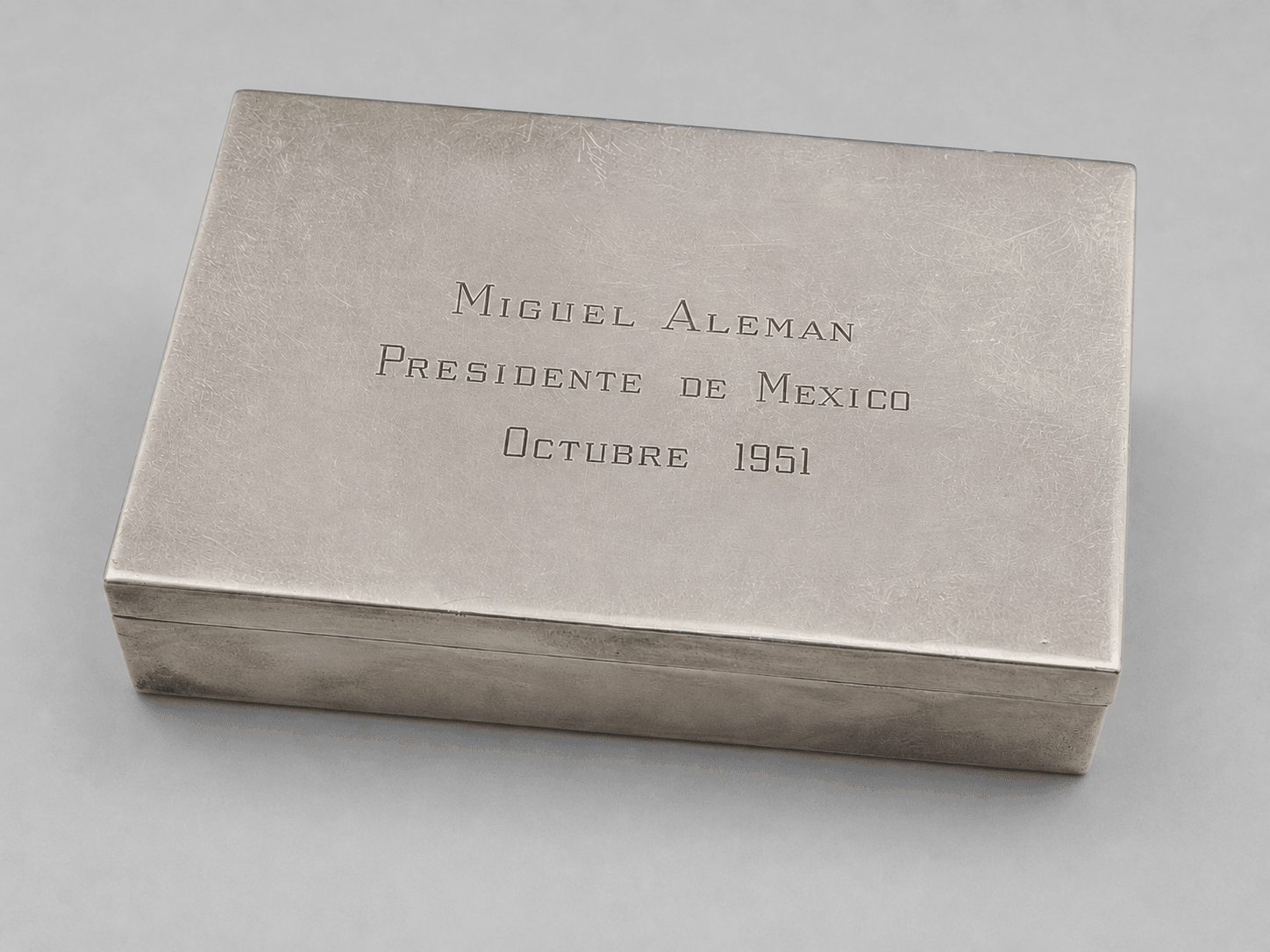
This silver box occupied the desk of Miguel Alemán Valdés, President of Mexico, where it served as the presidential cigar box offered to visiting diplomats, industrialists, artists, and foreign dignitaries. Every visitor who accepted a cigar encountered one of Mexico’s finest artistic achievements before a word of diplomacy was exchanged.
Engraved simply “Miguel Alemán, Presidente de México, Octubre 1951” and bearing the hallmark of Frederick W. Davis, the box reflects the work of one of the principal architects of Mexico’s modern design identity. Long before Taxco silver achieved international recognition, Davis championed indigenous craftsmanship, insisted upon uncompromising artistic standards, and created markets for Mexican designers and artisans. His influence extended far beyond his own workshop through his work with Sanborns, his promotion of contemporary and traditional crafts, and his service on the Mexican government’s board for the preservation and development of the nation’s artistic heritage. In many respects, Davis helped define the visual language through which modern Mexico introduced itself to the world.
Its restrained appearance is deliberate. The box relies neither on elaborate ornament nor precious stones to command attention. Instead, it conveys confidence through proportion, craftsmanship, material, and execution. That philosophy mirrored the image Mexico sought to project during the Alemán years: a nation that was modern, sophisticated, and deeply rooted in its own artistic traditions.
By 1951, Mexican silver had become one of the country’s most successful cultural exports. During the decades following the Revolution, artists, designers, collectors, and government leaders transformed silver from a regional craft into an international symbol of Mexican creativity. Workshops in Taxco and Mexico City supplied museums, luxury retailers, embassies, and important private collections throughout Europe and North America. Through these objects, Mexico presented itself not as a nation defined solely by its ancient civilizations or revolutionary past, but as a confident modern culture capable of producing design equal to any in the world.
This box occupied the president's desk in that transformation. Heads of state, ambassadors, business leaders, cultural figures, and foreign visitors did not simply admire Mexican silver - they held it in their hands. Before conversations turned to diplomacy, trade, investment, or culture, they encountered an object that embodied precision, restraint, and artistic excellence. In that moment, Mexican silver ceased to be merely decorative art. It became an expression of the nation itself.
Museum of Mexican Silver. “Presidential Cigar Box.” Catalog no. MoMS-002291. https://museumofmexicansilver.com/pieces/fred-davis-presidential-cigar-box
See something wrong with this record? Suggest a correction and the piece details fill in automatically.
The Mexican Silver Renaissance was never simply an artistic movement. It was one of the twentieth century’s most successful exercises in cultural diplomacy. Few works of Mexican silver can be connected so directly to the moment when the country’s artistic renaissance became an instrument of statecraft. This box stands not merely as a presidential artifact, but as evidence that art and design helped define how modern Mexico chose to present itself to the world.
Fred Davis
Woven Small-Link Silver Bracelet
Silver