Saves instantly, no account needed. Already a member? Sign in.
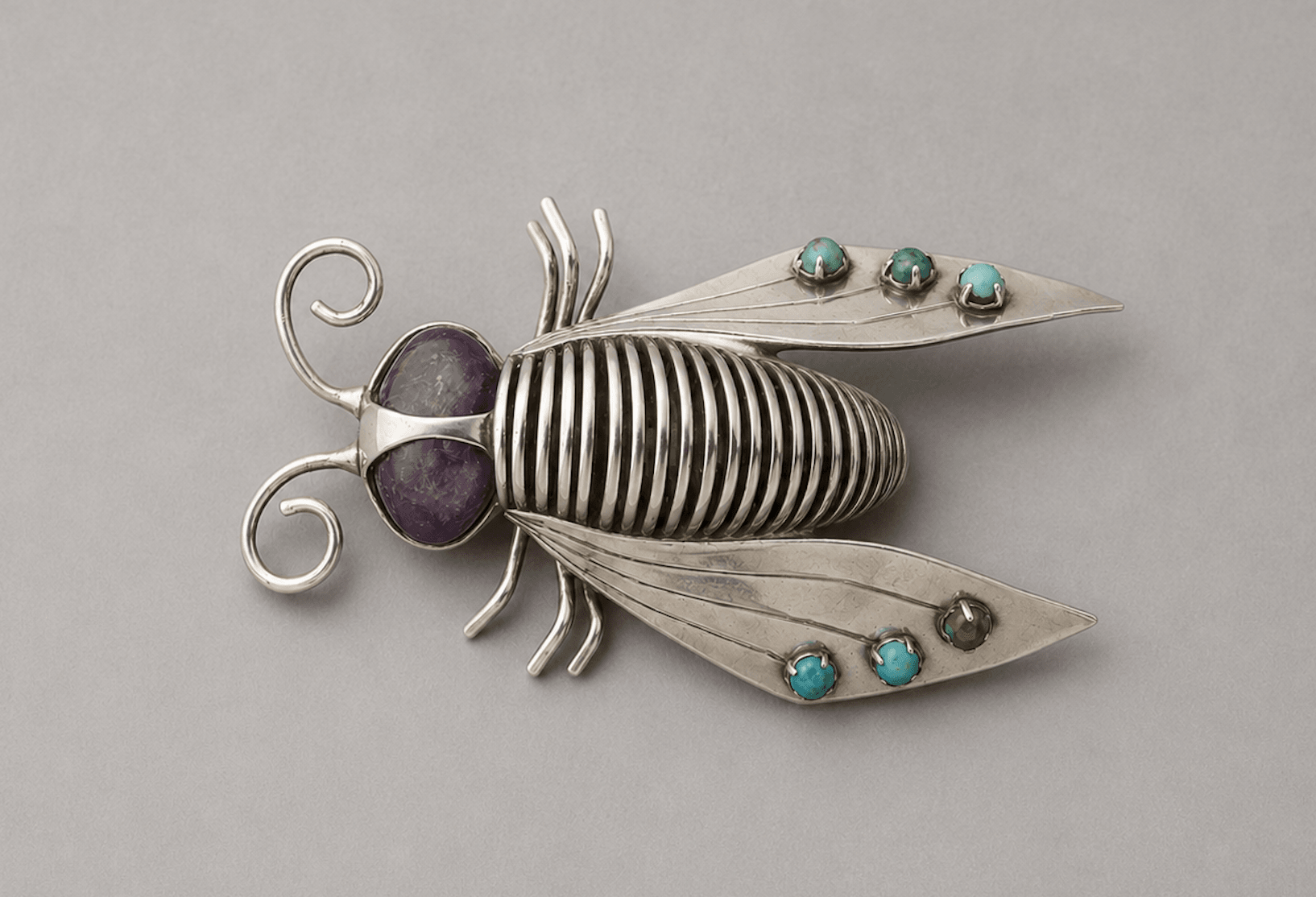
A silver beetle rests with its wings half-spread, the ribbed body fluted in tight horizontal bands like a ripening seed pod. Figural insects belong to the folkloric strain of Mexican silver, an animal observed and stylized rather than abstracted, and this one carries that naturalism from the domed amethyst head to the antennae that curl forward in fine wire scrolls.
The abdomen swells in close parallel ribs that catch the light along their crests, while a pair of leaf-shaped wings sweeps back from the thorax, each pricked with three small turquoise cabochons running in a diagonal line toward the tip. Two cabochon amethysts form the head, their deep violet set against the bright metal, and slim wire legs splay beneath the body, the whole reading as a single small sculpture of an insect caught mid-rest.
Fred Davis ran the silver and antiques counter at Sanborn's in Mexico City, and though he did not work metal himself, from the late 1920s he commissioned independent silversmiths to make his designs for the North American visitors he was first to court. With René d'Harnoncourt and others he helped foster the revival of Mexican folk art, and figural pieces in this vein, among them a Davis fish pin in silver and turquoise recorded by Morrill, came out of that effort. The FD mark and the SILVER MEXICO stamp identify this brooch as one of those Davis-issued pieces.
Amethyst and turquoise seldom share a single object, and here they meet in one insect, purple at the head and blue along the wings, a compact example of the naturalistic jewelry Davis brought to a wider audience.
Museum of Mexican Silver. “Silver and Amethyst Insect Brooch.” Catalog no. MoMS-002140. https://museumofmexicansilver.com/pieces/fred-davis-silver-and-amethyst-insect-brooch
See something wrong with this record? Suggest a correction and the piece details fill in automatically.
Fred Davis
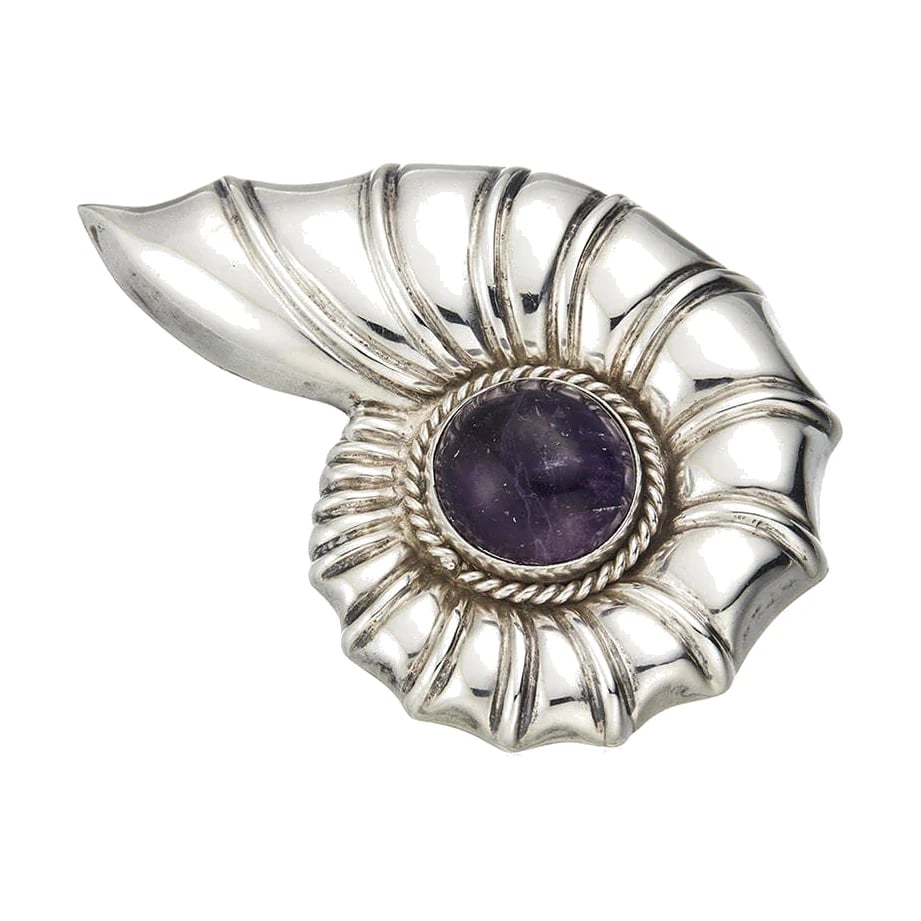
Amethyst and Silver Nautilus Brooch
Silver