Saves instantly, no account needed. Already a member? Sign in.
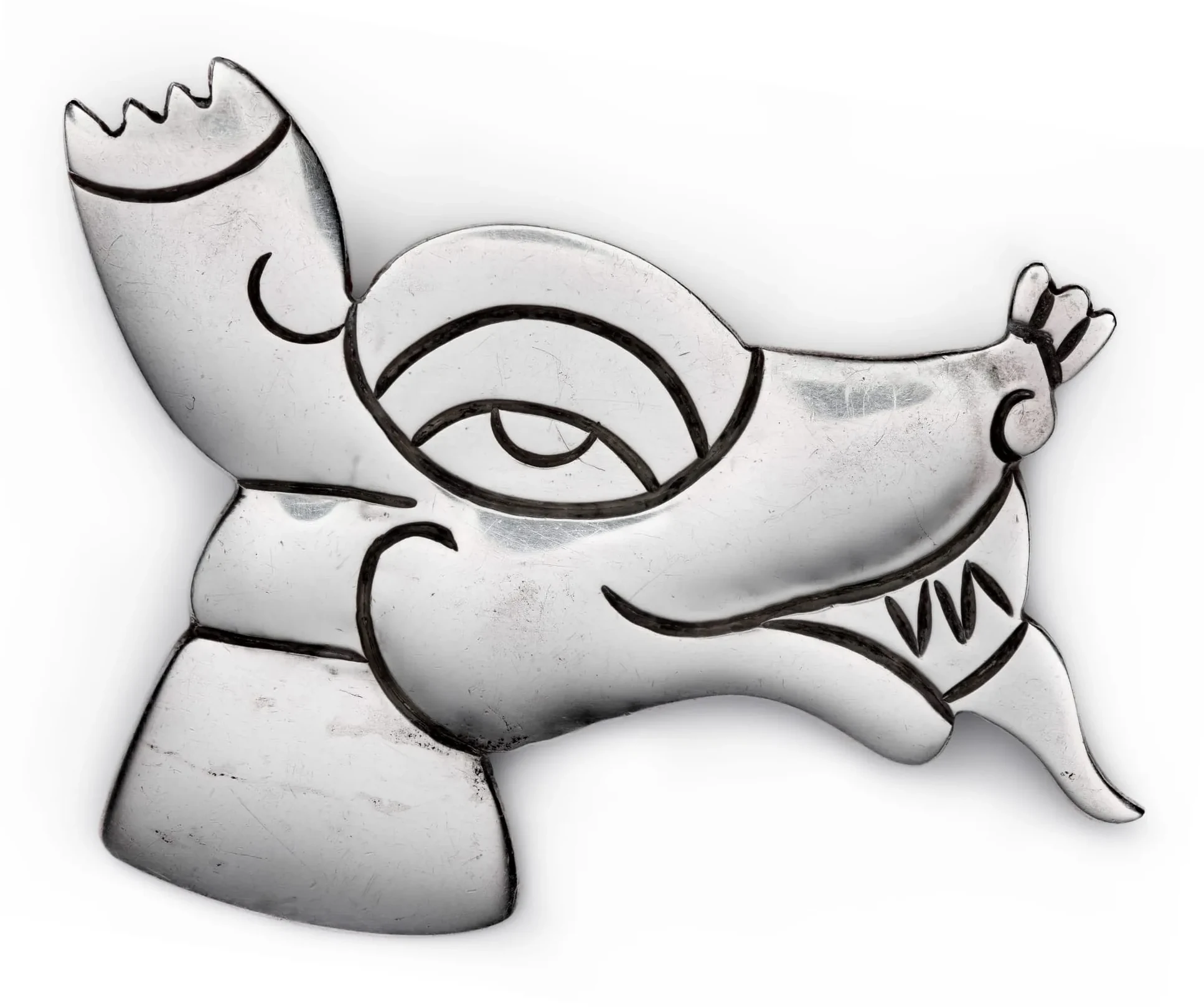
The brooch reduces a dog sign to a small, polished field of silver animated by dark recessed lines. Its body is not modeled as an animal in the round, but organized as a glyph: a curving back, compact head, raised tail, bent leg, and interior scrolls are held within a taut silhouette. At only 1 1/2 by 1 3/4 inches, LACMA accession M.2015.70.1 has the concentration of a miniature emblem. The silver surface catches light broadly, while the blackened channels slow the eye and give the form its reading. The result is a brooch that depends less on volume than on contour, incision, and the visual pressure between bright metal and shadow.
The design belongs to Héctor Aguilar’s Mesoamerican calendrical sign family, a group of pins associated with animal and symbolic day signs. The design recalls izcuintli, dog, one of the named days of the tonalpohualli, the 260 day ritual calendar represented in painted almanacs known as tonalamatl. The brooch relates to dog glyphs in codex tradition, but it does not copy a manuscript sign as an antiquarian exercise. Aguilar translates the source into a modern silver object, thickening the contour, simplifying the anatomy, and giving the dark internal lines the decisiveness of drawn marks. The object retains the legibility of a sign while acquiring the scale, reflectivity, and bodily intimacy of jewelry.
Aguilar’s use of such sources was central to his early design language. Morrill and Berk describe his jewelry as drawing primarily on Aztec and Mixtec art and architecture, with the ancient image serving as the point of departure for stylization rather than replication. That observation is especially useful here. The brooch is disciplined rather than decorative in the usual sense. It has no stone, no applied color, and no secondary border. Its ornament is its structure: the dog is made from the same decisions that make the brooch functional as a pinned silver form. In this respect it belongs to the same Taxco modernism that gave ancient motifs new life through proportion, abstraction, and controlled workshop execution.
Aguilar and Lois Smith Cartwright founded the Taller Borda in 1939, after Aguilar’s work with William Spratling’s Taller de Las Delicias. The dog brooch belongs to the moment when Taxco silver was developing a language distinct from both revivalist archaeological quotation and European modernist jewelry. Its small scale should not obscure its historical clarity. The piece shows how the silver renaissance treated Mesoamerican visual systems as design intelligence, not surface exoticism. In a museum collection, it helps define Aguilar’s contribution with particular economy: a calendrical sign becomes a modern brooch through line, polish, and the compression of an ancient graphic form into wearable silver.
Museum of Mexican Silver. “Dog Brooch.” Catalog no. MoMS-002278. https://museumofmexicansilver.com/pieces/hector-aguilar-dog-brooch
See something wrong with this record? Suggest a correction and the piece details fill in automatically.
Héctor Aguilar
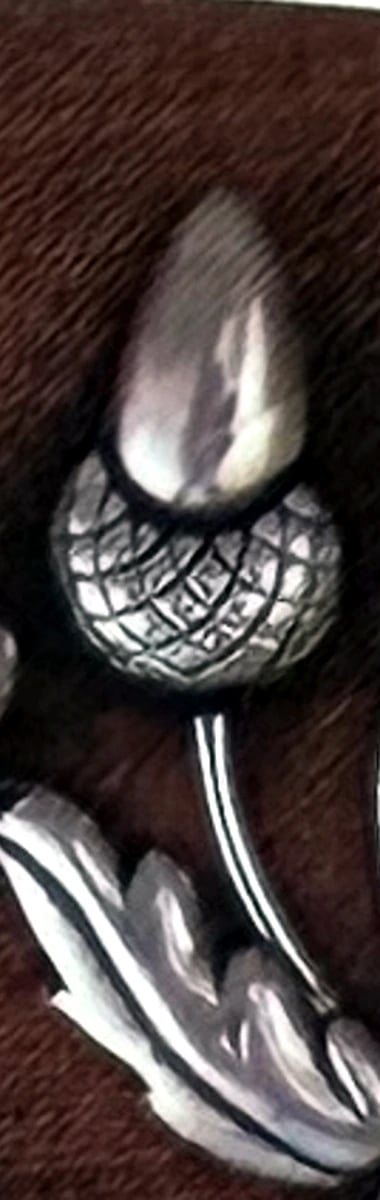
Acorn Brooch
c. 1940
925 silver