Saves instantly, no account needed. Already a member? Sign in.
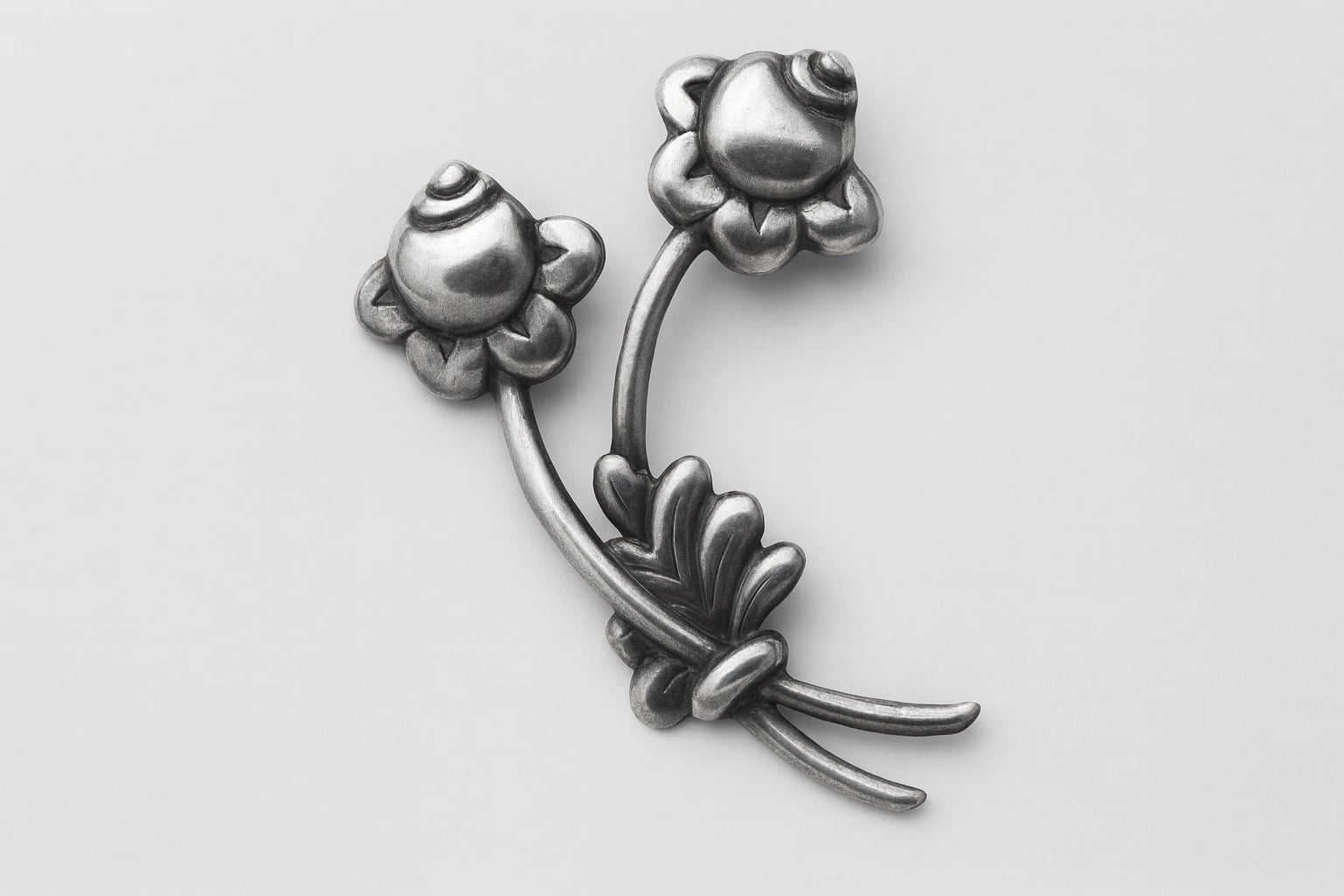
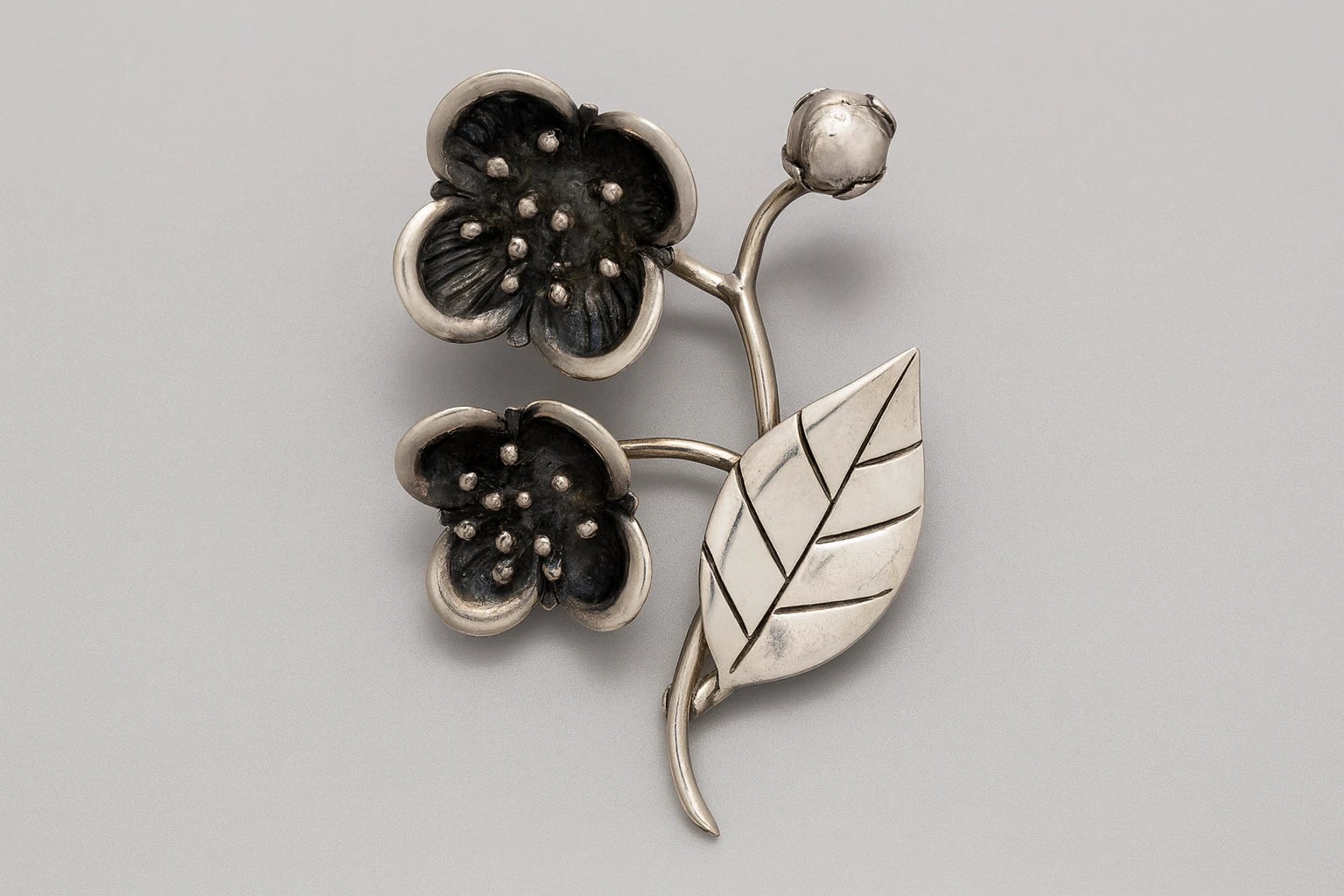
The brooch organizes a small botanical subject with unusual clarity: two open flowers, a rising bud, and a single veined leaf are carried on stems that curve rather than merely connect. Made about 1945 and measuring 2 3/4 by 1 3/4 inches, it belongs to the floral current for which Héctor Aguilar’s Taller Borda became especially admired in the middle years of the Mexican silver renaissance. The design is numbered 1853 in the archive record and was published in Penny Morrill’s Silver Masters of Mexico, evidence of its place within the documented repertory of Aguilar’s workshop.
The flowers are not treated as flat emblems. Each blossom has rounded, overlapping petals that hold small raised stamens near the center, so that the head of the flower gathers light in points rather than across a single polished plane. The leaf, by contrast, is broad, smooth, and controlled by incised diagonals that divide its surface into crisp compartments. This contrast matters. The brooch depends on the meeting of two kinds of line: the supple line of stem and petal, and the sharper, almost diagrammatic line of the leaf. The small bud at the top extends the composition upward and keeps the object from closing into a compact bouquet. Worn on the body, the pin would read as a vertical spray, with the curved lower stem giving the piece a sense of growth without losing Aguilar’s preference for firm structure.
Morrill notes that Aguilar was the principal designer for the work he signed, while Valentín Vidaurreta supplied many of the elaborate floral designs associated with the workshop. Vidaurreta arrived in Taxco in 1941 and collaborated with Aguilar until his death in 1955. That working relationship is important for this brooch because the object sits precisely within the Borda vocabulary in which natural flowers were translated into silver forms with more weight and permanence than botanical illustration. The petals retain softness, but the construction is disciplined. The leaf is not a secondary naturalistic detail. It anchors the floral cluster and gives the brooch a modern graphic armature.
The Taller Borda context also helps explain the object’s balance of intimacy and ambition. Aguilar had moved his operation into the restored Borda Palace, where silver, copper, and tin workshops, carpentry, and retail activity were brought together under one workshop identity. During the 1940s the workshop produced jewelry for Mexican and international markets, but its best pieces were not anonymous merchandise. They show how Taxco’s taller system could turn repeatable designs into objects with distinct presence through proportion, surface, and hand finishing. In this brooch, the familiar flower form becomes a compact study in rhythm: petal against leaf, polished edge against darkened recess, stem against open ground. It is a modestly scaled object, but it preserves one of the most characteristic strengths of Aguilar’s Borda production, the ability to give Mexican silver jewelry the compositional seriousness of modern design while keeping it close to the body.
Museum of Mexican Silver. “Flower Brooch with Bud and Leaf.” Catalog no. MoMS-002346. https://museumofmexicansilver.com/pieces/hector-aguilar-brooch-2
See something wrong with this record? Suggest a correction and the piece details fill in automatically.
Héctor Aguilar
Cornucopia Brooch
Sterling silver