Saves instantly, no account needed. Already a member? Sign in.
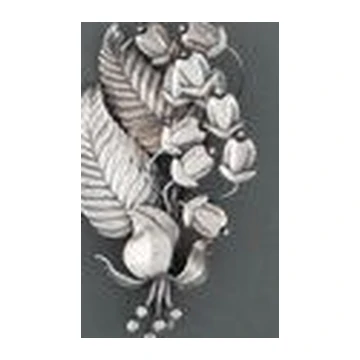
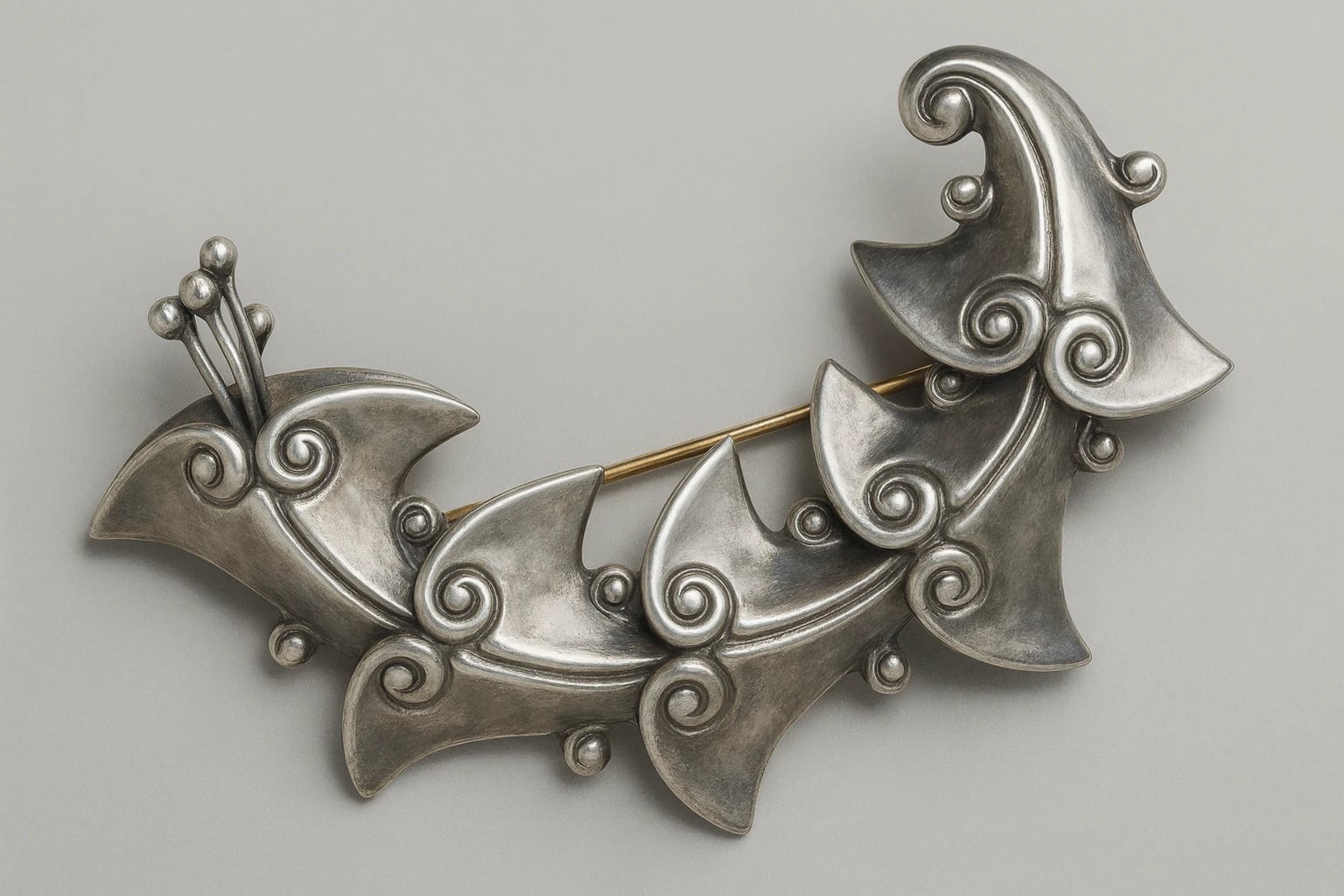
The brooch gathers a fantasy flower into a compact curve, three inches wide and about two inches across, with each petal lifted into high relief and edged by tight silver scrolls. Its composition is not botanical illustration. The flower has been reorganized as a sequence of overlapping cups, curls, beads, and projecting stamens, so that growth becomes a problem of rhythm and relief. The old linear Los Castillo mark, with “LOS CASTILLO, TAXCO, STERLING, MADE IN MEXICO” and design number 703, places the piece within the workshop’s pre-eagle production of the circa 1940s, a period supported by Hougart’s documentation of early Los Castillo sterling and “Made in Mexico” marks before and around the introduction of the eagle system.
The design depends on the contrast between broad petal surfaces and wiry curling tendrils. The petals catch light in wide, softly burnished fields, while the smaller scrolls concentrate the eye at the seams, tips, and centers of the flower. Several curls are set inside the petal forms rather than simply attached along their edges, which gives the brooch an interior movement. The flower seems to coil from left to right, with the largest bloom rising at one end and the smaller elements pulling the curve back toward the pin stem. The visible pin mechanism runs horizontally behind the relief, a practical line partly absorbed by the upward sweep of the design. Patina settles into the recesses and makes the relief easier to read: the brooch is silver as surface, drawing, and shadow.
Los Castillo’s early work occupies a distinct place within the Taxco renaissance. Hougart identifies Los Castillo as an influential design and manufacturing enterprise established in 1939 by Antonio Castillo with his brothers Justo and Jorge and cousin Salvador Terán, and notes its reputation for sterling jewelry as well as later technical lines in married metals, enamel, feather work, and related materials. Stromberg likewise places the workshop’s founding in 1939 and emphasizes the participation of Jorge “Chato” Castillo, Justo “Coco” Castillo, Margot van Voorhies Carr, and Salvador Terán in its formation. This brooch belongs to the workshop’s silver jewelry rather than to its better known mixed metal experiments, but it already shows the Los Castillo habit of treating ornament as constructed form. The curls are not applied decoration in a secondary sense. They organize the flower, hold its intervals, and turn the brooch’s edge into a sequence of small events.
The floral language also helps distinguish Los Castillo from the heavier early idioms associated with Spratling and some of the first Taxco workshops. Morrill and Berk describe the early silver made at Los Castillo as different from Spratling’s, in part because of Margot van Voorhies’s involvement and her spare, elegant approach to natural form. This brooch is more exuberant than spare, yet it shares that concern with nature as design rather than naturalism. Its flower is stylized through curve, repetition, and negative space, closer to a modern decorative drawing translated into metal than to a literal blossom. Stromberg’s discussion of Los Castillo floral jewelry as among the workshop’s recognizable early modes gives this example a useful context within Taxco’s broader exploration of Art Nouveau sources, modern silver relief, and wearable scale.
Museum of Mexican Silver. “Fantasy Flower Brooch with Curled Petals.” Catalog no. MoMS-002299. https://museumofmexicansilver.com/pieces/los-castillo-brooch
See something wrong with this record? Suggest a correction and the piece details fill in automatically.
Within a museum collection, the brooch documents an important early strand of Los Castillo production before the workshop became especially associated with spectacular mixed metal and inlay techniques. It shows the taller working in sterling alone, relying on modeled relief, disciplined scrollwork, and a strong silhouette to give a small object presence on the body. The result is an intimate piece of Mexican modernist design: not monumental in scale, but carefully resolved in the relation between line and volume, botanical suggestion and abstract order.
Los Castillo
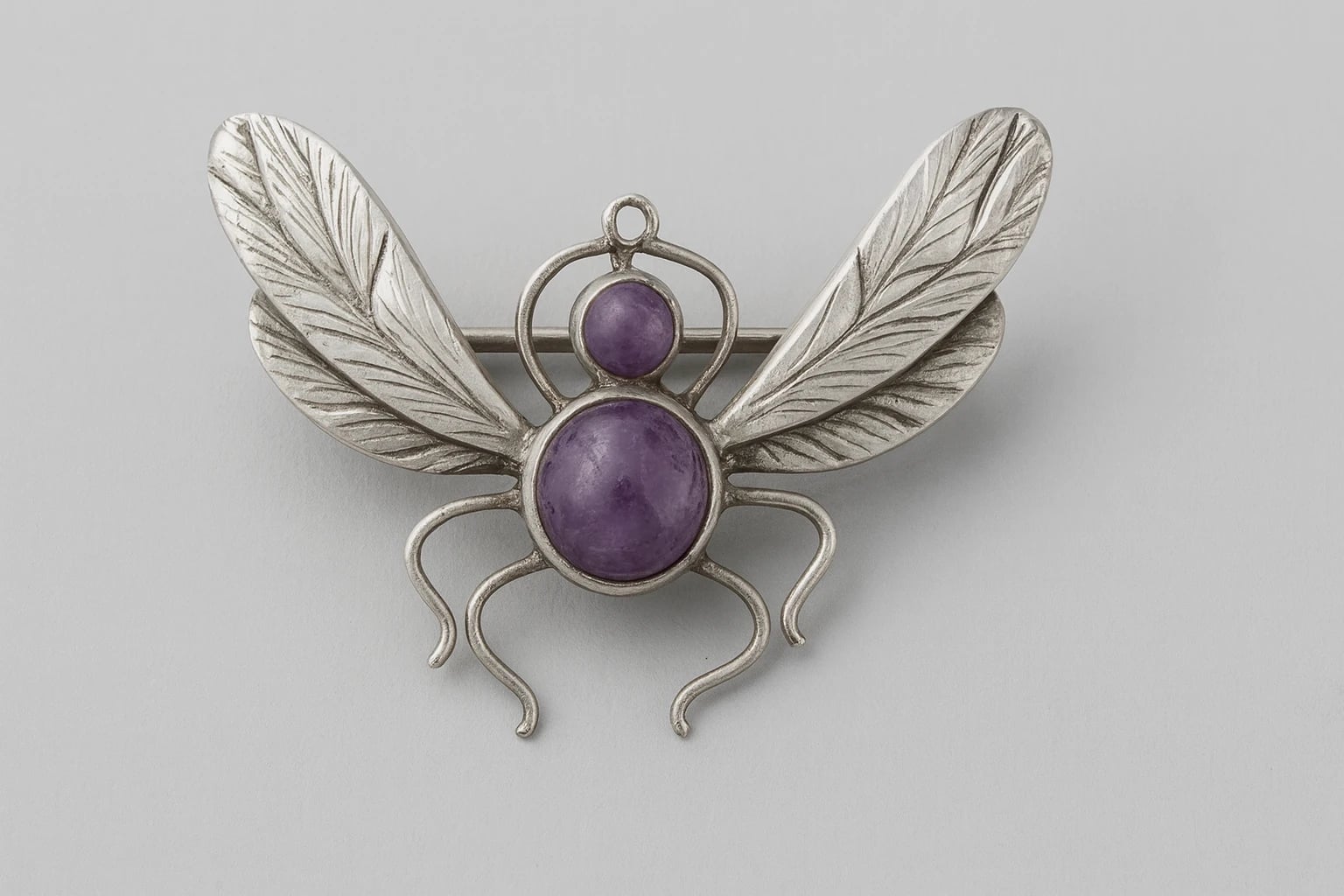
Butterfly Brooch with Amethyst
Amethyst