Saves instantly, no account needed. Already a member? Sign in.
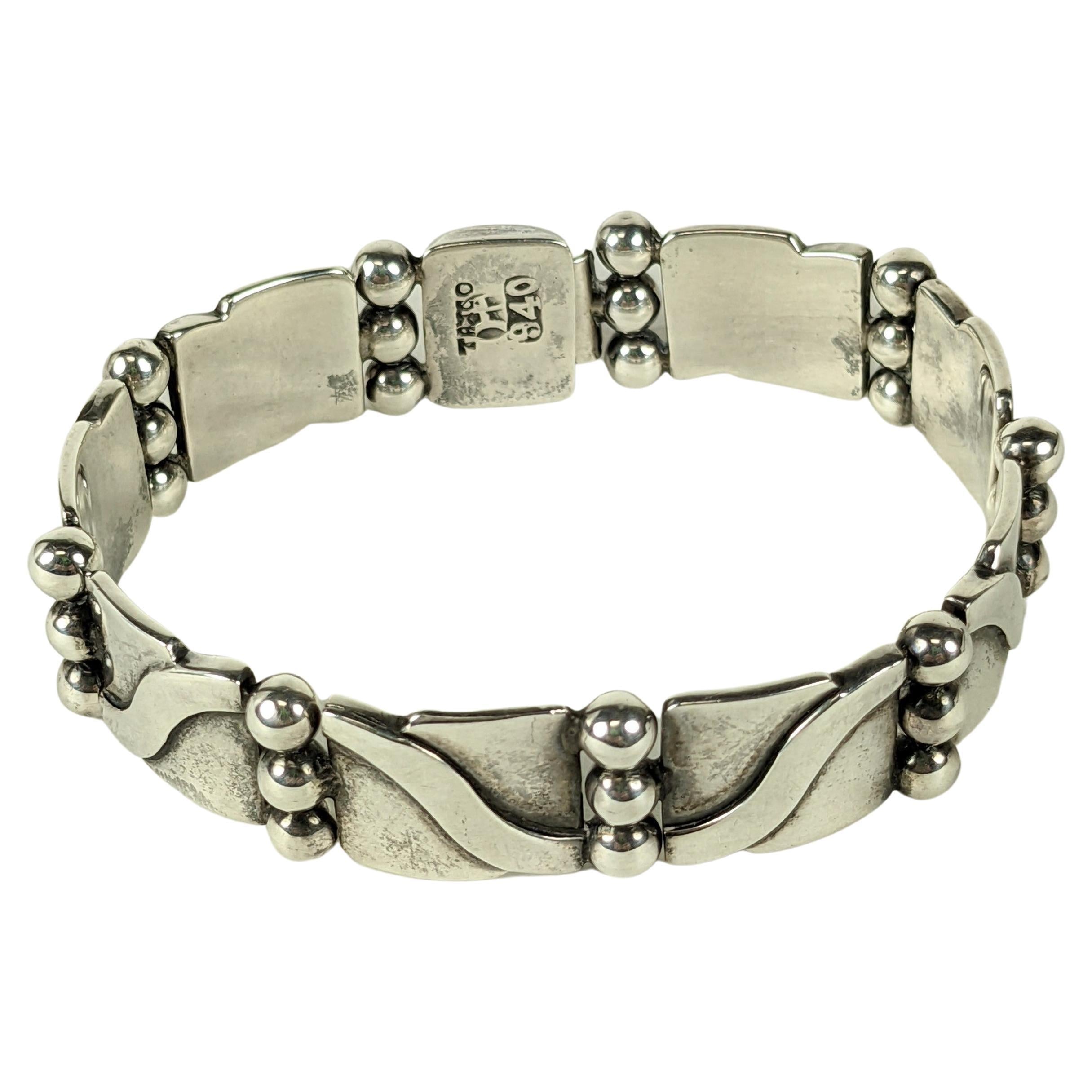
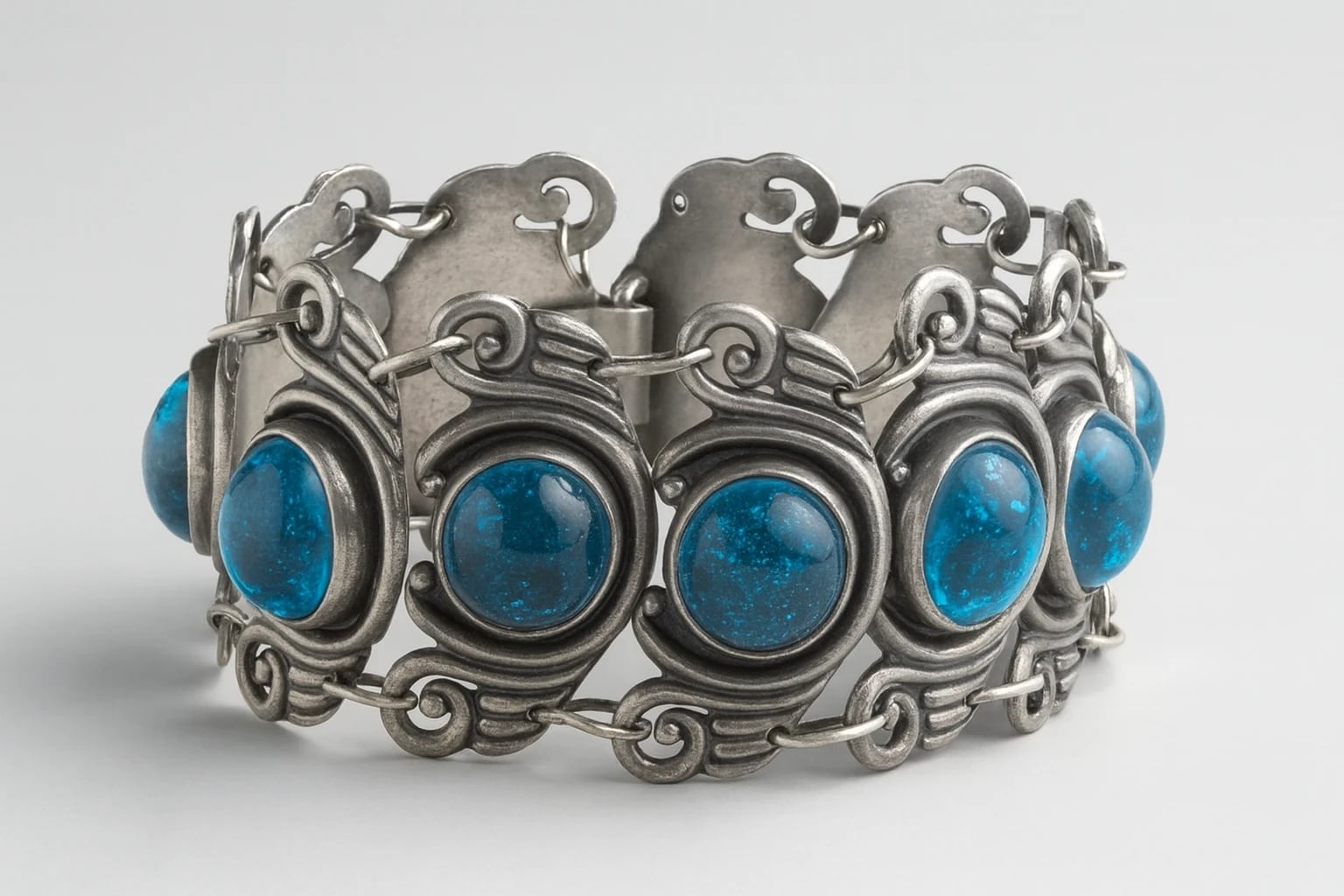
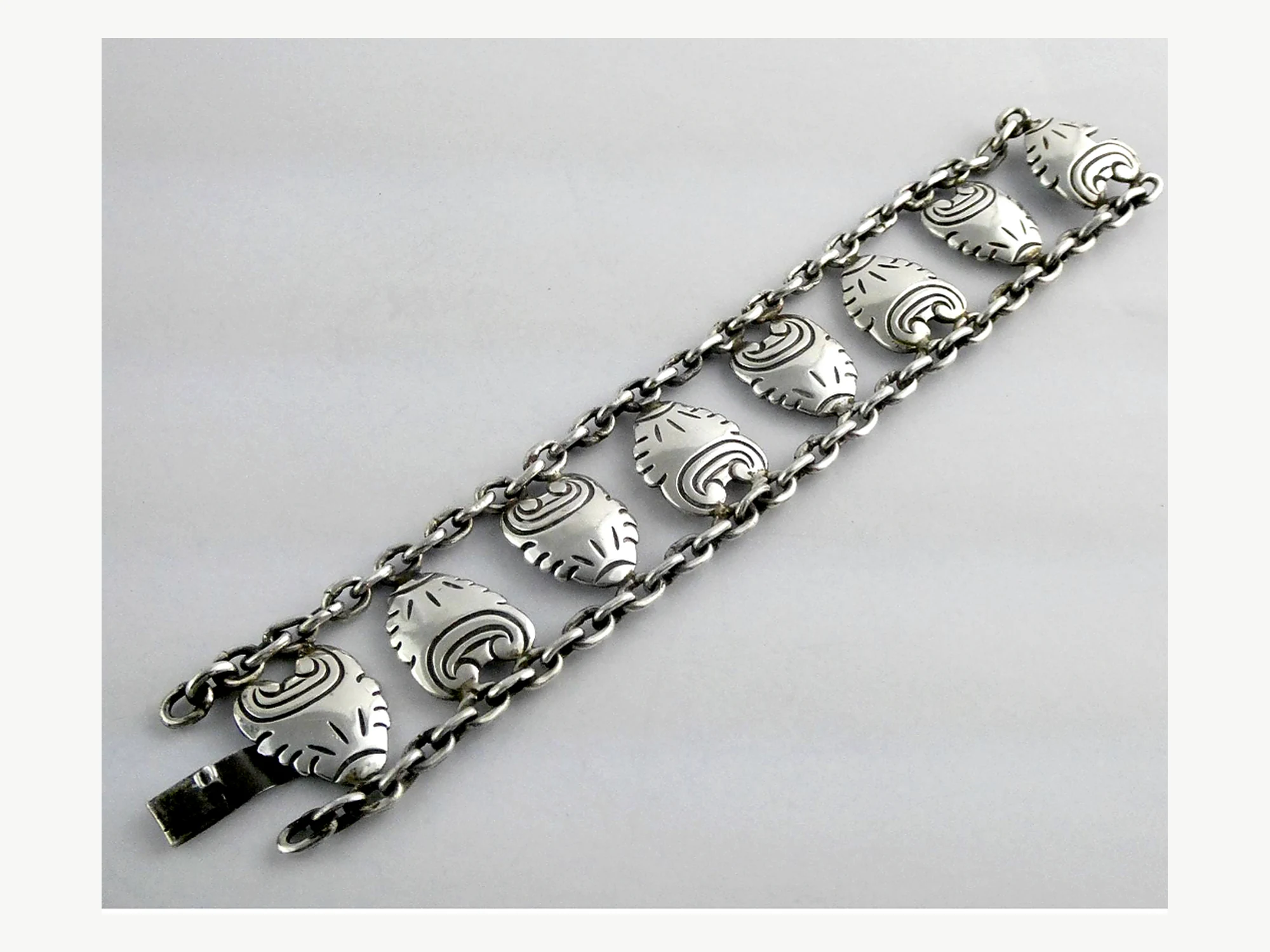
The bracelet treats a row of small silver plaques as moving relief sculpture. Seven scalloped forms sit between two parallel chain runs, each plaque swelling gently at the center and tapering into a softened, shell-like outline. Chased arcs gather near one edge, while short radiating cuts press outward across the surface. The decoration is spare, but it is not slight: a few curved grooves give each plaque direction, shadow, and a sense of internal pressure.
The construction gives the bracelet much of its character. Rather than linking the plaques edge to edge, the design suspends them within a double chain frame, allowing the repeated forms to shift while the two side runs hold the bracelet in a firm rectangular rhythm. The result is unusually lively for a relatively compact object. At 6 3/8 inches long and approximately 60 grams, it has enough silver to register physically on the wrist, yet the open chain structure prevents the mass from becoming inert. The fold-over clasp continues the practical clarity of the design, keeping the fastening subordinate to the repeated plaques and their alternating highlights.
The clasp is marked TAXCO, with Héctor Aguilar’s conjoined HA monogram and 940. This combination belongs to Aguilar’s early Taxco mark of the first half of the 1940s, before the later eagle-assay marks became a regular part of his workshop stamping. Morrill and Berk describe this early hallmark as an HA in an indented circle, flanked by TAXCO and 940, and Hougart records the same TAXCO, HA, 940 mark for 1940 to 1945. The high silver standard and early mark place the bracelet within the formative years of Aguilar’s independent production, when his work was defining the strong, direct formal language associated with the Taller Borda.
Aguilar’s best jewelry from this period often depends on repetition, scale, and decisive surface cutting rather than applied ornament. Here the chased lines do not merely embellish the plaques. They clarify the shape, giving each unit a directional curl and turning the row into a sequence of related gestures. The bracelet belongs to the larger achievement of the Taxco School in the 1940s: the transformation of silver jewelry into a modern design medium, responsive to the body, disciplined in construction, and rooted in Taxco’s workshop culture without being confined by traditional models.
Museum of Mexican Silver. “Scalloped Plaque Link Bracelet.” Catalog no. MoMS-002360. https://museumofmexicansilver.com/pieces/hector-aguilar-scalloped-plaque-link-bracelet
See something wrong with this record? Suggest a correction and the piece details fill in automatically.
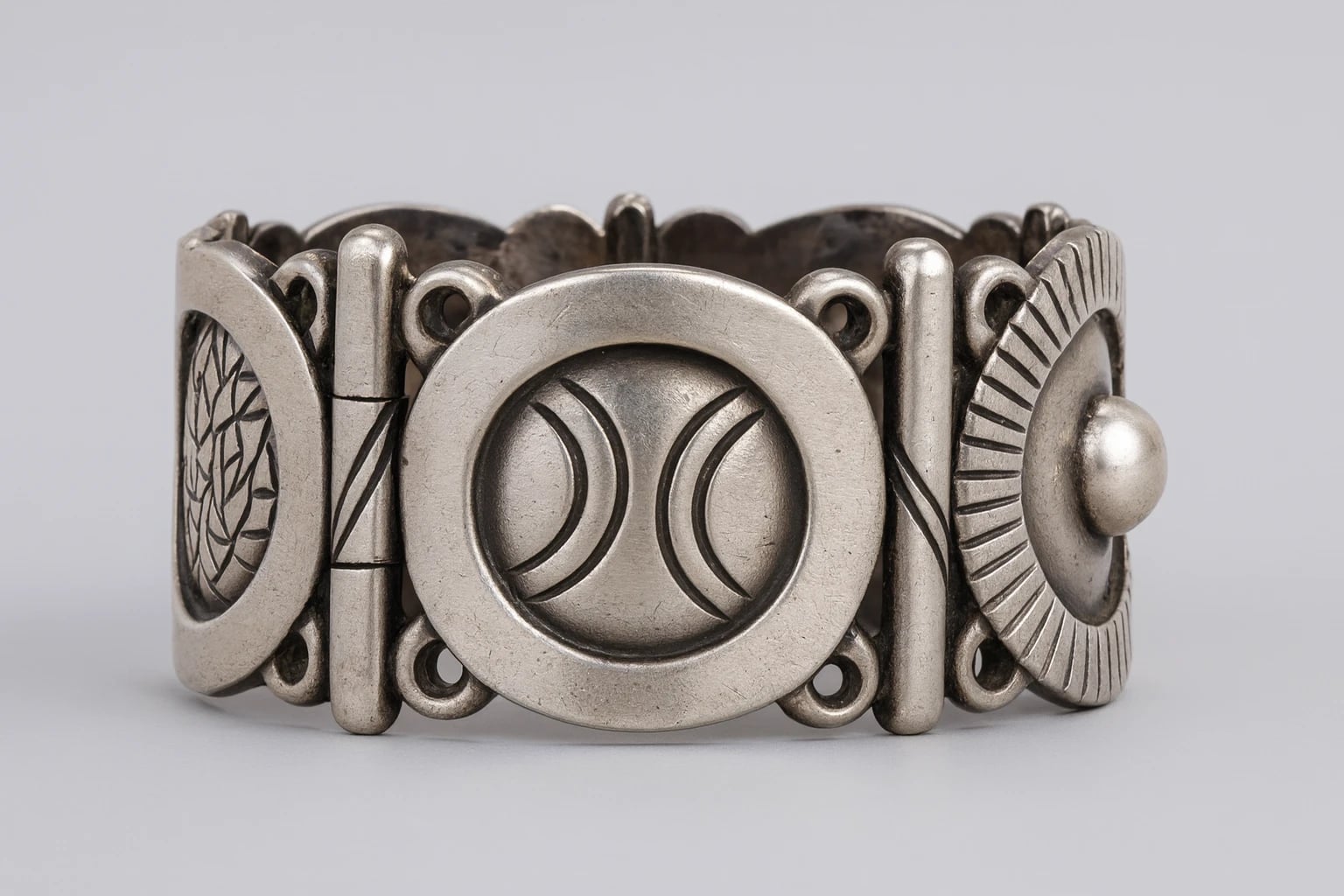
Héctor Aguilar
Aztec Panel Bracelet
Sterling silver