Saves instantly, no account needed. Already a member? Sign in.
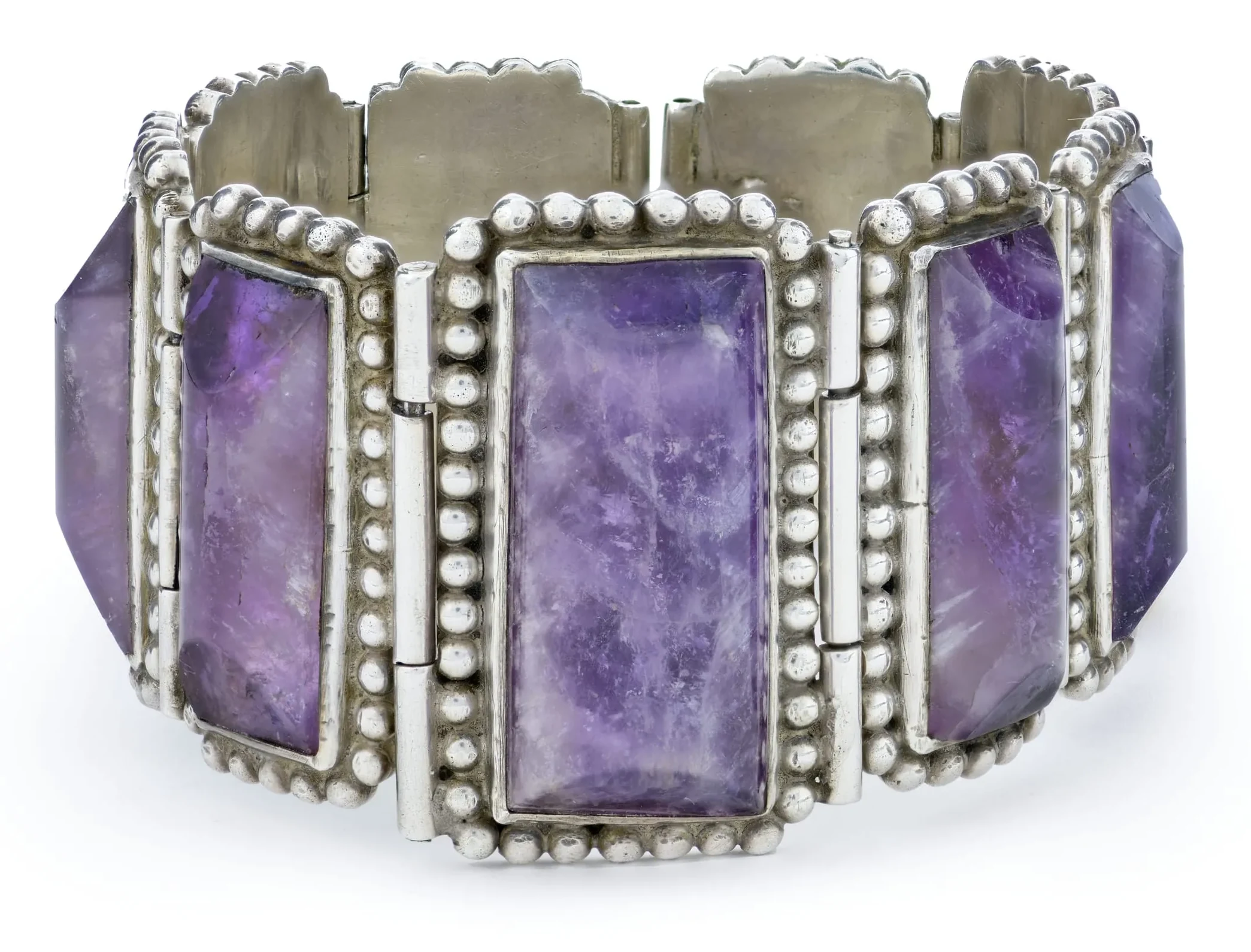
The bracelet is organized around a disciplined alternation of broad amethyst rectangles and rounded silver beads, a rhythm that gives a relatively small object unusual architectural presence. LACMA records the work as Beaded Bracelet (Pulsera con cuentas), circa 1940, by Los Castillo of Taxco, in silver and amethyst, with a height of 1 7/16 inches and a closed diameter of 2 3/8 inches. The proportions matter. The stones are not treated as small accents set into silver ornament. They occupy the face of the bracelet as large, translucent panels, while the silver beads act as a repeated border that both protects and animates the edges.
The design depends on the contrast between rectilinear mass and granular surface. Each amethyst panel is held within a raised frame, then surrounded by a procession of silver beads whose rounded forms catch light in a different register from the stone. The amethyst varies from pale lavender to deeper violet, with internal clouds and fractures that make each panel optically active. Against this shifting color, the silver structure is emphatic and almost masonry-like: vertical bars mark the joints, frames define the stones, and the bead rows soften the geometry without weakening it. The bracelet bends by means of articulated sections, so its visual weight is divided into a sequence of hinged architectural units rather than a single rigid cuff.
Los Castillo was among the major workshops that shaped Taxco silver in the years just after the renaissance had gathered force. Hougart records that the enterprise was established in 1939 by Antonio Castillo Terán with his brothers Justo and Jorge and their cousin Salvador Terán, and notes the workshop’s importance in jewelry and in experimental metal techniques (Hougart, p. 82). This bracelet does not rely on the workshop’s better-known married metals, feather mosaic, or enamel lines. Its interest lies instead in a more direct command of silver and stone: a modern bracelet built from repeated modules, large color fields, and a border system that turns setting into ornament. The absence of a visible hallmark in the available image means that the note should not depend on a mark for interpretation, though the LACMA record and the established Los Castillo attribution place the object securely within the workshop’s early history.
The bracelet also clarifies a particular strand of Mexican modernist jewelry, one in which scale, articulation, and material contrast carry much of the design’s force. The large amethyst panels recall the Taxco School’s willingness to use stones as structural color rather than conventional embellishment. Their rectangular format gives the bracelet a measured severity, while the beaded silver settings introduce a handmade pulse that keeps the surface from becoming austere. Morrill and Berk describe the taller as a collaborative workshop structure in which owners, designers, maestros, and trained silversmiths could contribute to production, a useful reminder that a Los Castillo object should be understood as the product of an organized design culture rather than a solitary hand (Morrill and Berk, p. 250 in the glossary section on taller practice).
Museum of Mexican Silver. “Beaded Amethyst Bracelet.” Catalog no. MoMS-002280. https://museumofmexicansilver.com/pieces/los-castillo-beaded-amethyst-bracelet
See something wrong with this record? Suggest a correction and the piece details fill in automatically.
Within a museum collection, this bracelet is valuable because it preserves an early Los Castillo solution to a central problem of modern jewelry: how to make a wearable object feel substantial without making it static. Its linked panels, raised settings, and alternating bead rows produce movement across the wrist while maintaining a clear frontal order. The result is neither pictorial nor symbolic in an obvious way. It is modern through construction, proportion, and the disciplined handling of color. In the broader history of the Mexican silver renaissance, the bracelet shows how Taxco workshops brought modern design into intimate scale, using the bracelet not as a minor accessory but as a compact field for architectural form, mineral color, and articulated silverwork.
Los Castillo
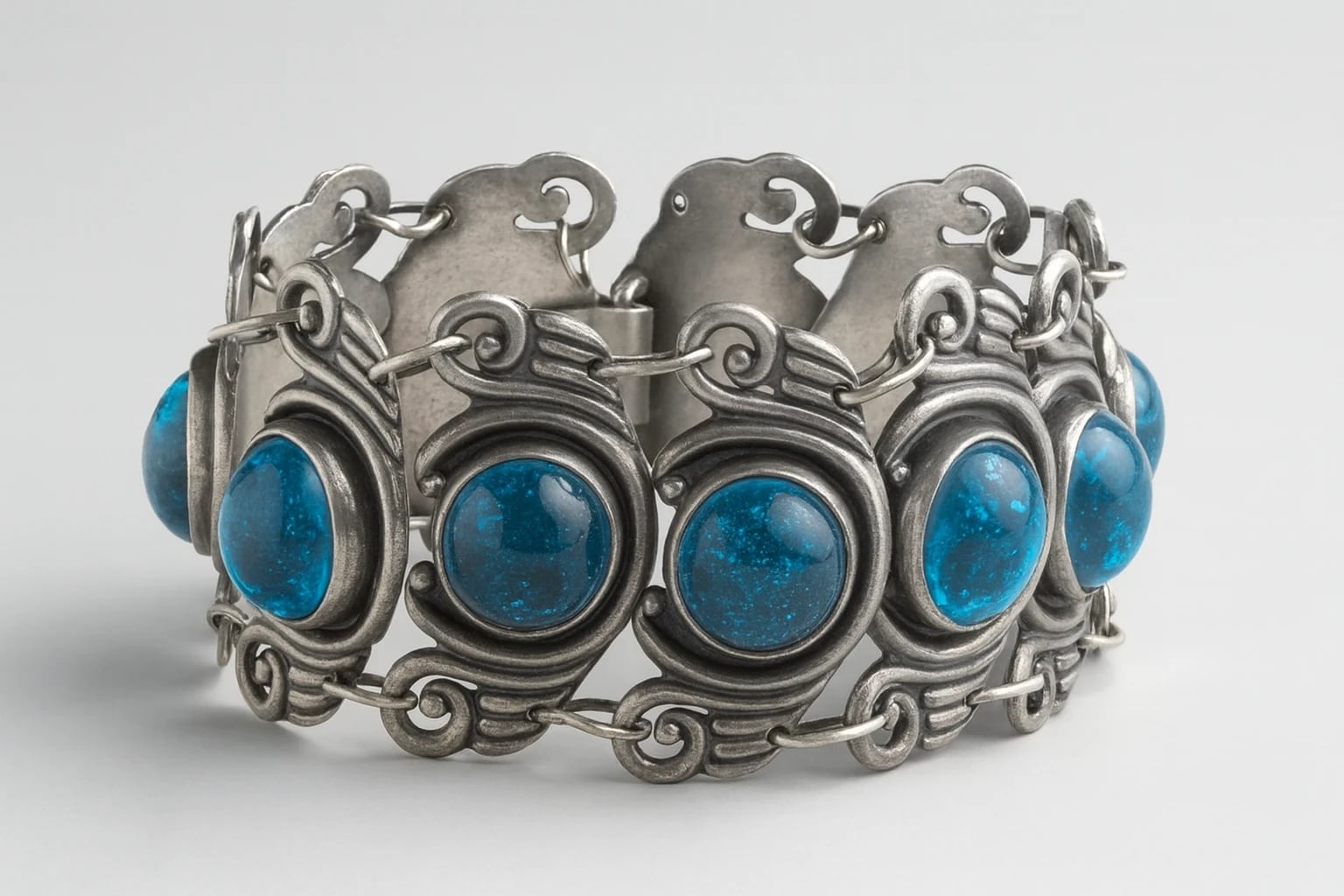
Scroll Link Bracelet with Blue Glass Cabochons