Saves instantly, no account needed. Already a member? Sign in.
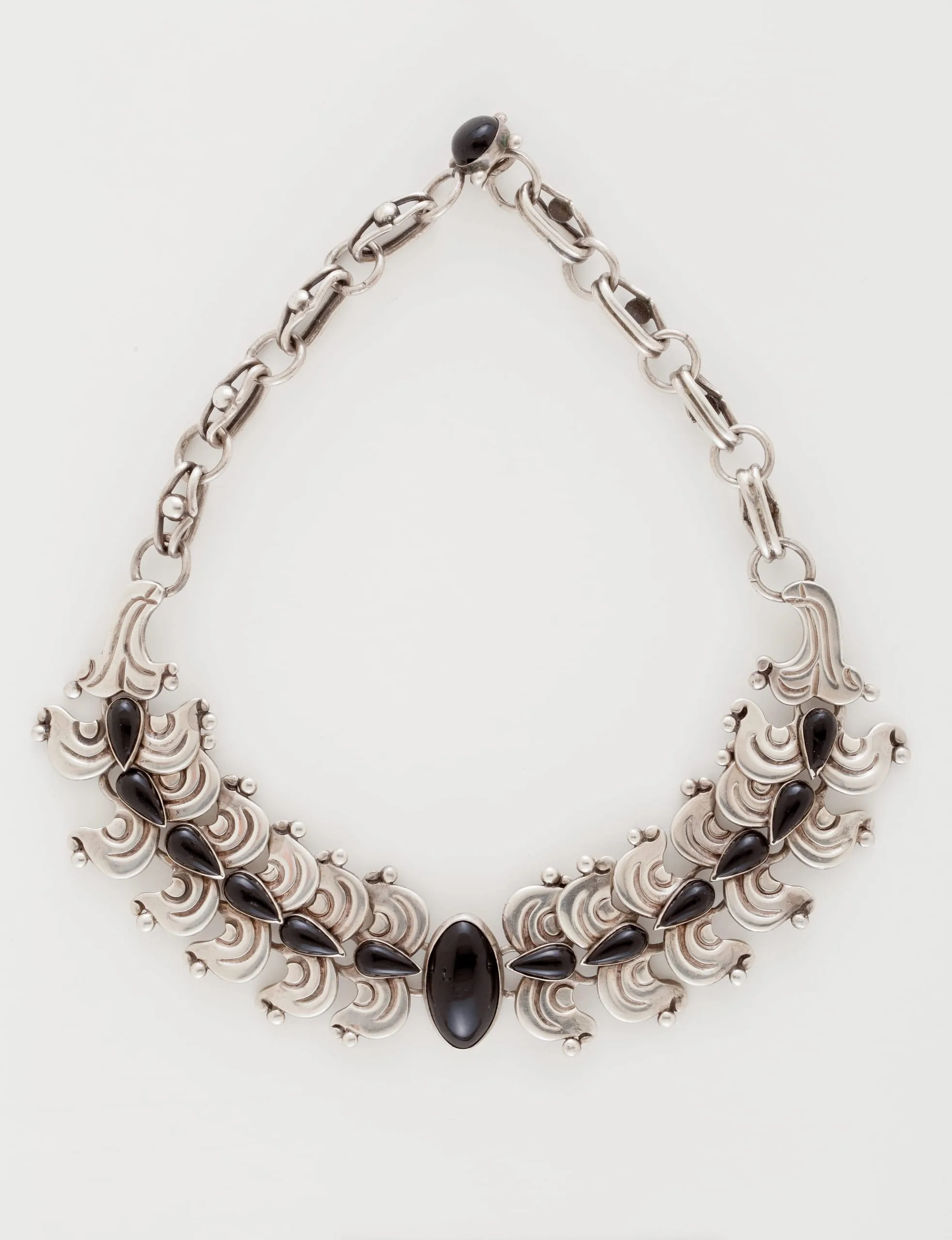
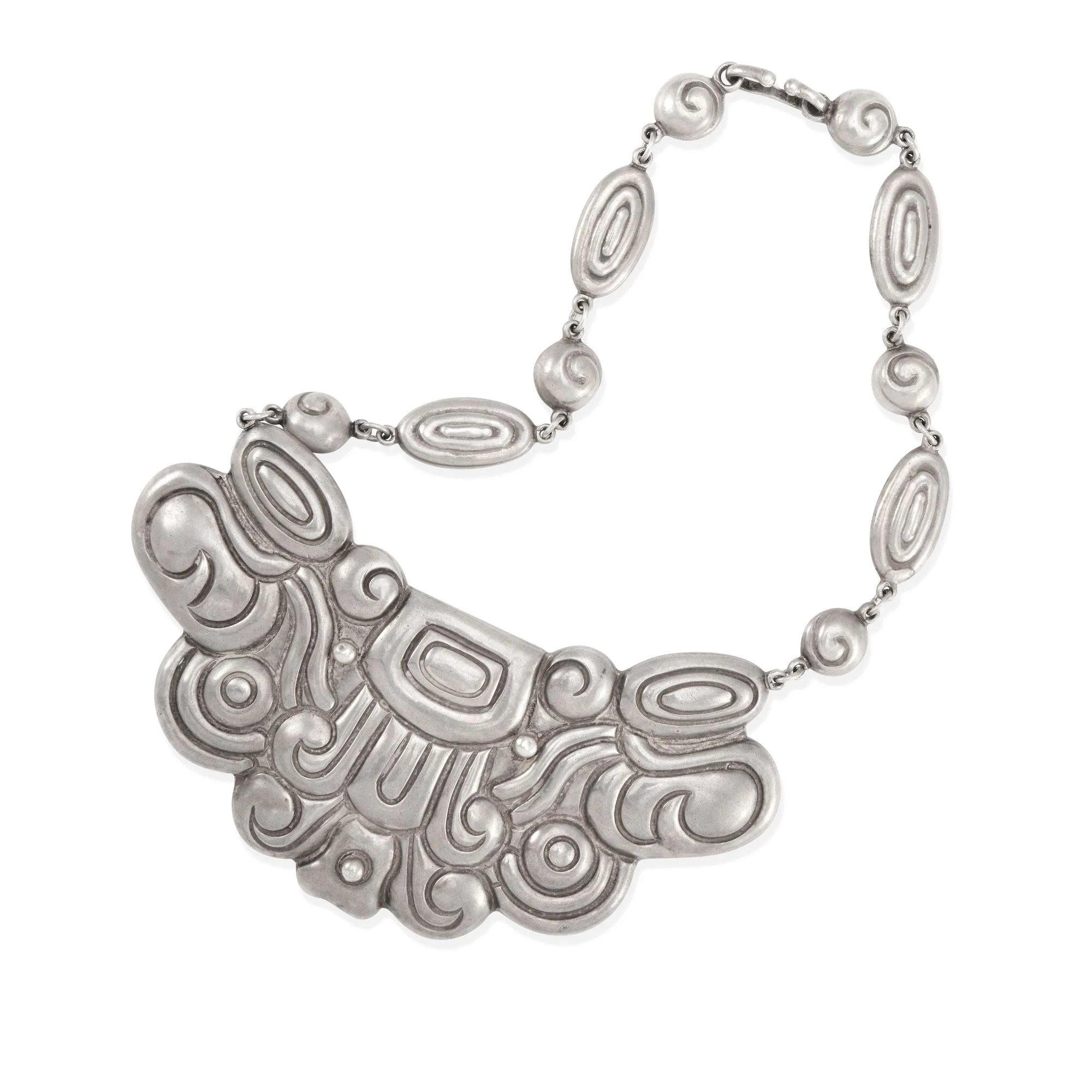
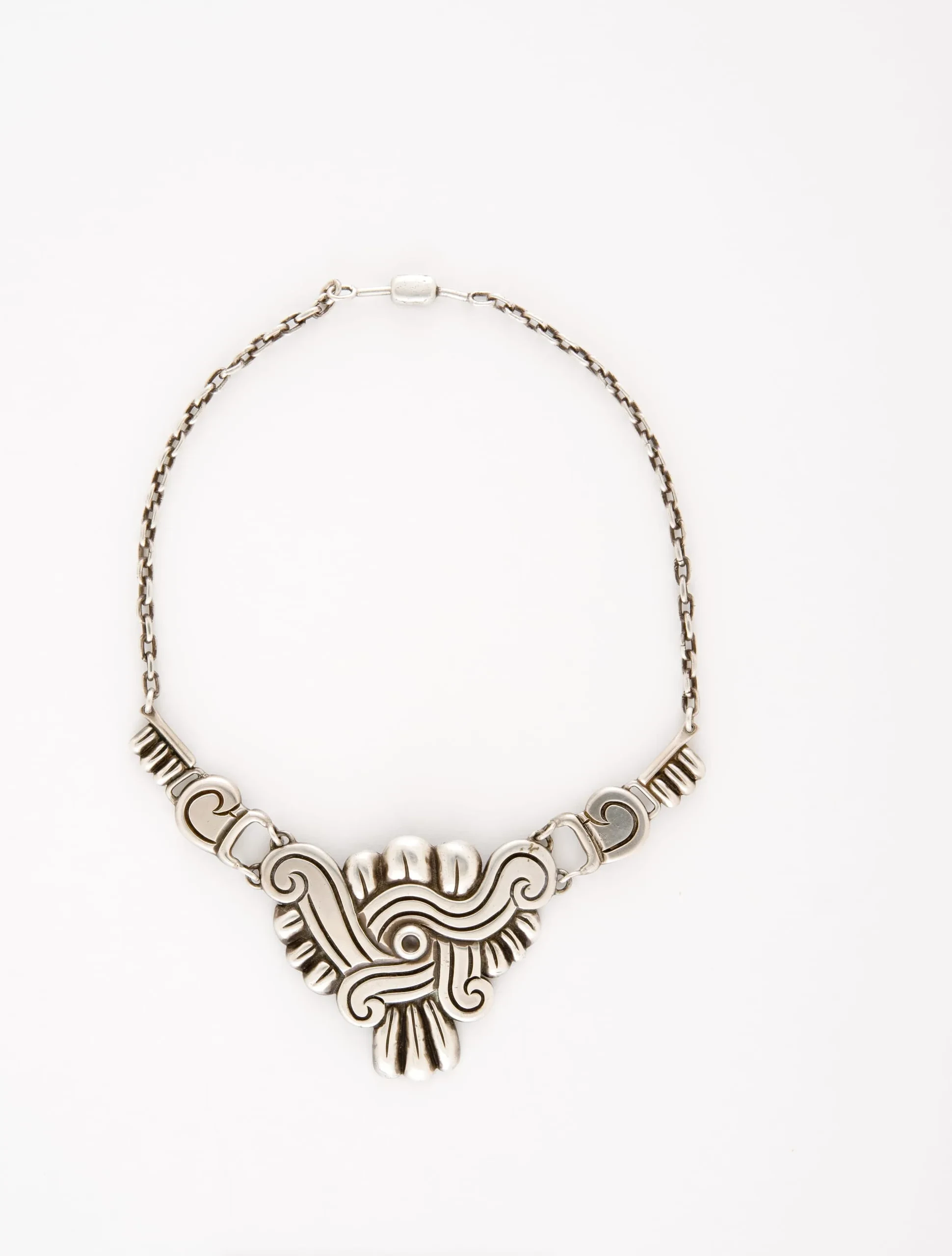
The pendant gives this necklace its unusual balance: a broad, low relief silver form organized from scrolling Pre-Columbian motifs, suspended from a comparatively spare linked chain. LACMA records the work as Héctor Aguilar’s Necklace with Pre-Columbian Motifs, circa 1940, in silver, accession M.2014.213. Its front element has the breadth of a small pectoral rather than a conventional pendant. Curving volutes, recessed channels, and fluted ridges are set into a nearly symmetrical arrangement, with the surface alternating between rounded polished planes and darkened interior lines. The chain narrows the composition at the neck, then releases the weight visually into the large central form.
The design depends on articulation as much as image. Rectangular and oval chain links give way to angled connector elements at the shoulders of the pendant, allowing the front to sit as a joined series rather than as one rigid plate. The side sections echo the central scrolls in smaller units, so the necklace does not simply hang an ornament from a chain. It builds a gradual transition from flexible line to sculptural mass. The fluted lower edges catch light in short vertical strokes, while the incised scrolls create a slower, continuous movement across the face of the silver. That contrast between pulse and sweep is central to the object’s effect.
Aguilar’s use of ancient Mexican sources was not antiquarian copying. Morrill writes that he developed much of his design vocabulary from Pre-Columbian art, including clay stamp imprints, Mixtec manuscripts, and sculptural sources at Xochicalco, and that this choice carried a philosophical charge: Mexico’s ancient art was to be valued on the same plane as European art (Morrill 1996, p. 99). In this necklace, the source is absorbed into modern silver design. The scroll becomes structure, border, and surface rhythm at once. Its forms remain legible as ancientizing motifs, but they are tightened into the clean relief, balanced repetition, and controlled silhouette that mark Aguilar’s early work.
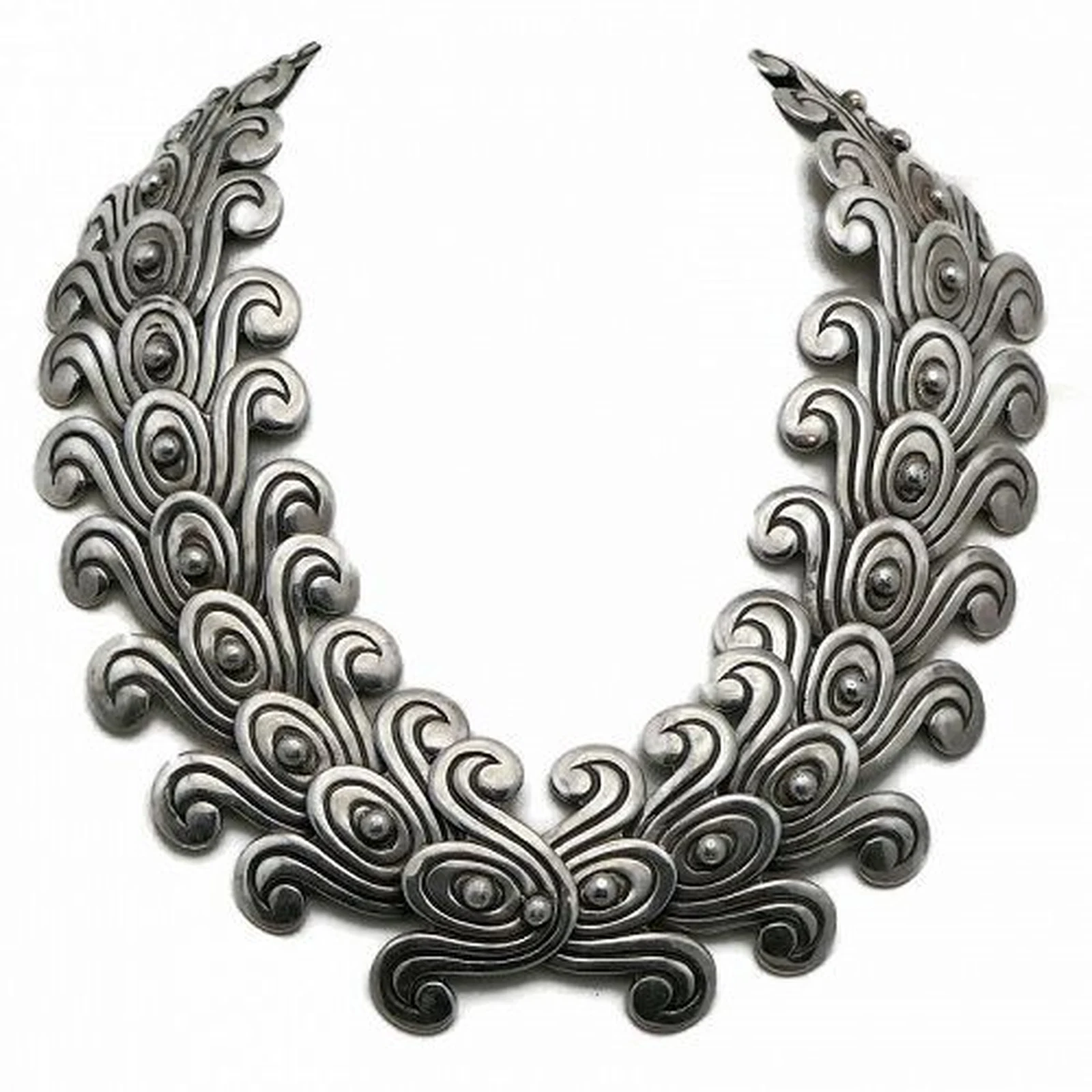
The necklace belongs to a documented group of Aguilar Pre-Columbian necklaces from around 1940. Morrill publishes related examples, including several circa 1940 necklaces in 990 silver that use ancient Mexican motifs at large scale and high relief. Those references do not document every detail of the LACMA necklace, but they place it within a concentrated moment when Aguilar and Taller Borda were giving ancient motifs a forceful Taxco modernist presence.
Museum of Mexican Silver. “Necklace with Pre-Columbian Motifs.” Catalog no. MoMS-002275. https://museumofmexicansilver.com/pieces/hector-aguilar-necklace-with-pre-columbian-motifs
See something wrong with this record? Suggest a correction and the piece details fill in automatically.
The workshop context matters because this object stands at the intersection of design authority and taller practice. Morrill describes Aguilar as the designer of most jewelry and objects produced by Taller Borda, while also noting Valentín Vidaurreta’s important contribution to jewelry design (Morrill 1996, p. 99). The object record identifies this necklace as Aguilar’s, and its weighty scrollwork corresponds closely to the muscular formal language associated with his early production. With no hallmark visible in the available image, the date rests here on the museum record and on the documented design family rather than on a readable mark. The necklace is valuable within LACMA’s collection because it preserves one of the clearest early statements of Aguilar’s Pre-Columbian mode: monumental in conception, carefully jointed for the body, and modern not despite its historical sources, but through the discipline with which it transforms them.
Héctor Aguilar
Fish-Scale and Sphere Beaded Necklace
Silver