Saves instantly, no account needed. Already a member? Sign in.
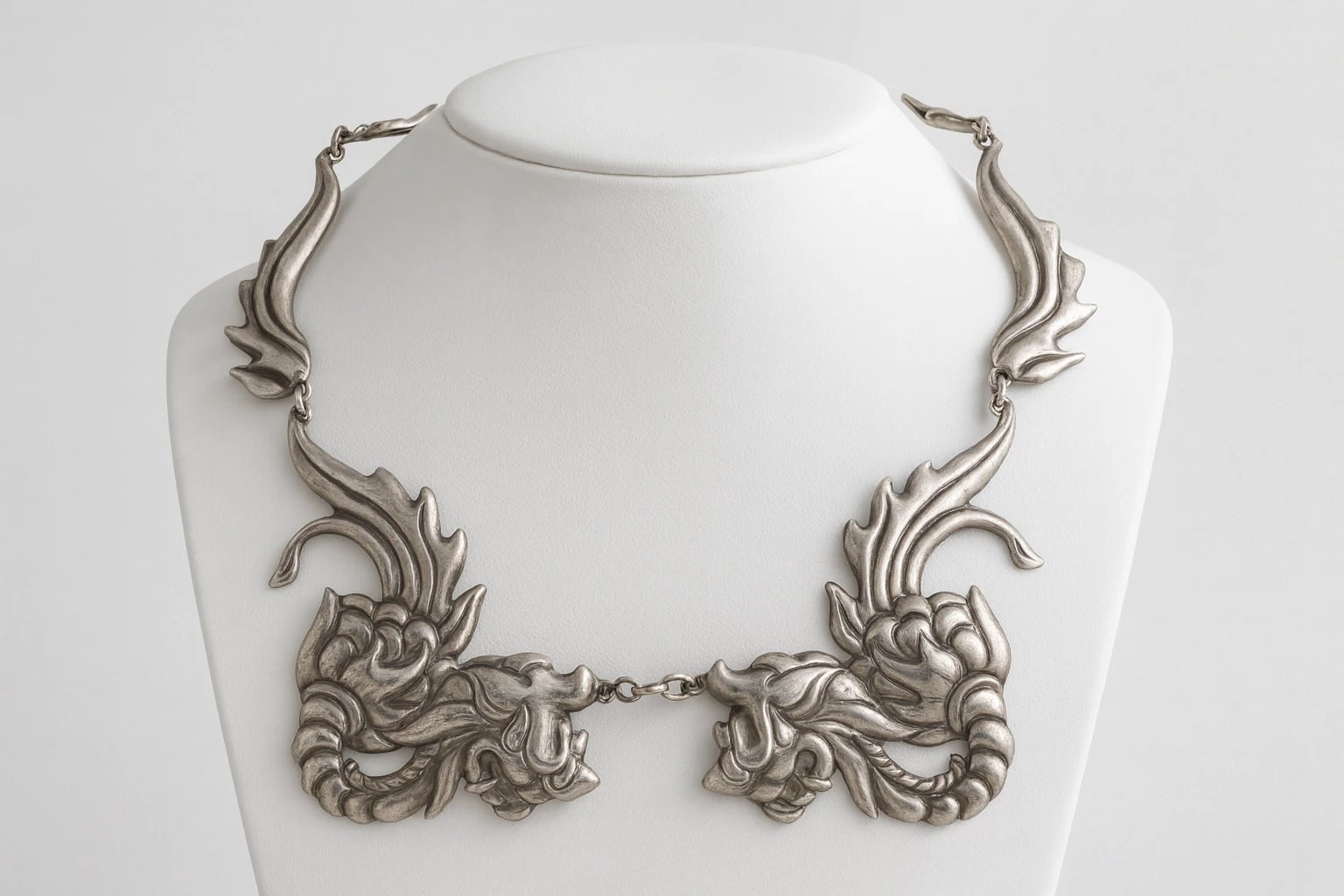
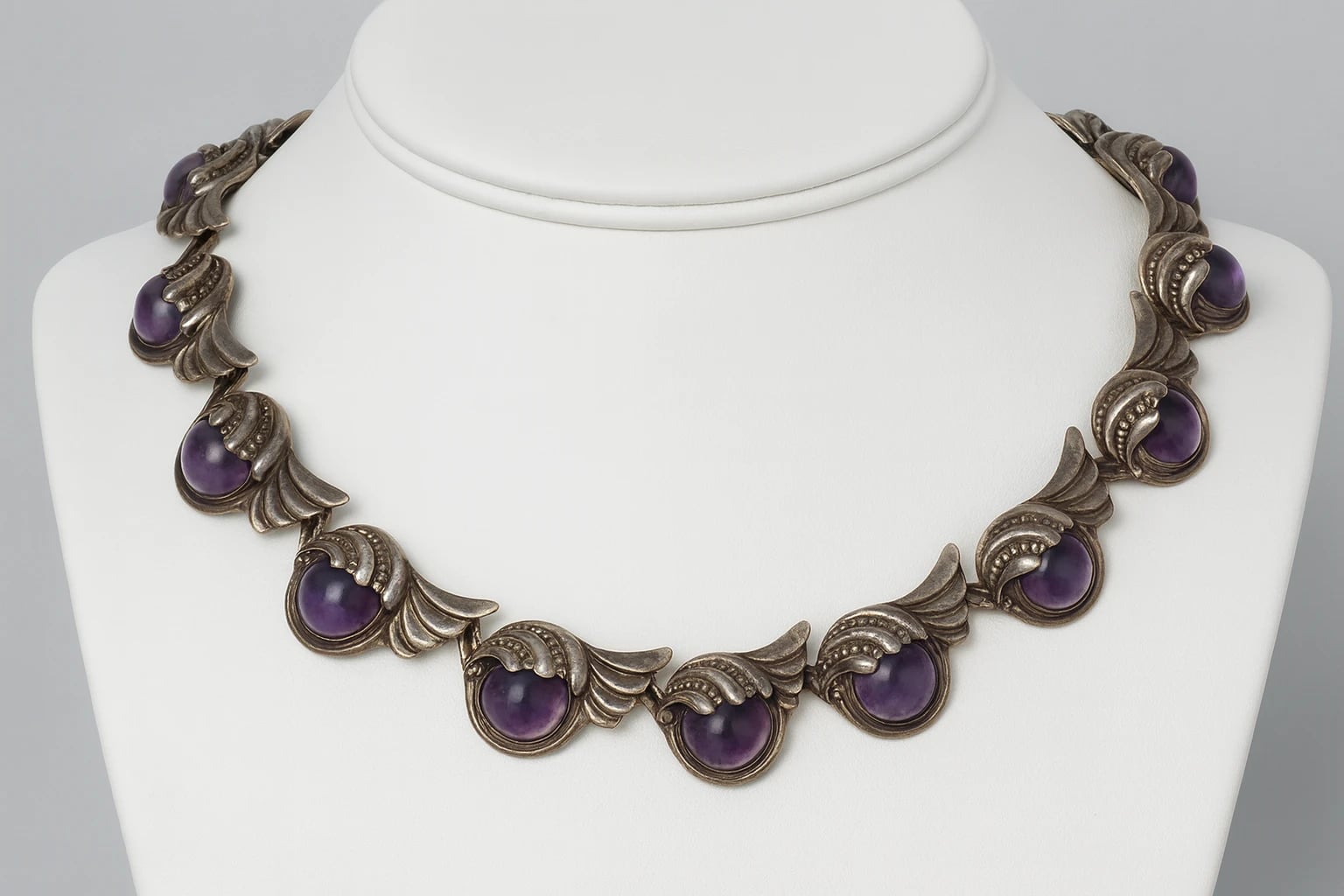
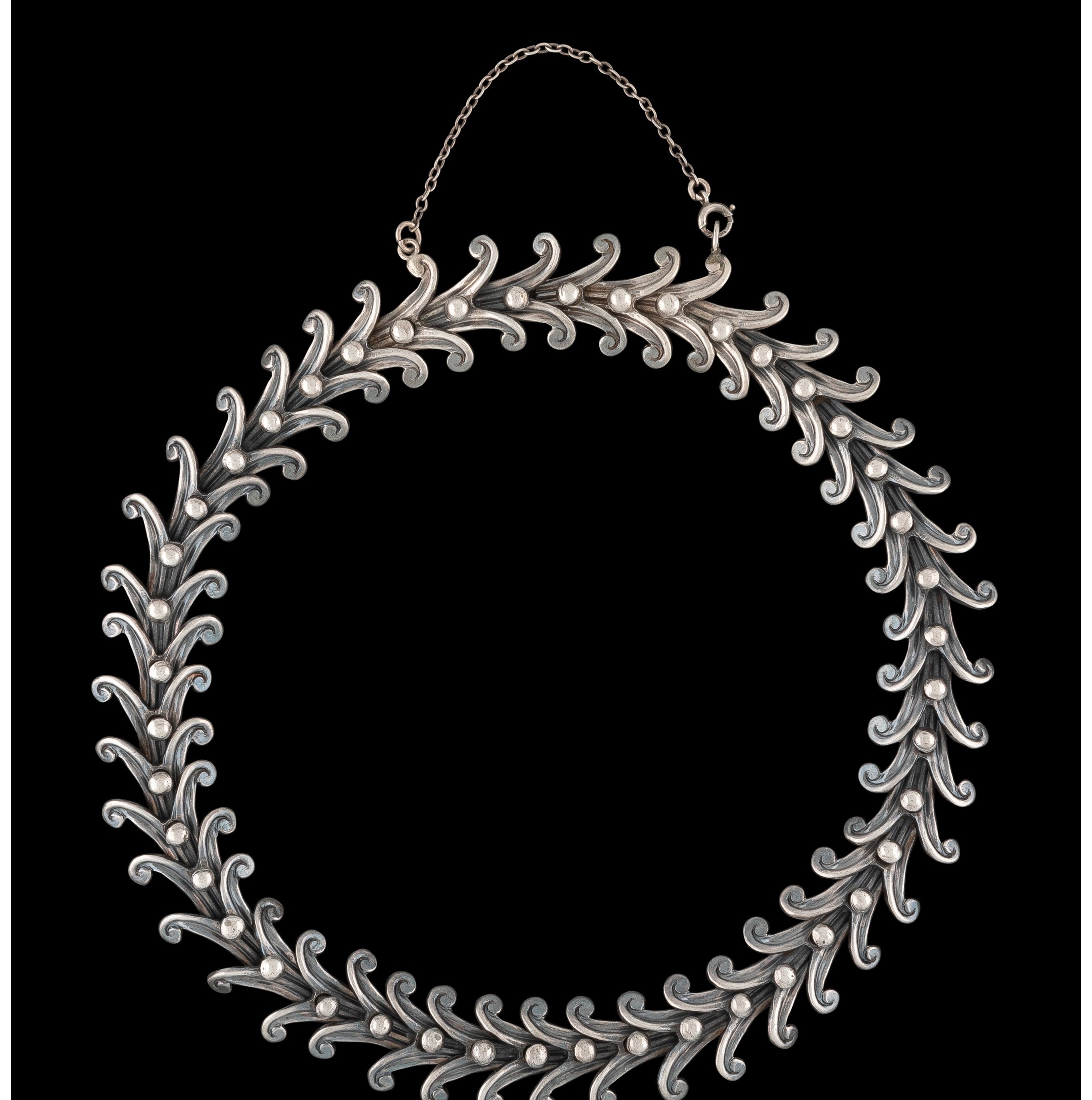
The necklace is organized as a sequence of scrolling leaves, each link shaped with enough mass to hold its own profile and enough open space to keep the collar from becoming heavy in appearance. The central section turns inward and outward at once: paired foliate scrolls curl toward the clasping point at the chest, while ribbed channels draw the eye back toward the outer edges. At 16 1/2 inches long and 1 1/4 inches wide, it sits close to the base of the neck, where the repeating units would register as a continuous band rather than a pendant composition.
Los Castillo’s design number 475 belongs to the workshop’s early numbered production, and the necklace carries an old linear mark reading STERLING, MADE IN MEXICO, LOS CASTILLO, with the design number. The curator’s reading of the piece identifies it as pre-Eagle and circa 1940s. That chronology fits the workshop’s early period, when Los Castillo used numbered marks before and around the years in which the eagle assay system became standard. Hougart documents comparable early Los Castillo marks with numbered designs in the 1940s and also notes that, apart from the earliest 980 production, Los Castillo pieces were generally stamped with a design or inventory number.
The design shows a side of Los Castillo sometimes overshadowed by the workshop’s later reputation for married metals, enamel, and other technical experiments. Here the interest lies in silver itself: its raised edges, darkened recesses, and softly modeled channels. The leaves are not botanical studies. They are ornamental forms disciplined by modern construction, with each link resolving into a compact unit that can repeat, hinge, and curve around the body. Their scrolls recall older Mexican and European vocabularies of foliage, but the necklace treats that inheritance as structure. Ornament becomes the method by which the collar articulates.
Founded in 1939 by Antonio Castillo with his brothers Justo and Jorge and their cousin Salvador Terán, Los Castillo quickly became one of the defining workshops of the Taxco silver renaissance. The workshop’s importance did not rest on a single house style. Its early production included sterling jewelry of considerable formal variety, while later decades brought techniques such as metales casados, Mosaico Azteca, Pluma Azteca, and Onix Negro into wider recognition. This necklace belongs to the earlier phase, before those technical identities dominated the workshop’s public image. It shows Los Castillo working through line, repetition, relief, and bodily scale, the basic resources of silver jewelry treated with seriousness and control.
Museum of Mexican Silver. “Scrolling Leaf Necklace.” Catalog no. MoMS-002304. https://museumofmexicansilver.com/pieces/los-castillo-necklace
See something wrong with this record? Suggest a correction and the piece details fill in automatically.
As a museum object, the necklace is useful precisely because it is not dependent on rarity or elaborate materials for its significance. It documents a moment when Taxco workshops were developing modern jewelry through repeatable designs that still required close attention to proportion and movement. The leaf form links place the work within a broad decorative tradition, but their joined rhythm and sculptural compression belong to mid twentieth century Mexican silver. In this collar, Los Castillo made a wearable ornament whose visual strength comes from the disciplined handling of a single motif across the curve of the body.
Los Castillo
Circles Within Circles Necklace