Saves instantly, no account needed. Already a member? Sign in.
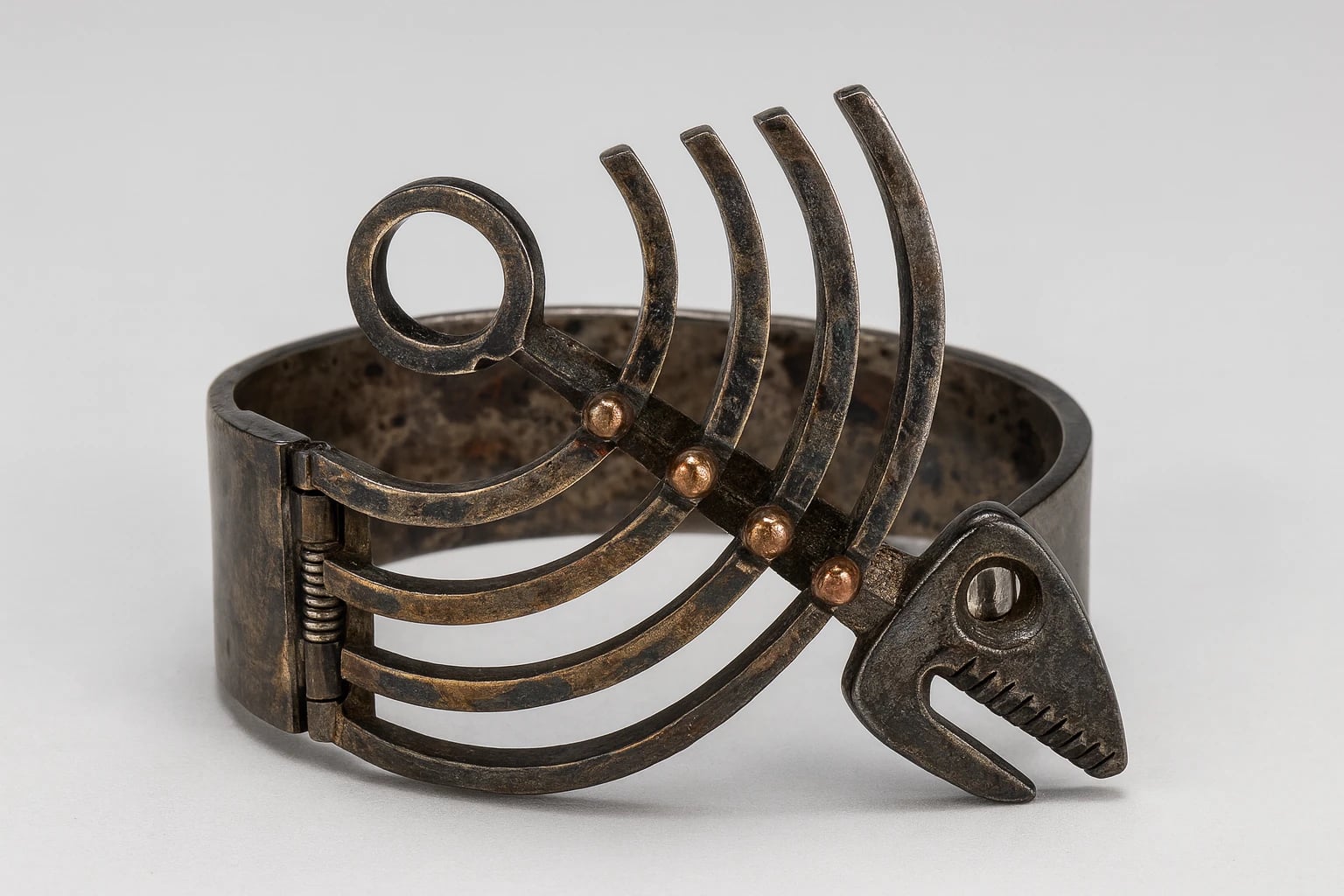
Rendered as three-dimensional anatomy rather than applied ornament, the fish skeleton was one of the more structurally ambitious motifs to come out of the Los Castillo workshop, and this hinged cuff is an especially complete realization of it. The graduated ribs, angular skull, and coiled tail loop are fabricated as actual physical structure — raised from the cuff's outer face rather than pressed into it — giving the piece a sculptural density that flat treatments of the same subject never approach.
The base is a broad hammered-silver cuff with a fitted box hinge. Five arched ribs climb in sequence from a spine soldered to the outer surface, each junction fastened with a small accent in a contrasting warm metal. At one end the skull, angular and open-jawed with a circular eye socket, reads almost heraldic; at the other, a tight loop stands in for the creature's tail. A deep oxidized patina across the hammered band sharpens the contrast with the skeleton's polished ridges and reinforces the impression of a form stripped to its essential geometry.
Morrill's 1996 study documents a related Los Castillo fish-tail cuff dated to approximately 1940-45, placing this bracelet within a marine series from the workshop's founding decade. The Castillo brothers trained under William Spratling before establishing their own Taxco shop, and the structural logic of this piece reflects that early ambition to translate natural form into wearable silver without ornamental softening. The combination of the demanding hinged-cuff format with a fully articulated three-dimensional skeleton makes this a notable example of early Taxco work.
Museum of Mexican Silver. “Fish Bracelet.” Catalog no. MoMS-001869. https://museumofmexicansilver.com/pieces/los-castillo-bracelet-fish
See something wrong with this record? Suggest a correction and the piece details fill in automatically.
Los Castillo
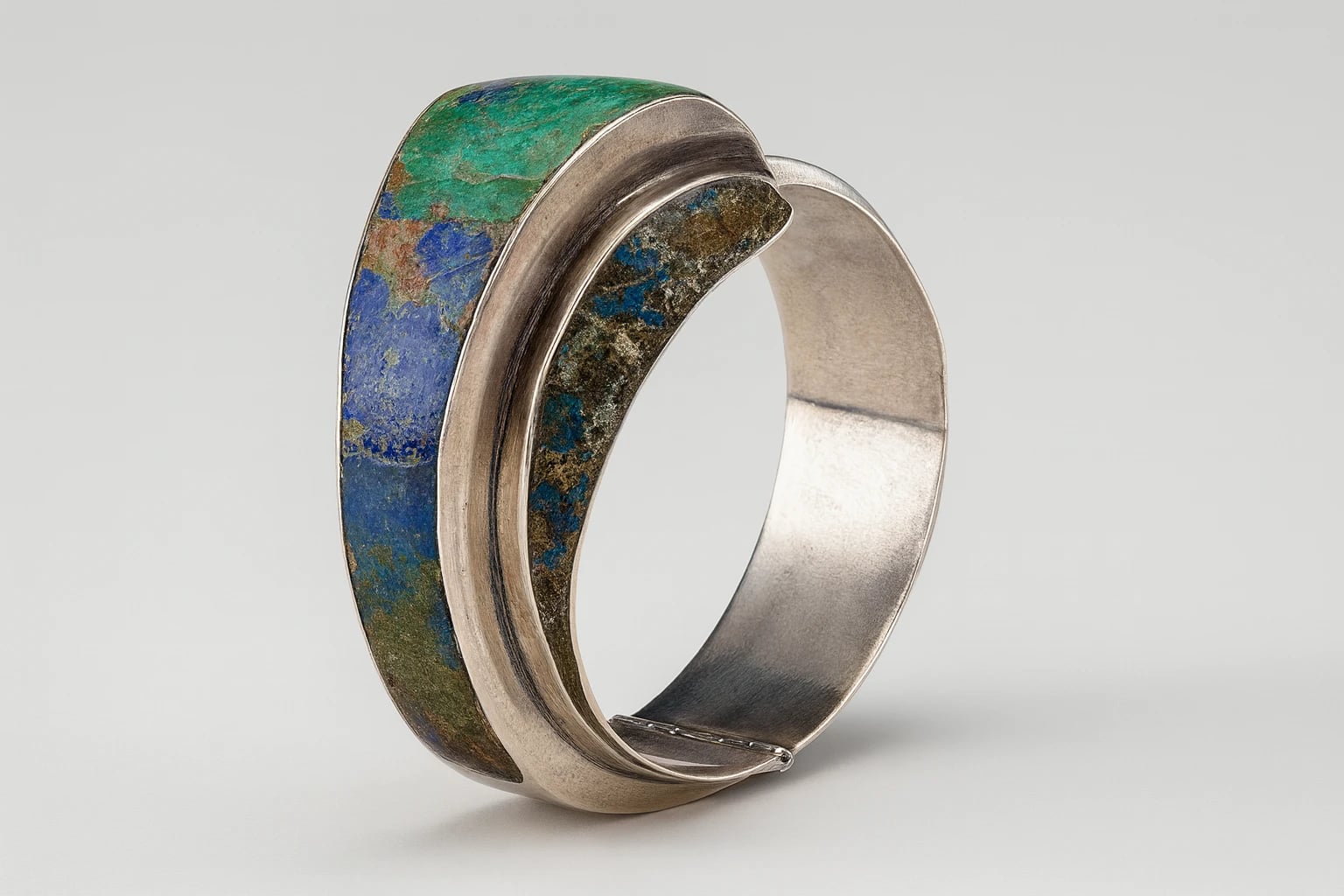
Stone-Mosaic Bracelet with Chrysocolla
Chrysocolla