Saves instantly, no account needed. Already a member? Sign in.
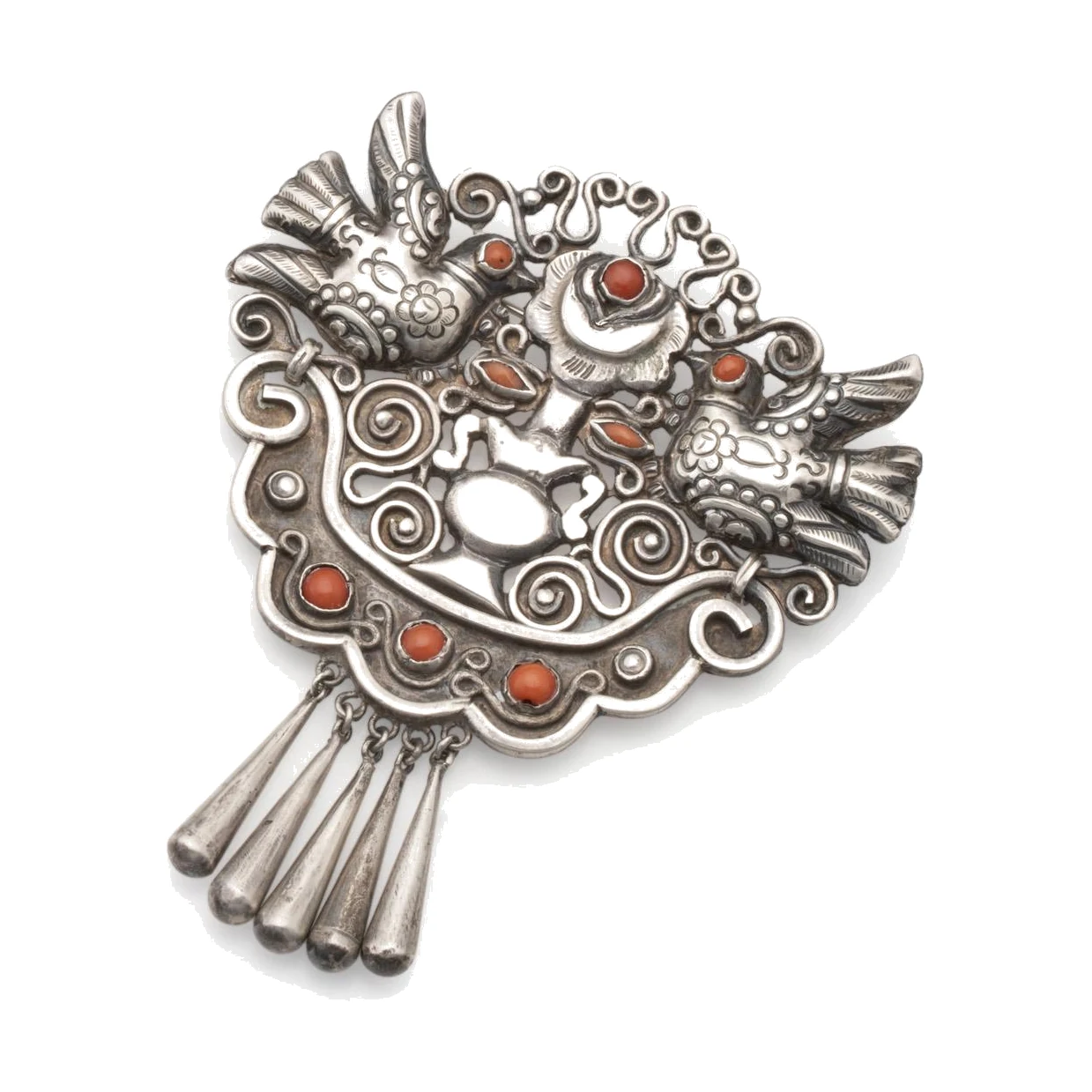
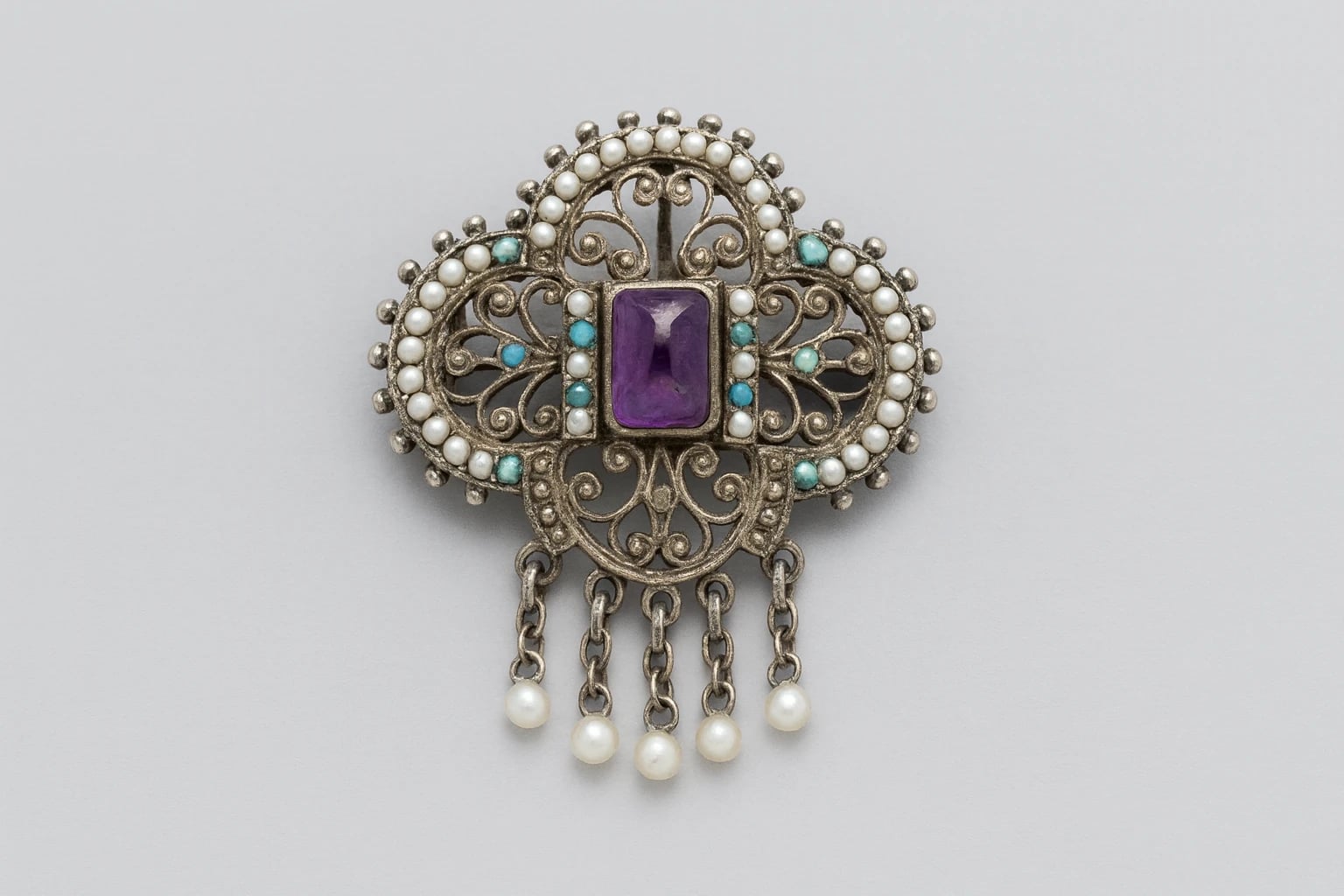
A dense field of scrolling silver wirework carries a central amethyst, with small turquoise accents set into the curling tendrils that fill the brooch. The composition belongs to the ornamental vocabulary that Matilde Poulat, working under the mark MATL, made her own: a tightly organized garden of silver scrolls, beads, and leaf forms built up into a jewel that reads as folk art translated into precious metal. The amethyst anchors the design at its center, its cool violet answered by the opaque blue-green of the turquoise, so that color functions structurally rather than decoratively, marking the focal point and punctuating the surrounding metalwork.
The construction depends on the interplay of silver line and set stone. Poulat's designs are organized around repeated scroll and volute motifs, wirework curls that fill the surface without leaving large passages of blank metal, giving the whole a busy, almost devotional density. Turquoise, a stone with deep roots in Mexican craft going back to Mesoamerican mosaic work, appears here in small accents rather than as the dominant material, while the amethyst provides a single larger passage of transparent color. This layering of opaque and translucent stones within a matrix of curling silver is characteristic of the MATL manner, in which the metalwork itself carries as much visual weight as the gems it frames.
Matilde Eugenia Poulat trained at the San Carlos Academy of Art in Mexico City, where Diego Rivera was among her fellow students, and she came to silver as a painter and designer before opening her own shop in 1934. The name MATL, taken from an Aztec word for water, was registered as a trademark, number 142093, and the mark appears in several forms across her production. Her work stands somewhat apart from the Taxco workshops: made in Mexico City, drawing on colonial religious silver and Mexican popular art rather than on the streamlined geometry associated with Spratling's circle, it represents a distinct current within the broader silver renaissance. After her death in 1960, her nephew Ricardo Salas continued the MATL designs, and the style proved durable enough to remain in production for decades under his direction.
The MATL idiom occupies a particular place in twentieth-century Mexican silver because it insists on ornamental richness at a moment when much celebrated Taxco design moved toward reduction and abstraction. A brooch of this kind documents the persistence of a decorative, folk-rooted sensibility within the renaissance, one that treated the jewel as a small, densely worked object rather than a study in negative space. Because the MATL designs were carried forward by Salas long after Poulat's death, close attention to the specific mark and stones matters for placing any given example within that long production history.
Museum of Mexican Silver. “Scrollwork Brooch with Amethyst and Turquoise.” Catalog no. MoMS-002249. https://museumofmexicansilver.com/pieces/matl-amethyst-scrollwork-brooch-with-turquoise
See something wrong with this record? Suggest a correction and the piece details fill in automatically.
MATL (Matilde Poulat)
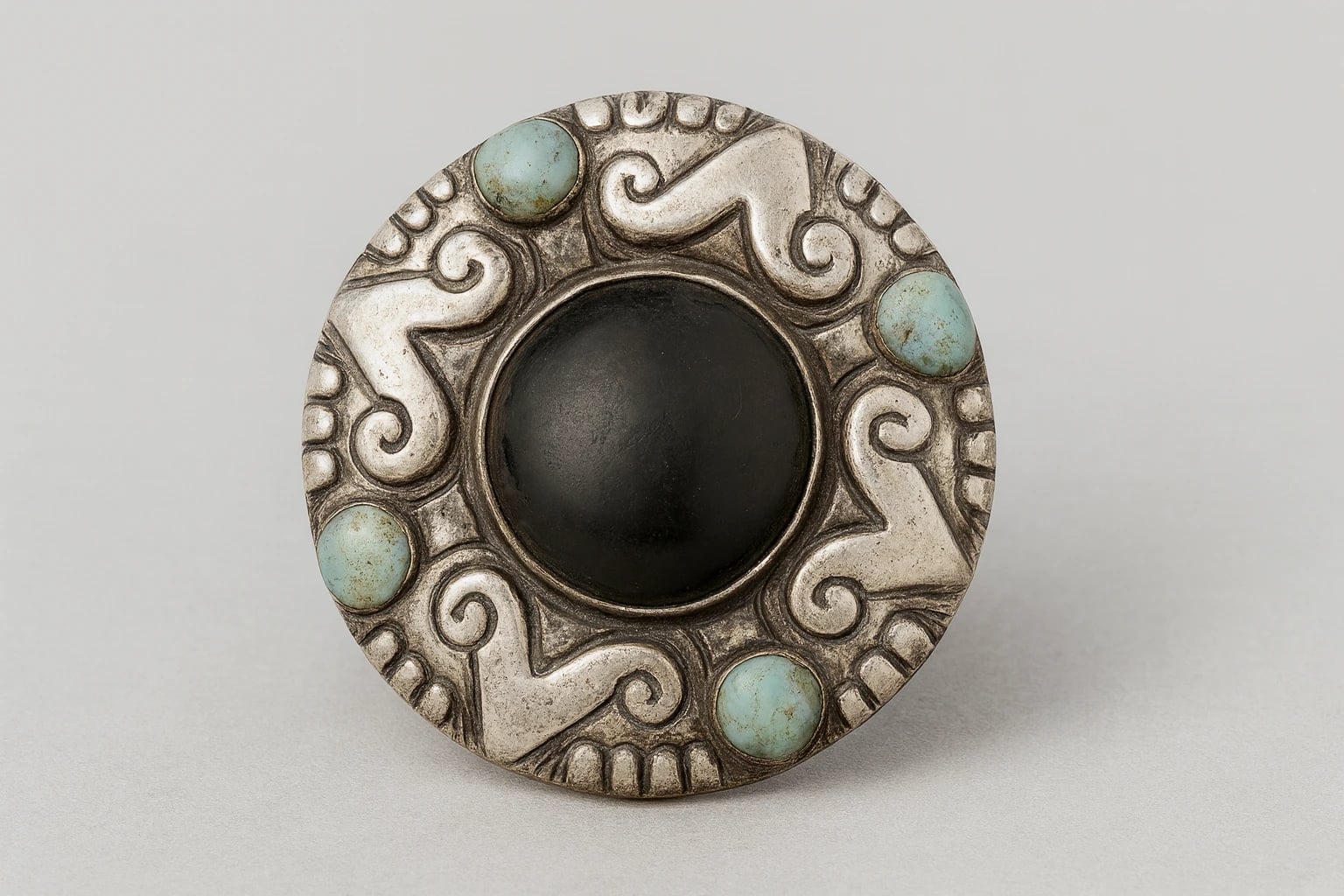
Circular Onyx Brooch with Turquoise
1934 or later
Silver